

Medically Reviewed by Dr. Vijay Kumar Sohanlal, MBBS, MS (Orthopaedics), Orthopaedic & Joint Replacement Surgeon, Founder & Owner of MAHI Multispeciality Hospitals, Kilpauk, Chennai
Last medically reviewed: September 2026
Quick answer MAHI Hospitals provides robotic knee surgeon in Tamil Nadu for patients with advanced knee arthritis, ligament damage, or joint pain that has not responded to medication or physiotherapy. Our orthopaedic team evaluates each patient individually and uses robotic guidance to plan implant position before surgery begins, aiming for accurate alignment and a shorter recovery window where the patient is a suitable candidate.
Meet Our Robotic Knee Surgeon in Tamil Nadu
Dr. Vijay Kumar Sohanlal is an Orthopaedic and Joint Replacement Surgeon who currently leads orthopaedic care at MAHI Multispecialty Hospital, Chennai. He completed his MBBS from Mysore University and his MS in Orthopaedics from Sri Ramachandra Medical College, followed by advanced fellowship training in Germany and Australia with focused experience in arthroplasty, joint replacement, and arthroscopy. Before joining MAHI Hospitals, he was associated with MGM Healthcare, Medway Hospitals, and Fortis Malar in Chennai.
Dr. Vijay Kumar Sohanlal evaluates every knee replacement case individually rather than applying a single standard approach. He works directly with patients to decide whether robotic assisted surgery, a conventional approach, or non surgical management is the right path, based on their anatomy, medical history, and treatment goals.
What Makes a Patient Suitable for Robotic Knee Replacement
Not every patient with knee pain needs surgery, and not every surgical candidate needs the robotic approach. During evaluation, the surgeon typically looks at:
- The pattern and severity of joint space narrowing on weight bearing X-rays
- Whether pain is confined to one compartment of the knee or affects the whole joint
- Alignment of the leg, since bowed or knock kneed alignment changes the surgical plan
- Bone quality and any prior surgery on the same knee
- The patient’s activity level, occupation, and functional goals, since a farmer and an office worker may need different outcomes from the same procedure
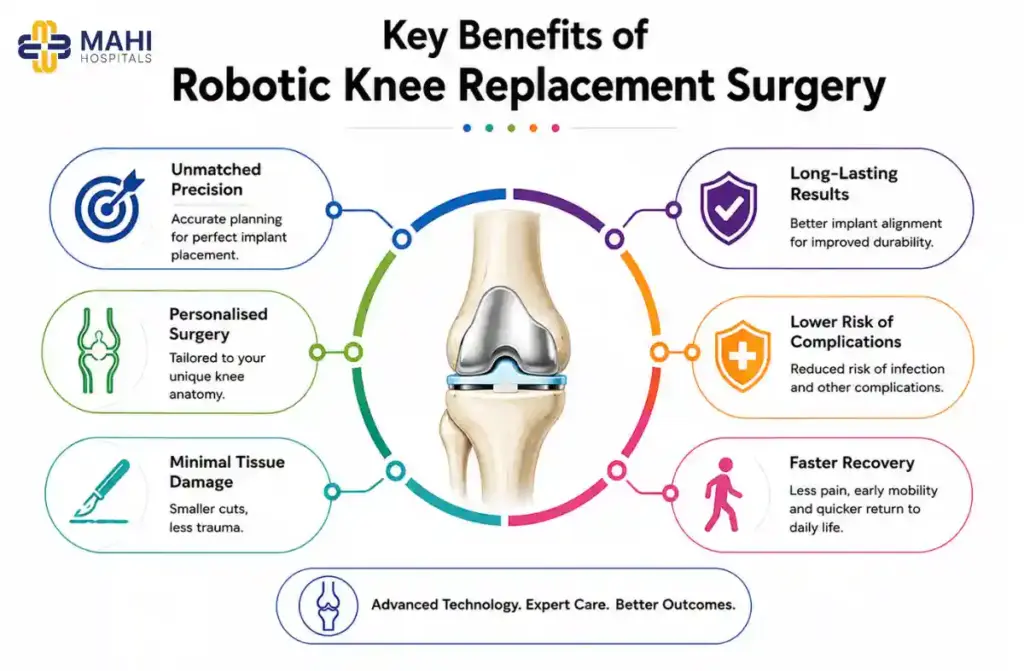
Two patients with X-rays that look similar on the surface can end up with different treatment plans once these factors are weighed together. This is why a proper in person evaluation, not a general online estimate, decides suitability.
Partial vs Total Knee Replacement: How the Decision is Made
When damage is limited to one compartment of the knee, a partial replacement can preserve more of the patient’s natural bone and ligaments, generally allowing a faster return to daily activity. When damage is widespread across the joint, or ligaments are no longer stable enough to support a partial implant, a total replacement is the safer long term choice. Dr. Vijay Kumar Sohanlal confirms this during clinical examination and imaging, not from the patient’s description of pain alone, since pain severity does not always match the extent of joint damage.
How Robotic Assistance is Used During Surgery
Robotic assisted joint replacement combines advanced computer based planning with the surgeon’s own clinical expertise. It assists with preoperative planning and precise implant positioning during selected knee and hip replacement procedures. Dr. Vijay Kumar Sohanlal still makes every clinical decision, from diagnosis through to the final implant position. The robotic system is a planning and guidance tool, not an autonomous operator, and whether it is used at all depends on the patient’s condition, anatomy, medical history, and treatment requirements.
When Knee Replacement Should Be Delayed
Surgery is not always the right next step. It is often delayed or reconsidered when:
- Pain can still be managed with weight loss, physiotherapy, or activity changes
- The patient has an active infection anywhere in the body, since this raises surgical risk
- Blood sugar or blood pressure is not adequately controlled
- The patient is not yet ready for the rehabilitation commitment surgery requires
A responsible surgical opinion includes telling a patient when to wait, not only when to operate.
What Causes Persistent Pain After Knee Replacement
Most patients see significant pain relief after recovery, but a smaller number continue to have discomfort. Common causes include soft tissue stiffness during the healing phase, referred pain from the hip or spine, mild implant malalignment, or, less commonly, early loosening of the implant. Persistent pain beyond the expected recovery window should always be reassessed by the operating surgeon rather than managed with painkillers alone.
When an Implant Becomes Loose
Implant loosening can happen years after a successful surgery, usually due to gradual wear, low grade infection, or bone changes around the implant. Warning signs include new pain after a pain free period, a feeling of instability, or swelling that does not settle. This is evaluated with X-rays and, where needed, further imaging, and may require a revision procedure.
Recovery After Robotic Knee Replacement
Hospital stay: Most patients stay in hospital for around 3 to 5 days after surgery, depending on pain control, wound healing, and how quickly they regain basic mobility.
Physiotherapy: Guided physiotherapy usually begins within 24 hours of surgery, starting with gentle knee bending and straightening exercises while still in bed.
Walking with support: Most patients stand and take a few assisted steps with a walker on the day after surgery, and progress to walking longer distances with support over the following days.
Walking without support: Many patients transition from a walker to a stick, and eventually to walking unaided, somewhere between 3 to 6 weeks after surgery, though this varies by individual.
Return to daily activities: Light daily activities and short outdoor walks are usually possible within 4 to 6 weeks. Driving and longer physical activity typically resume once the surgeon confirms adequate strength and range of motion, often around 6 to 8 weeks.
Follow up schedule: Patients are usually reviewed at around 2 weeks for wound check and suture removal if needed, again at 6 weeks to assess mobility and X-ray healing, and periodically thereafter, commonly at 3 months, 6 months, and 1 year, to track implant function and long term recovery.
Full recovery: Complete recovery, including muscle strength and confidence in the joint, can continue improving for up to 6 months to a year, even though most patients feel largely back to normal activity well before that.
Why Patients Choose MAHI Hospitals
Patients choosing MAHI Hospitals for knee and hip care are treated directly by Dr. Vijay Kumar Sohanlal, an orthopaedic and joint replacement surgeon with international fellowship training in Germany and Australia in arthroplasty, joint replacement, and arthroscopy, and prior clinical experience at MGM Healthcare, Medway Hospitals, and Fortis Malar in Chennai. Treatment plans are personalized to each patient’s diagnosis, mobility needs, and recovery goals, and non surgical options such as medication, physiotherapy, and activity modification are discussed alongside surgical options where appropriate, rather than surgery being presented as the only path forward.
Read More: Robotic Knee Surgeon in Chennai