Revision Knee Replacement

Expert Revision Knee Replacement in Chennai with advanced surgical techniques, personalized treatment, and comprehensive care for improved mobility and comfort.
Revision Knee Replacement
Introduction

A knee replacement that didn’t go as planned doesn’t mean you’ve run out of options. With the right diagnosis, experienced hands, and a carefully planned revision procedure, many patients regain the comfort and confidence they thought they had lost forever.

Revision Knee Surgery in Chennai

Undergoing knee replacement surgery is often a life changing decision. Most people choose it after months, or even years, of living with persistent pain, limited mobility, and the hope that surgery will finally help them return to a normal life.

But for a small number of patients, recovery doesn't go as expected.

Instead of relief, they continue to experience pain while walking, stiffness that never improves, instability in the knee, swelling, or difficulty performing everyday activities. Some begin to wonder whether the implant has failed, whether something went wrong during surgery, or whether they simply have to live with the discomfort forever. These concerns are understandable, and more importantly, they deserve proper evaluation rather than assumptions.

A failed knee replacement does not always mean the original surgery was performed incorrectly. Implants naturally wear over time, infections can occasionally occur despite appropriate precautions, injuries may damage a previously successful replacement, and changes within the surrounding bone or soft tissues can gradually affect how the artificial joint functions.

When these problems significantly interfere with movement and quality of life, revision knee replacement surgery may offer an effective solution.

Unlike a primary knee replacement, revision knee surgery is a highly specialized procedure that focuses on identifying why the original implant is no longer functioning as intended before carefully correcting the underlying problem. It requires advanced surgical planning, specialized implants, and considerable orthopedic expertise to restore stability, relieve pain, and improve long term function.

For patients exploring revision knee replacement surgery in Chennai, the city has become a trusted destination because of its experienced revision specialists, advanced orthopedic infrastructure, modern diagnostic capabilities, and comprehensive rehabilitation programs that support recovery at every stage.

Most importantly, revision surgery is about far more than replacing an implant. It is about restoring confidence after disappointment, rebuilding mobility after uncertainty, and giving patients another opportunity to return to the life they expected after their first surgery.

Why Patients Trust Chennai for Revision Knee Surgery in Chennai

After an unsuccessful knee replacement, choosing another hospital or another surgeon can feel overwhelming. Many patients are no longer looking for promises, they're looking for answers, experience, and confidence that the next decision will be the right one.

Over the years, Chennai has earned the trust of patients across India and internationally by developing a strong ecosystem for complex orthopedic procedures, including revision knee replacement.

Rather than relying on a single specialist or technology, successful knee replacement revision surgery depends on the combined expertise of experienced surgeons, precise diagnostics, modern surgical techniques, and structured rehabilitation working together.

That collaborative approach is one of the reasons patients continue to choose Chennai for advanced orthopedic care.

Experience with Complex Cases

Revision knee surgery is considerably more demanding than a primary knee replacement. Surgeons often need to remove an existing implant, evaluate bone quality, correct alignment, manage soft tissue balance, and reconstruct the knee using specialized revision implants.

Hospitals that routinely manage these complex procedures develop greater familiarity with challenging surgical scenarios, helping improve decision making before, during, and after surgery.

Advanced Diagnostics Before Treatment

Successful revision knee replacement surgery begins long before entering the operating room.

Modern orthopedic centers in Chennai use comprehensive clinical assessment, advanced imaging, laboratory investigations, and detailed implant evaluation to determine why the previous knee replacement has failed before recommending further treatment.

Treating the underlying cause, not simply replacing the implant, is what leads to better long term outcomes.

Comprehensive Rehabilitation

Revision surgery is only one step in the recovery journey. Physiotherapists, pain management specialists, rehabilitation experts, and orthopedic teams work together to help patients gradually rebuild strength, improve flexibility, restore walking patterns, and regain confidence throughout recovery. This multidisciplinary approach supports both physical healing and functional independence.

Personalized Treatment Rather Than Standard Solutions

Every revision case is different. Some patients experience implant loosening, while others develop infection, instability, bone loss, or implant wear. Because the reasons vary, treatment must also be individualized rather than following a standard surgical plan.

Experienced revision specialists carefully evaluate each patient's medical history, previous surgery, imaging findings, lifestyle, and expectations before recommending the most appropriate approach.

Did You Know? Revision knee surgery is among the most technically demanding procedures in orthopedic surgery because surgeons often need to remove an existing implant, preserve healthy bone, restore knee stability, and implant a new prosthesis, all during the same operation.

Revision Knee Replacement Surgery

Understanding Revision Knee Replacement

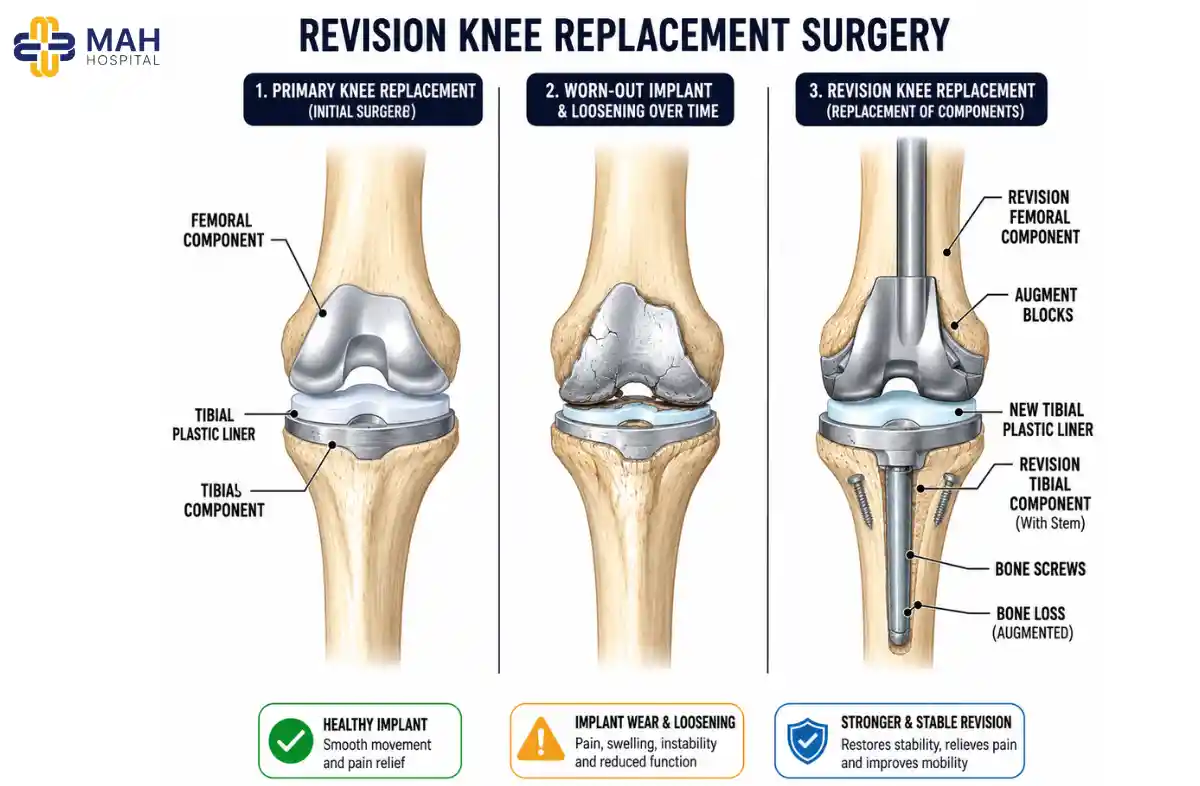
Hearing the words "revision surgery" can naturally create anxiety. Many patients worry that it simply means repeating the previous operation or that the chances of success are lower. In reality, revision knee surgery is a carefully planned procedure designed to solve a specific problem, not simply replace an artificial joint. During the operation, the orthopedic surgeon removes part or all of the existing knee implant, addresses the underlying cause of failure, and reconstructs the joint using specialized revision implants whenever necessary.

The procedure may also involve correcting bone loss, restoring proper alignment, improving ligament balance, treating infection, or repairing damaged surrounding tissues depending on the patient's condition. Because every failed knee replacement has a different cause, no two revision procedures are exactly alike.

This is why careful diagnosis is one of the most important stages of treatment. Rather than asking, "How do we replace the implant?" Experienced surgeons first ask, "Why did the original knee replacement stop functioning properly?" .Finding the correct answer to that question often determines the success of the revision knee replacement procedure.

When Do You Need a Revision Knee Replacement?

Most knee replacements function successfully for many years, allowing patients to enjoy significant improvements in mobility and quality of life. However, like any medical procedure, certain situations may eventually require further treatment.

Understanding these causes not only explains when do you need a revision knee replacement but also reassures patients that many of these problems are recognized, treatable, and well understood by experienced orthopedic specialists.

  • Implant Loosening Over time, the artificial implant may gradually lose its secure attachment to the surrounding bone. Patients often notice increasing pain during walking, reduced stability, or difficulty bearing weight.
  • Implant Wear Although modern knee implants are designed for durability, years of regular use can eventually lead to wear of the implant surfaces, particularly in highly active individuals.
  • Infection Around the Implant While relatively uncommon, infection remains one of the most important reasons for revision surgery. Early diagnosis and timely treatment are essential to protect both the implant and surrounding tissues.
  • Knee Instability Some patients describe the feeling as though the knee is "giving way" or shifting unexpectedly. This may occur because of ligament imbalance, implant positioning, or changes in surrounding soft tissues.
  • Fracture Around the Implant A fall or significant injury can cause fractures in the bone surrounding an artificial knee, occasionally making revision surgery necessary to restore stability and function.
  • Bone Loss In certain cases, gradual bone loss around the implant can reduce its stability, requiring specialized reconstruction techniques during revision surgery.

Did You Know? Not every painful knee replacement requires revision surgery. A detailed orthopedic evaluation helps determine whether symptoms can be managed with non surgical treatment or whether revision knee replacement offers the best opportunity for lasting improvement.

Signs You May Need Revision Knee Surgery

Many patients live with ongoing discomfort after knee replacement because they assume the pain is a normal part of recovery. While some stiffness and soreness are expected during the healing phase, symptoms that persist, worsen, or return after initial improvement should never be ignored.

If you've already undergone knee replacement surgery and continue to experience problems months or years later, it may be time to consult an experienced orthopedic specialist for a comprehensive evaluation.

You should seek medical attention if you notice:

  • Persistent or worsening knee pain after recovery.
  • Swelling that repeatedly returns without a clear reason.
  • A feeling that the knee is loose, unstable, or "giving way."
  • Difficulty walking despite completing rehabilitation.
  • Reduced range of motion that limits everyday activities.
  • Clicking, shifting, or unusual movement within the artificial joint.
  • Recurrent infection or drainage around the surgical site.
  • Increasing difficulty climbing stairs, standing from a chair, or bearing weight.

These symptoms do not automatically mean that revision knee replacement is necessary. However, they do indicate that the artificial joint should be carefully evaluated to identify the underlying cause and determine the most appropriate treatment.

Primary Knee Replacement vs Revision Knee Replacement

Many patients assume revision surgery simply means replacing the existing implant. In reality, it is a far more specialized procedure that requires extensive planning, advanced surgical techniques, and individualized treatment strategies.

Primary Knee Replacement Revision Knee Replacement
First-time knee replacement surgery performed to treat severe joint damage. Second surgery performed to correct or replace a failed knee replacement.
Standard preoperative planning based on the patient's joint condition. Requires detailed evaluation to determine the cause of implant failure.
Typically uses standard knee replacement implants. Often requires specialized revision implants, stems, or augments.
Less complex surgical procedure with fewer technical challenges. More complex procedure requiring advanced surgical expertise.
Usually involves less operative time and blood loss. Often takes longer due to implant removal and bone reconstruction.
Bone quality is generally well preserved. May involve bone loss that requires grafts or augmentation.
Recovery is generally faster and more predictable. Recovery may take longer with more intensive rehabilitation.
Lower risk of complications in most patients. Slightly higher risk of complications due to the complexity of surgery.
Primarily performed for advanced arthritis or severe joint damage. Performed for implant loosening, wear, infection, instability, or fractures.
Aims to relieve pain and restore normal knee function. Restores stability, relieves pain, and improves function after implant failure.

The objective of knee replacement revision surgery is not simply to perform another operation, it is to resolve the underlying problem so the new implant can function more effectively over the long term.

Who May Benefit from Revision Knee Replacement?

Revision surgery is recommended only after a thorough clinical assessment confirms that replacing or reconstructing the existing implant offers the best opportunity for improving knee function.

You may be considered a suitable candidate if:

  • Your previous knee replacement no longer functions as expected.
  • Persistent pain continues despite appropriate rehabilitation and conservative treatment.
  • Imaging studies show implant loosening, wear, instability, or bone loss.
  • Infection has affected the artificial joint.
  • The implant has been damaged following trauma or fracture.
  • Knee instability significantly limits your ability to walk or perform daily activities.

The decision is always individualized. Your orthopedic surgeon carefully evaluates your symptoms, medical history, imaging findings, previous operative records whenever available, and overall health before recommending revision knee replacement.

Choosing the Right Surgeon for Revision Knee Surgery in Chennai

Selecting the right surgeon becomes even more important when dealing with a failed knee replacement. Unlike primary knee replacement, revision procedures require the ability to diagnose complex problems, anticipate surgical challenges, and adapt the treatment plan during the operation when necessary. When choosing a revision knee specialist, look for:

Extensive Experience in Revision Procedures

Revision surgery requires skills that go beyond routine joint replacement. Surgeons who regularly perform these procedures are often better equipped to manage complex implant failures, bone defects, ligament imbalance, and challenging reconstructions.

Comprehensive Diagnostic Evaluation

A good revision surgeon never rushes toward surgery. They first determine why the previous replacement failed through careful clinical examination, imaging studies, laboratory investigations, and review of previous surgical records whenever possible.

Access to Advanced Surgical Resources

Complex revision cases often require specialized implant systems, advanced instrumentation, and multidisciplinary support. Hospitals equipped for revision surgery are better prepared to manage these demanding procedures.

Commitment to Long Term Follow up

Successful treatment continues well after surgery. Regular follow up appointments and structured rehabilitation help monitor recovery, improve mobility, and maximize implant longevity.

Did You Know? One of the most important predictors of successful revision knee replacement is accurately identifying why the previous implant failed before planning the next operation.

Meet the Specialist Behind Trusted Revision Knee Replacement in Chennai

At MAHI Hospitals, revision knee replacement surgery in Chennai is led by Dr. Vijay Kumar Sohanlal, an orthopedic and joint replacement surgeon with decades of experience in advanced and revision joint surgery, including robotic and navigation assisted procedures for the knee, hip, shoulder, and other joints. His approach centers on identifying the exact reason a previous knee replacement has failed before planning the next surgical step, rather than treating revision as a routine repeat procedure.

Patients travelling to MAHI Hospitals for revision knee surgery in Chennai benefit from detailed pre operative evaluation, access to specialized revision implant systems, and a structured, multidisciplinary rehabilitation program designed to support long term recovery.

What Happens During Revision Knee Surgery?

Although every procedure is different, revision knee replacement follows a carefully planned sequence designed to restore stability, reduce pain, and improve joint function.

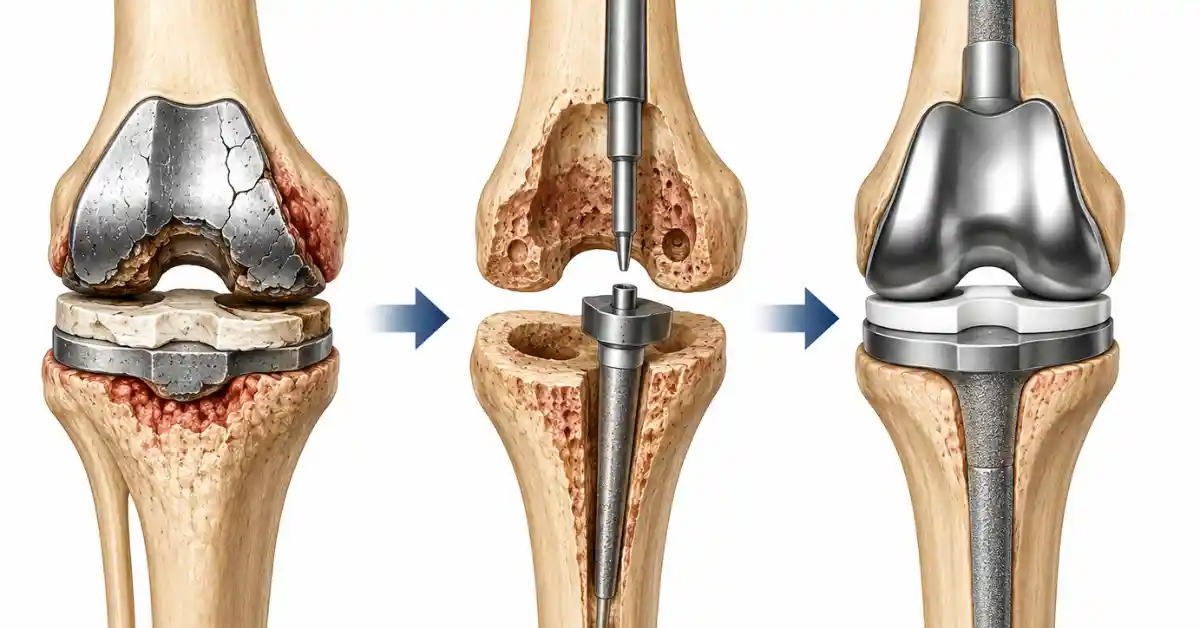
The surgery begins with the removal of part or all of the existing implant. The surgeon then carefully evaluates the surrounding bone, ligaments, and soft tissues while addressing the underlying cause of implant failure.

Depending on the findings, the procedure may involve:

  • Replacing worn or loose implant components.
  • Treating infection where necessary.
  • Correcting alignment problems.
  • Reconstructing areas affected by bone loss.
  • Restoring ligament balance for improved stability.
  • Implanting specialized revision prostheses designed for complex cases.

Because every patient's condition is unique, the exact surgical approach is customized according to the underlying problem rather than following a standard technique.

Recovery After Revision Knee Surgery

Recovery after knee replacement revision surgery is often more gradual than recovery after a primary knee replacement. This is completely expected because the procedure is typically more complex and may involve reconstruction of bone and soft tissues in addition to replacing the implant.

A structured rehabilitation program plays a vital role in helping patients regain strength, flexibility, balance, and confidence throughout the healing process.

Recovery Stage What to Expect
First Few Days Pain management begins immediately, and gentle movement is introduced under supervision.
Weeks 1 to 4 Walking gradually improves with assistive devices while physiotherapy focuses on restoring knee mobility.
Weeks 4 to 12 Strength, flexibility, and walking confidence continue to improve through guided rehabilitation.
Three to Six Months Most patients experience steady functional improvement and increasing independence in daily activities.

Recovery timelines vary depending on the reason for revision surgery, overall health, and commitment to rehabilitation.

Revision Knee Replacement Surgery Cost

The revision knee replacement surgery cost in Chennai varies from patient to patient because every case is different. Factors that influence the overall cost include the reason for revision (loosening, infection, instability, or bone loss), the type and complexity of the revision implant required, the extent of bone or soft tissue reconstruction needed, the length of hospital stay, and the rehabilitation program that follows.

Because revision surgery is more technically demanding than a primary knee replacement, it generally involves more surgical time, specialized implants, and closer post operative monitoring, all of which are reflected in the overall treatment cost. During your consultation, your orthopedic surgeon will provide a clear, itemized cost estimate only after a thorough clinical evaluation and imaging assessment, so you know exactly what to expect before committing to treatment.

Understanding the Risks and How Modern Orthopedic Care Minimizes Them

Every surgical procedure carries potential risks, and revision knee surgery is no exception. However, modern orthopedic care has significantly improved patient safety through better diagnostic techniques, advanced implant technology, evidence based surgical protocols, and comprehensive rehabilitation.

Potential risks may include infection, blood clots, delayed healing, stiffness, nerve or blood vessel injury, implant loosening, or the need for additional procedures in complex cases.

Experienced orthopedic teams work proactively to minimize these risks through detailed preoperative planning, meticulous surgical techniques, strict infection control measures, preventive medications when appropriate, early mobilization, and close postoperative monitoring.

For most patients, careful planning and adherence to rehabilitation contribute significantly to successful long term outcomes.

Conclusion

A knee replacement that doesn't deliver the expected results can be deeply discouraging, but it does not mean your journey ends there. Many causes of persistent pain, implant failure, instability, or reduced mobility can be successfully evaluated and treated through revision knee replacement when performed by experienced orthopedic specialists.

The most important step is not rushing into another operation, it is understanding why the previous knee replacement failed. A thorough evaluation, accurate diagnosis, and personalized treatment plan form the foundation of successful revision surgery.

If you're living with ongoing knee problems after replacement surgery, seeking expert evaluation can help you understand your options and move toward recovery with greater clarity and confidence. Sometimes the most important step isn't your first surgery, it's finding the right team to guide your next one.

Frequently Asked Questions

Common questions about Revision Knee Replacement and our services

Revision knee replacement is a specialized procedure performed to repair or replace a previously implanted artificial knee that has failed due to wear, loosening, infection, instability, fracture, or other complications.

Unlike a primary knee replacement, revision surgery focuses on identifying and correcting the underlying reason the original implant failed. It is generally more complex and often requires specialized implants and advanced surgical planning.

Persistent pain, swelling, instability, difficulty walking, recurrent infection, or imaging findings showing implant problems may indicate the need for further evaluation by an orthopedic specialist.

Yes. Recovery often takes longer than after a primary knee replacement because knee replacement revision surgery is typically more complex and requires more extensive rehabilitation.

Many patients experience significant improvements in pain relief, stability, and mobility when the underlying cause of implant failure is accurately diagnosed and treated by experienced revision specialists.

Chennai is recognized for its experienced orthopedic surgeons, advanced medical infrastructure, multidisciplinary rehabilitation programs, and expertise in managing complex joint replacement cases, including hospitals such as MAHI Hospitals in Chennai.

Not always. The decision depends on the cause of failure, the patient’s overall health, bone quality, and clinical evaluation. An orthopedic specialist determines the most appropriate treatment after a comprehensive assessment.

The revision knee replacement surgery cost depends on the complexity of the case, the type of revision implant used, the extent of bone or tissue reconstruction required, hospital stay duration, and the rehabilitation plan. Your surgeon will provide a personalized estimate after evaluation.

Related Blogs

No data was found

Latest Health Vlog Updates

Watch expert healthcare videos, medical insights, and wellness tips to stay informed and healthy.

Need Help With Our Services?

Fill out the form and our patient care coordinators will get back to you within 24 hours to assist with appointments, queries, or any guidance you need.