Medically Reviewed by Dr. Vijay Kumar Sohanlal, MBBS, MS (Orthopaedics), Orthopaedic & Joint Replacement Surgeon, Founder & Owner of MAHI Multispeciality Hospitals, Kilpauk, Chennai
Last medically reviewed: August 2026
If you have ever tried to manage a parent’s knee pain, blood pressure, and blood sugar concerns across different clinics, you know how difficult and time-consuming it can be. One doctor may recommend a scan at another centre, while a specialist consultation may require another visit. Soon, you may have several reports but still lack a clear, coordinated treatment plan.
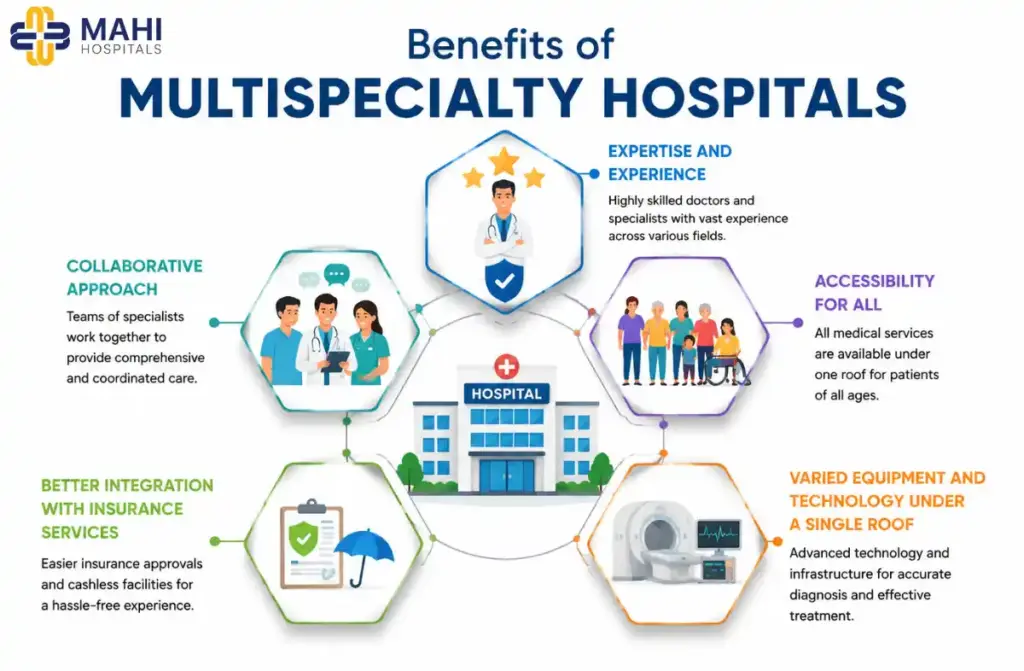
That is where a genuine multispeciality hospital can make a difference. A multispeciality hospital in Chennai brings different medical specialties together under one roof, helping patients access consultations, diagnostic services, and treatment through a more coordinated approach.
This article explains what a multispeciality hospital really offers, how to identify a hospital with genuinely integrated care, and how MAHI Hospitals serves patients looking for comprehensive healthcare in Chennai.
What “Multispeciality” Actually Means
A multispeciality hospital brings multiple medical departments together under one roof, backed by shared diagnostics, imaging, operation theatres, and an emergency department, so a patient’s case gets handled by a coordinated team rather than a string of disconnected opinions.
This matters more than it sounds like it should. Conditions rarely stay in their own lane. Someone recovering from knee surgery might also be managing diabetes and high blood pressure. In a hospital where the orthopaedic surgeon, the physician, and the diabetologist can look at the same chart, that overlap gets managed properly. In a hospital where “multispeciality” is really just a shared building with departments that don’t talk to each other, it doesn’t.
That difference is the whole point of this article, because it’s also the difference that actually matters when you’re choosing where to go.
The Honest Way to Judge Whether a Hospital Is Genuinely Multispeciality
A polished lobby and a long list of departments on a website don’t tell you much on their own. A few things actually do.
Is there a named specialist behind each department, or just a listing?
Any hospital can list 25 specialities on a page. Far fewer can point you to a specific consultant with real credentials, a track record in that department, and patient outcomes you can check. Before choosing a hospital for a specific condition, it’s worth asking directly: who is the consultant for this department, and what’s their experience with my specific condition?
Does the hospital have real depth in the areas that matter to you?
A hospital doesn’t need to be equally deep in all 25 departments to be genuinely useful. What matters is whether it has real strength in the department you actually need. A hospital with an outstanding orthopaedic and joint replacement programme and a solid general medicine department is a better fit for a knee problem than a hospital with a broader list but no standout expertise anywhere.
Accreditation that actually means something
NABH accreditation confirms a hospital has been independently assessed against patient-safety and quality standards, worth checking as a baseline. NABL applies specifically to diagnostic labs, confirming lab results are accurate and standardised, because a wrong result leads straight to a wrong treatment plan.
Technology that’s actually current
Robotic surgical systems, modern imaging, and up-to-date ICU monitoring aren’t add-ons. They’re part of what allows accurate diagnosis and safer surgery in the first place. It’s a completely fair question to ask a hospital directly: what surgical and imaging equipment do you currently run, and how recently was it upgraded?
Support after the procedure, not just during it
Clear discharge instructions, physiotherapy support, and staff who actually explain medications and follow-up steps shape whether treatment holds up once you’re home. A hospital that tailors rehabilitation and follow-up to your specific age and condition, rather than handing out a generic printed sheet, is doing something a lot of hospitals only claim to do.
MAHI Hospitals, Kilpauk: Where the Strength Actually Is
MAHI Hospitals in Kilpauk has built its reputation specifically around advanced surgical infrastructure for orthopaedic and robotic joint replacement care, alongside a well-established dermatology programme, while running a broader range of departments under one roof.
Orthopaedics and Robotic Joint Replacement is led by Dr. Vijay Kumar Sohanlal, a senior joint replacement and orthopaedic surgeon with over 18+ years of clinical experience. He holds international fellowship training in computer-assisted joint replacement and arthroscopy from centres in Germany, Australia, and India, and previously held orthopaedic leadership roles at Medway Hospitals and MGM Healthcare. His work focuses on total and revision knee and hip replacement, robotic and navigation-assisted joint replacement, and complex fracture and trauma care.
Dermatology is led by Dr. Deepika Lunawat, a gold medalist dermatologist serving as Medical Director at MAHI’s dermatology division, with expertise in skin conditions, laser treatments, hair loss, and aesthetic care.
Beyond these two departments, MAHI also runs cardiology, neurology and neurosurgery, obstetrics and gynaecology, paediatrics and neonatology, gastroenterology, oncology, and a range of other specialities under one roof, supported by round-the-clock emergency readiness.
Location: Kilpauk, Chennai, easily reached from Chetpet, Aminjikarai, Purasaiwakkam, and Egmore.
Why Orthopaedic Strength Matters for a “Multispeciality” Choice
Here’s something worth being direct about: a hospital doesn’t have to be the biggest name in every department to be the right choice for you. It has to be genuinely strong in the department you actually need.
If you’re dealing with knee or hip pain, a hospital with a dedicated robotic joint replacement programme, a named surgeon with two decades of experience and international fellowship training, and real patient outcomes you can verify, is a stronger choice than a hospital that lists orthopaedics as one of 25 items on a page with no further detail.
One MAHI patient’s own account captures this well: after knee replacement surgery under Dr. Vijay Kumar Sohanlal, they went from severe knee pain and difficulty walking to moving comfortably and managing daily activities with far less pain, guided through recovery with proper follow-up and support at each stage.
That’s the kind of evidence worth looking for in any department you’re evaluating, not just orthopaedics.
Why Chennai Draws Patients From Across Tamil Nadu
Chennai’s position as a healthcare hub isn’t accidental. Decades of investment in medical colleges, specialist training, and hospital infrastructure have made it a genuine destination for patients from across Tamil Nadu, Andhra Pradesh, Puducherry, and beyond.
Infrastructure that’s kept pace. The city’s better hospitals run robotic surgical systems, high-resolution imaging, and round-the-clock diagnostic support, the kind of setup that used to require travelling abroad for certain procedures.
A genuine cost advantage. Treatment costs in India remain a fraction of comparable procedures in the US, UK, or the Gulf, while accredited Chennai hospitals deliver care that holds up against international benchmarks. For NRIs returning for surgery, or patients from neighbouring countries, that combination is a large part of Chennai’s draw.
Round-the-clock emergency readiness. Heart attacks, strokes, and accidents don’t wait for office hours. A hospital genuinely built for 24/7 emergency care hospital response, with specialists on call across departments, can be the deciding factor in a full recovery. This is one area a properly staffed multispeciality hospital has a real structural advantage over a standalone clinic.
What the Patient Journey Should Actually Look Like
A well-run multispeciality hospital moves patients through a clear path:
- Registration and initial consultation, where you’re guided to the right department rather than left to figure it out yourself
- Diagnosis and testing, supported by in-house imaging and lab work under one system
- Personalised treatment planning, built around your specific condition, age, and any other health issues, not a one-size-fits-all protocol
- Surgery or treatment, followed by structured recovery support, including physiotherapy and rehabilitation guidance where relevant
If a hospital can’t clearly walk you through what each of these steps looks like for your specific condition before you commit to treatment, that’s worth noticing.
Questions Worth Asking Before You Choose
- Who is the named specialist for the department I actually need, and what’s their specific experience with my condition?
- What equipment does the hospital currently use for diagnosis and surgery, and how recently was it upgraded?
- Is the hospital NABH accredited? Is the diagnostic lab NABL certified?
- What does the follow-up and rehabilitation process actually look like after treatment?
- Which insurers is the hospital empanelled with, and is billing transparent before admission?
A hospital confident in its own care should be able to answer all of these without hesitation.
Patient Testimonials
I had a great experience at Mahi Hospital.One of the best Hospital for Orthopaedic and Dermatology in Chennai. The doctors were highly professional, knowledgeable, and took the time to explain everything clearly. The nursing staff was attentive, compassionate, and provided excellent care.The hospital is clean, well-maintained, and equipped with good facilities. I truly appreciated the overall quality of service and patient care. I highly recommend Mahi Hospital to anyone seeking reliable and quality healthcare.
Conclusion
Choosing a hospital isn’t about finding the one with the longest list of departments. It’s about finding genuine strength in the department you actually need, backed by a named specialist, a real track record, and support that continues after you’ve left the building.
MAHI Hospitals in Kilpauk has built that strength specifically in orthopaedic and robotic joint replacement care, alongside a well-established dermatology programme, within a broader multispeciality setup. For families in North and Central Chennai dealing with a joint condition, a skin concern, or routine and emergency care more generally, that combination of proven depth and broad coverage is worth a closer look.
Read More: Yoga Asanas for Back Pain