
Medically Reviewed by Dr. Vijay Kumar Sohanlal, MBBS, MS (Orthopaedics), Orthopaedic & Joint Replacement Surgeon, Founder & Owner of MAHI Multispeciality Hospitals, Kilpauk, Chennai
Last medically reviewed: September 2026
When your back hurts, movement can be the last thing you feel like doing. Sitting down may feel easier than standing, bending can become something you consciously avoid, and even getting out of bed can remind you that your back is not moving as freely as it should.
That often leads to a natural question: can gentle yoga actually help?
For some people, it can be a useful part of managing back pain. Research suggests that yoga may provide small improvements in pain and physical function, particularly in people with chronic low-back pain, although its effects appear broadly similar to other forms of exercise.
The important part is choosing movements that suit your body rather than assuming that every yoga asanas for back pain is appropriate for every type of back pain. The goal is not to bend further, stretch harder or hold a difficult position. It is to help the back move with greater comfort, control and confidence.
Why Gentle Movement Can Make a Difference to an Aching Back
Back pain is not a single condition. It can be related to muscle and movement problems, changes in the spine, injuries, nerve involvement and several other causes. That is why an exercise that feels relieving to one person may feel uncomfortable to another.
When appropriate, gentle movement can help maintain mobility and physical function while gradually rebuilding confidence in everyday activity. Exercise is also an important part of broader evidence-based care for persistent low-back pain.
Yoga can bring several useful elements together:
- Mobility: Slow, controlled movements can take the spine and hips through a comfortable range rather than allowing stiffness to become the reason for avoiding movement.
- Strength and support: Certain poses involve the abdominal, hip and back muscles, making the practice more than simply stretching.
- Body awareness: Paying attention to breathing, posture and movement can make it easier to recognise what your back tolerates well.
- Movement confidence: Gradually returning to comfortable activity can help reduce the tendency to become overly protective of the back.
But there is an important distinction: yoga should complement appropriate back care, not replace an assessment when symptoms suggest something more significant.
The Right Yoga Pose Depends on What Your Back Needs
There is no universally “best” yoga pose for back pain.
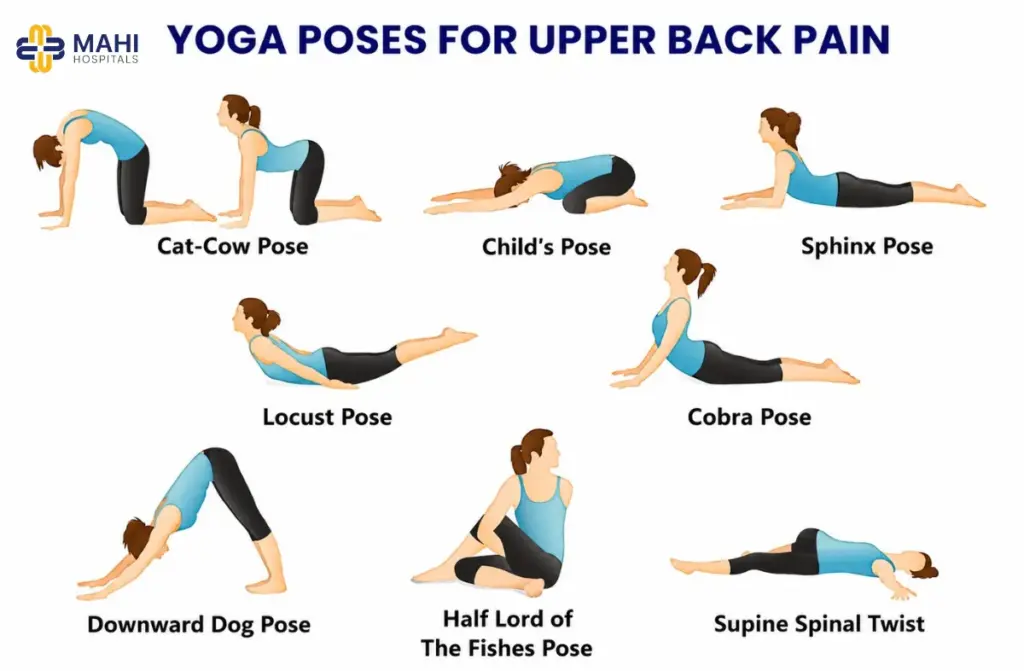
Someone whose main problem is stiffness may benefit from gentle mobility. Someone who has reduced strength may need more emphasis on controlled strengthening. Another person may need to avoid certain movements altogether until the underlying problem is understood.
| What the back may need | Where yoga may help |
| Gentle mobility | Controlled spinal and hip movements can help maintain comfortable movement. |
| Flexibility | Gradual stretching may help when stiffness is contributing to restricted movement. |
| Strength and stability | Poses such as Bridge and Bird Dog can introduce controlled strengthening. |
| Movement confidence | A gradual routine can make everyday movement feel less intimidating. |
This is why the quality of the movement matters more than how advanced the pose looks.
Yoga Asanas That Can Help a Stiff or Aching Back
The following poses can be useful components of a gentle routine for some people. They should be performed within a comfortable range, particularly if you are new to yoga or currently experiencing back pain.
| Yoga asana | Main focus | How it may support the back | Keep in mind |
| Cat-Cow (Marjaryasana–Bitilasana) | Spinal mobility | Moves the spine gently between flexion and extension, helping reduce the feeling of stiffness. | Keep the movement slow and comfortable rather than trying to create the largest possible range. |
| Child’s Pose (Balasana) | Gentle stretching and relaxation | Can provide a comfortable stretch through the back and hips while allowing the body to settle. | Modify the position if your knees, hips or back do not tolerate the full posture. |
| Sphinx Pose | Gentle extension | Introduces a mild backward movement of the spine while the forearms provide support. | If extension increases your symptoms, particularly pain travelling into the leg, this may not be appropriate. |
| Gentle Cobra (Bhujangasana) | Extension and back engagement | Encourages controlled spinal movement while engaging muscles around the back and shoulders. | A higher lift is not necessarily better; avoid forcing the lower back into a deep arch. |
| Knee-to-Chest | Lower-back and hip mobility | May provide a gentle stretching sensation around the lower back and hips. | Move gradually and avoid pulling aggressively on the legs. |
| Supine Spinal Twist | Controlled rotation | Introduces gentle rotational movement through the spine and hips. | Stay within a comfortable range instead of forcing the knee toward the floor. |
| Bridge Pose (Setu Bandhasana) | Strength and hip support | Engages the glutes and trunk muscles, adding strengthening to a routine that might otherwise focus mainly on stretching. | Lift with control and avoid excessive arching of the lower back. |
| Bird Dog | Stability and coordination | Challenges the trunk to remain controlled while the arms and legs move, helping develop stability. | Prioritise balance and control rather than completing more repetitions. |
Clinical insight: A useful yoga routine does not need to contain the most difficult poses. For someone with back pain, the ability to perform a simple movement comfortably and consistently is often more valuable than achieving an advanced posture.
Practising Yoga Without Turning a Helpful Movement Into an Irritating One
One of the biggest mistakes people make with exercise for back pain is assuming that discomfort must be pushed through for the movement to work.
That is not the goal.
A better approach is to let comfort, control and symptom response determine how far you go.
- Work within your current range: If a pose feels comfortable halfway through its full movement, there is no need to force yourself into the complete posture. Your range can gradually improve as your tolerance improves.
- Let control matter more than depth: A slow, well-controlled movement is usually more useful than rushing into a deeper position simply to “feel the stretch.”
- Progress gradually: Once a routine becomes comfortable, you can gradually increase repetitions, duration or difficulty rather than changing everything at once.
- Use symptoms as feedback: A movement that repeatedly produces sharp, increasing or unfamiliar pain should not simply be repeated in the hope that the body will eventually accept it.
Yoga is generally considered safe when appropriately practised, but strains and other injuries can occur, particularly when movements are performed incorrectly or without appropriate modification. People with existing conditions may need individual adjustments.
How Your Back Responds Tells You More Than How Deep You Stretch
Learning to interpret your body’s response is an important part of exercising with back pain.
Not every sensation during movement is a warning sign. A gentle stretch or mild muscular effort can be expected. What matters is whether the symptom remains comfortable and settles appropriately.
| What you notice | How to approach it |
| Gentle stretching sensation | Usually acceptable when comfortable and controlled. |
| Mild muscular effort | Expected during strengthening movements such as Bridge or Bird Dog. |
| Temporary mild stiffness | May occur when returning to activity, particularly after inactivity. |
| Sharp or escalating pain | Stop the movement and reassess rather than pushing further. |
| New numbness or tingling | Stop and seek appropriate clinical guidance, particularly if it persists or worsens. |
| New or worsening weakness | Requires professional assessment rather than continued self-directed exercise. |
| Pain increasingly travelling down the leg | Stop the exercise and have the symptoms assessed. |
This approach changes the purpose of yoga. You are no longer trying to win against the pose; you are learning how your body responds to movement.
A Simple Routine That Builds Movement Gradually
You do not need a long yoga session to begin moving more comfortably. A short sequence can introduce mobility, relaxation, strengthening and stability without making the routine unnecessarily complicated.
| Sequence | Movement | Purpose |
| 1 | Cat-Cow | Gently mobilise the spine |
| 2 | Child’s Pose | Relax and gently stretch the back and hips |
| 3 | Sphinx Pose | Introduce controlled spinal extension |
| 4 | Bridge Pose | Build hip and trunk strength |
| 5 | Supine Spinal Twist | Introduce comfortable rotation |
| 6 | Bird Dog | Develop trunk stability and coordination |
| 7 | Rest | Allow the body to settle |
Start with movements that feel manageable rather than trying to complete a demanding routine from the first session.
Consistency matters more than intensity. A simple routine that you can perform comfortably and regularly is more useful than an ambitious sequence that repeatedly aggravates your symptoms.
Yoga is One Part of the Bigger Back-Care Picture
It is tempting to look for one exercise that will solve back pain. In reality, persistent back problems often benefit from a broader approach.
The WHO recommends person-centred care for chronic primary low-back pain, with exercise among the interventions that may form part of management. It also emphasises that a combination of appropriate interventions may be more useful than relying on a single treatment in isolation.
| Part of back care | Why it matters |
| Regular movement | Helps maintain physical capacity instead of allowing fear of pain to lead to prolonged inactivity. |
| Progressive strengthening | Builds the muscular capacity needed for everyday activities. |
| Mobility work | Helps maintain comfortable movement of the spine, hips and surrounding joints. |
| Gradual return to activity | Allows the body to rebuild tolerance rather than suddenly going from inactivity to demanding exercise. |
| Understanding recurring pain | Repeated episodes may need assessment to identify contributing factors instead of repeatedly treating the symptoms in isolation. |
| Adequate recovery | Sleep and recovery support the body’s ability to adapt to physical activity. |
The aim is not to spend your life protecting your back from movement. It is to gradually build the strength, mobility and confidence needed to move normally again.
When Back Pain Needs More Than Home Exercise
Yoga may be appropriate for some forms of back pain, particularly as part of a broader exercise-based approach. But persistent, severe or unusual symptoms should not automatically be treated as ordinary muscular stiffness.
Professional assessment becomes particularly important when pain continues despite appropriate self-care, repeatedly interferes with everyday activities, follows a significant injury, or is accompanied by neurological symptoms.
Some symptoms require more urgent attention, including new or worsening weakness, significant numbness, loss of bladder or bowel control, severe pain following major trauma, fever with significant back pain, or rapidly worsening symptoms.
The purpose of an assessment is not to assume that something serious is wrong. It is to understand why the symptoms are occurring and what type of movement or treatment is actually appropriate.
A Patient-Centred Approach to Back Care at MAHI
At MAHI Hospitals, back and musculoskeletal care focuses on understanding the underlying problem and helping patients return to movement safely.
When yoga is appropriate, it can be one part of a broader plan that may include suitable exercise, strengthening, rehabilitation and gradual progression based on the individual’s symptoms and functional goals.
The focus is not simply on reducing pain for the moment. It is on helping patients move with greater confidence and return to the activities that matter to them.
Conclusion
Yoga can be a useful way to keep your back moving, but the goal is not to stretch harder it is to move better.
The most valuable practice is one that matches your current ability, progresses gradually and combines mobility with strength and control. You do not need to achieve advanced poses to support a healthier back.
If a particular movement consistently makes your symptoms worse, that is a reason to reassess rather than push through. And when pain persists, repeatedly returns or comes with concerning symptoms, understanding the underlying problem is more important than simply adding another exercise to your routine.
With the right approach, yoga can become less about perfect poses and more about something far more practical: helping you move through everyday life with greater comfort, strength and confidence.
Read More: Medicine for Knee Pain in Old Age