
Medically reviewed by: Dr. Vijay Kumar Sohanlal, MBBS, MS (Orthopaedics), Orthopaedic and Joint Replacement Surgeon, Founder and Owner, MAHI Multispecialty Hospital, Kilpauk, Chennai
Last medically reviewed: September 2026
A sudden twist, awkward landing, sports injury or fall can leave your knee swollen, painful and difficult to trust. Sometimes, the symptoms gradually settle with appropriate rehabilitation. But if the knee continues to give way, feel unstable or limit the activities you enjoy, a more important question comes up: Does the ligament need Knee Ligament Surgery, or can the knee recover without it?
A torn knee ligament does not automatically mean an operation. The right treatment depends on which ligament is injured, the severity of the tear, how stable the knee remains, whether other structures are damaged, and what you expect your knee to do after recovery.
Understanding these factors can make the decision about knee ligament surgery much clearer and help you discuss the most appropriate treatment approach with your orthopaedic specialist.
The Four Ligaments Behind Knee Stability
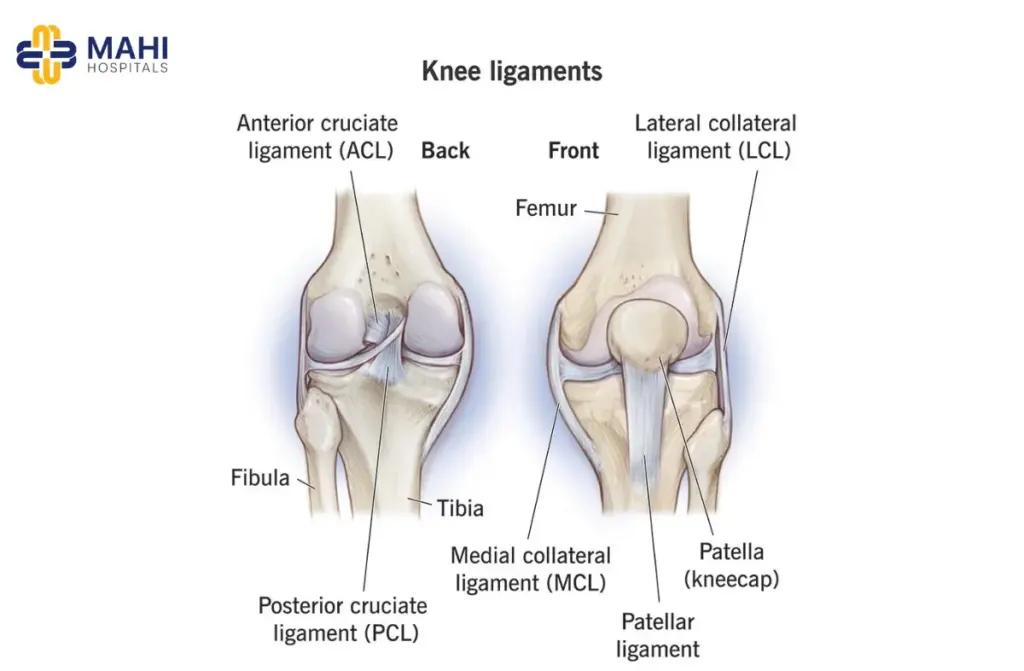
The knee depends on four major ligaments to control movement and provide stability.
| Ligament | Main role | Common injury situation |
| ACL | Controls forward movement and rotation | Sudden direction changes, landing or sports injuries |
| PCL | Helps prevent excessive backward movement of the shin | High-impact injuries or force to the front of the knee |
| MCL | Supports the inner side of the knee | A force pushing the knee inward |
| LCL | Supports the outer side of the knee | A force affecting the inner side of the knee |
When one of these ligaments is significantly damaged, the knee may lose some of the support that normally keeps its movement controlled.
That is why the tear itself is only part of the story. What matters clinically is how that injury has affected the stability and function of the knee.
When a Knee Injury Stops Being Just a Pain Problem
Pain and swelling are common immediately after an injury and may improve with time. Persistent instability is different.
Further assessment becomes particularly important when:
- The knee repeatedly gives way, especially while turning, walking on uneven ground or changing direction.
- Swelling keeps returning after activity instead of gradually settling.
- Normal activities remain difficult despite appropriate rehabilitation.
- The knee still feels unstable after physiotherapy, suggesting that mechanical stability may not have been restored.
- A ligament injury has occurred alongside meniscus, cartilage or other structural damage.
A knee that hurts after an injury may simply need time to recover. A knee that repeatedly gives way may indicate that its stabilising structures are no longer functioning adequately.
The Tear on the MRI is Not the Whole Decision
Not every torn knee ligament needs surgery.
Some ligament injuries can be managed successfully without an operation. Depending on the ligament and severity of the injury, treatment may involve activity modification, bracing, physiotherapy, strengthening and gradual return to normal activity. The decision becomes more complex when instability persists.
Doctors may consider several factors:
- Severity and type of tear: A partial tear can behave differently from a complete rupture.
- Actual knee stability: Repeated giving-way episodes can indicate inadequate mechanical support.
- Activity demands: Someone hoping to return to football, running or other pivoting sports may have different requirements from someone with lower physical demands.
- Associated injuries: Meniscus or cartilage damage can change both treatment and recovery planning.
- Response to rehabilitation: If structured rehabilitation restores stability and function, surgery may not be necessary.
Clinical Insight: An MRI can confirm that a ligament is damaged, but the scan alone does not determine whether surgery is needed. The examination, knee stability, associated injuries and the patient’s functional goals all contribute to that decision.
The Point at Which Surgery Starts Making More Sense
Knee ligament surgery may be considered when the knee remains functionally unstable despite appropriate non-surgical treatment.
It may also become more appropriate when:
- A significant tear causes persistent instability.
- The patient needs to return to activities that place high demands on knee stability.
- The ligament injury is accompanied by significant meniscus or cartilage damage.
- Multiple knee ligaments are injured.
- Repeated giving-way is interfering with daily life, work, exercise or sport.
The purpose of surgery is not simply to correct what appears on an MRI. The larger goal is to restore stability and create a knee that can meet the patient’s functional demands.
Repair or Reconstruction: Two Different Paths
Not every torn ligament is treated in the same way.
| Approach | What it involves | When it may be considered |
| Ligament repair | The injured ligament is repaired or reattached | Selected injuries where the original tissue can be preserved |
| Ligament reconstruction | The damaged ligament is replaced with a graft | When the original ligament cannot reliably restore stability |
The choice depends on where the ligament has torn, the quality of the remaining tissue, the type of injury, knee stability and other individual factors.
Inside the Operating Room: Restoring Knee Stability
Many ligament procedures are performed using arthroscopic techniques, allowing the surgeon to examine and treat structures inside the knee through small incisions.
The exact procedure varies, but the surgical plan generally involves:
| Stage | What happens |
| Assessment | The knee is examined and relevant imaging is reviewed before surgery. |
| Arthroscopic examination | The ligament and other structures, including the meniscus and cartilage, can be assessed directly. |
| Repair or reconstruction | The damaged ligament is repaired when appropriate, or reconstructed when the original tissue cannot reliably restore stability. |
| Graft fixation | When reconstruction is performed, the graft is positioned and secured to recreate the function of the original ligament. |
| Stability assessment | The knee is checked to ensure the reconstruction or repair provides the intended stability. |
The surgical technique is selected according to the injury pattern and the needs of the individual knee, rather than using exactly the same approach for every patient.
The Graft: Rebuilding What the Damaged Ligament Can No Longer Do
If a damaged ligament cannot reliably be repaired, a graft acts as the replacement ligament during reconstruction. A graft may come from the patient’s own tissue, known as an autograft, or donor tissue may be used in selected circumstances.
There is no single graft choice that is right for everyone. The decision can depend on the ligament being reconstructed, the patient’s age and activity level, previous procedures and other surgical considerations.
Recovery is a Process of Rebuilding Trust in the Knee
Recovery after knee ligament surgery is about much more than waiting for the tissue to heal. The knee must gradually regain movement, strength, control and confidence.
| Recovery phase | Main focus |
| Early recovery | Controlling pain and swelling while protecting the repair or reconstruction |
| Mobility | Gradually restoring knee movement and progressing weight-bearing as advised |
| Strength | Rebuilding the muscles that support and control the knee |
| Functional rehabilitation | Improving balance, coordination and movement quality |
| Return to activity | Progressing toward work, exercise or sport-specific demands |
Recovery can vary significantly between patients. The ligament involved, associated injuries, surgical procedure, muscle condition and rehabilitation progress all influence the timeline.
Rehabilitation is therefore not an afterthought to surgery. It is part of the treatment itself.
Expert Insight: Surgery repairs or reconstructs the ligament. Rehabilitation helps the knee and the surrounding muscles learn to work together again.
Returning to Sport is About Function, Not Just Time
Returning to sport should not be based on a calendar date alone.
Before returning to higher-demand activities, the knee generally needs adequate strength, range of motion, stability, balance and movement control. Sport-specific rehabilitation may also be required for activities involving jumping, landing, pivoting and rapid changes of direction.
A gradual, function-based return is safer than assuming the knee is ready simply because a certain number of months have passed.
The Bigger Concern With Leaving an Unstable Knee Untreated
Not every ligament tear inevitably becomes worse without surgery. Some patients can function well with appropriate non-surgical management. The concern is persistent instability.
Repeated giving-way can limit activity, reduce confidence in the knee and, in some patients, increase the risk of additional injury to structures such as the meniscus or cartilage. This is why the decision should be based on how the knee is functioning, rather than on the presence of a tear alone.
Understanding the Risks Before Surgery
As with any surgery, ligament procedures carry potential risks. Individual risk varies depending on the procedure, overall health and associated injuries.
| Potential concern | What it means |
| Infection | Uncommon, but requires prompt assessment and treatment if it occurs. |
| Stiffness | Knee movement may become restricted, making appropriate rehabilitation important. |
| Persistent instability | The knee may remain unstable if healing, graft function or other factors affect the result. |
| Graft-related problems | A reconstruction can stretch, fail or become injured, particularly after significant reinjury. |
| Blood clots | Surgery and temporarily reduced mobility can increase clot risk. |
| Ongoing pain or weakness | Recovery can be affected by associated injuries, muscle weakness or individual healing factors. |
Understanding these risks is not about expecting complications. It helps patients understand why careful planning, rehabilitation and follow-up are important parts of successful treatment.
A Patient-Centred Approach to Knee Ligament Care at MAHI
At MAHI Hospitals, knee ligament treatment is approached around the injury, the stability of the knee and the patient’s functional goals rather than simply the MRI finding.
Depending on the individual situation, treatment may involve rehabilitation, ligament repair or reconstruction.
Dr. Vijay Kumar Sohanlal, Orthopaedic & Joint Replacement Surgeon and Founder of MAHI Hospitals, has more than 18+ years of clinical experience, with international fellowship training in Germany and Australia and experience across arthroscopy, sports injuries, knee reconstruction and joint surgery.
For someone facing a ligament injury, that experience matters because the important question is not simply “Can this ligament be operated on?” but “What treatment will give this particular knee the stability and function it needs?”
Knowing When Your Knee Needs a Closer Look
An orthopaedic assessment is worth considering if you have:
- Repeated giving-way or instability
- Persistent swelling or difficulty using the knee normally
- Difficulty returning to your usual activities despite rehabilitation
- A confirmed ligament tear
- A significant twisting or sports injury
- Uncertainty about whether surgery or non-surgical treatment is more appropriate
An assessment does not automatically mean surgery. It helps clarify what has been injured, how stable the knee is and what treatment is most likely to serve your long-term goals.
Conclusion
A torn knee ligament does not automatically mean that surgery is the only answer. What matters is how the injury has affected the stability and function of your knee.
For some patients, structured rehabilitation may be enough. For others, persistent instability, associated injuries or demanding activity goals may make repair or reconstruction more appropriate.
The right decision begins with understanding the injury rather than rushing toward a procedure. With appropriate assessment, treatment planning and rehabilitation, the goal is not simply to repair a ligament — it is to help you regain a knee that you can trust again.
Read More: Best Hip Replacement Surgeon in Chennai.