

Medically reviewed by: Dr. Vijay Kumar Sohanlal, MBBS, MS (Orthopaedics), Orthopaedic and Joint Replacement Surgeon, Founder and Owner, MAHI Multispecialty Hospital, Kilpauk, Chennai
Last medically reviewed: September 2026
Knee pain rarely announces itself all at once. It usually starts quietly, a bit of stiffness on the stairs, a dull ache after a long day of standing, a walk that feels shorter than it used to. Most people brush it off for months, sometimes years, before asking whether anything can be done short of surgery.
At MAHI Hospitals in Chennai, this is one of the most common conversations Dr. Vijay Kumar Sohanlal has with his patients. Many of them arrive already having read about PRP treatment for knee arthritis online and want to know two things in plain language: does it actually work, and is it right for their knee specifically. This article answers both, based on how PRP is actually used in clinical practice today, not on marketing claims.
What is PRP Treatment for Knee Arthritis
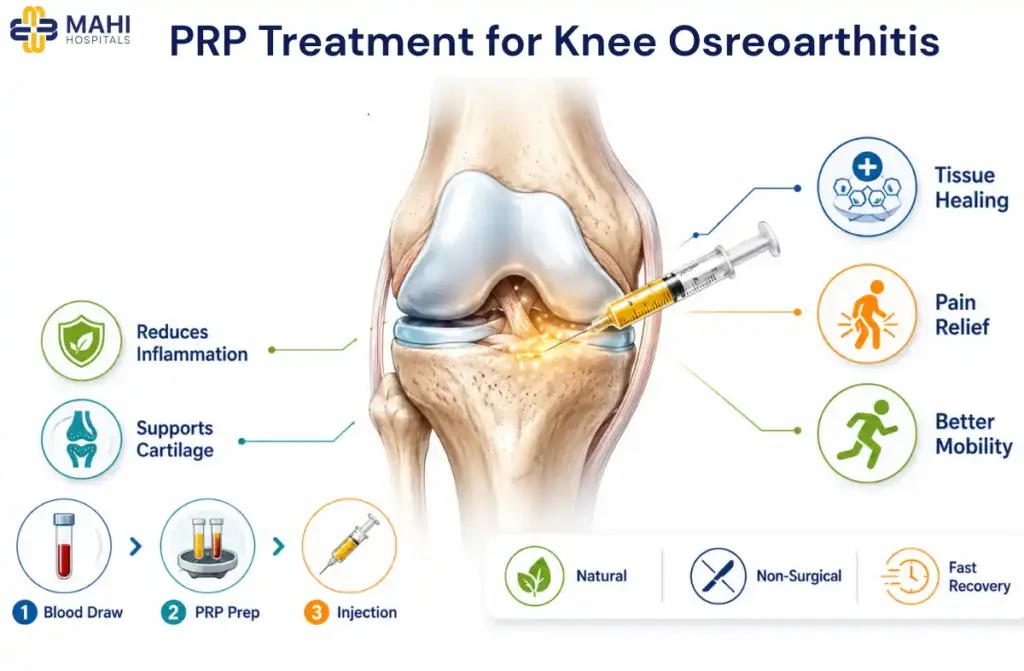
PRP treatment for knee arthritis is a regenerative injection therapy. A small sample of the patient’s own blood is drawn and spun in a centrifuge to separate a concentrated layer of platelets. This platelet rich plasma is then injected directly into the knee joint. Platelets release growth factors that can help calm inflammation and support the body’s own repair signals inside the joint.
It is important to be direct about what PRP injections for knee pain can and cannot do:
- PRP does not regrow lost cartilage.
- It cannot reverse advanced bone on bone arthritis.
- It is not a substitute for knee replacement once the joint has broken down structurally.
What it can do, for the right patient at the right stage, is reduce pain, support joint function, and in some cases delay the need for surgery. Platelet Rich Plasma for osteoarthritis works best as one part of a broader plan, not as a standalone miracle fix.
What We See in Practice at MAHI Hospitals
Beyond the general clinical picture, it helps to know what a Chennai based orthopaedic practice actually observes. Dr. Vijay Kumar Sohanlal, who also performs robotic and navigation assisted knee replacement, evaluates every PRP candidate the same way he would evaluate a surgical candidate: by stage of arthritis, cartilage condition, muscle strength, and activity goals, not simply by age or X ray appearance alone.
In practice, patients who respond best tend to share three things: early to moderate arthritis on imaging, a willingness to follow through with physiotherapy after the injection, and realistic goals such as walking comfortably or returning to daily activity rather than expecting a completely new knee. Patients with advanced, severely narrowed joint spaces are advised honestly that PRP is unlikely to change their trajectory, and alternatives, including partial or total knee replacement, are discussed instead.
Understanding What is Actually Happening Inside an Arthritic Knee
Calling arthritis simple wear and tear undersells what is going on. The knee is a living structure made of cartilage, bone, joint fluid, ligaments, and muscle, all working together. When arthritis sets in, several things change at once, which is why two patients with the same diagnosis can have very different symptoms.
Cartilage Changes
Healthy cartilage cushions the bones and allows smooth movement. As arthritis progresses, it thins and loses resilience, which shows up as pain on weight bearing activities, stiffness after rest, and a growing hesitation to move freely.
Inflammation
Inflammation is often underestimated. Irritation inside the joint can cause swelling, sensitivity, and stiffness even before cartilage loss becomes severe, which is part of why treatments now target the joint’s overall biology rather than cartilage alone.
Bone and Joint Structural Change
As cartilage thins, the underlying bone takes on more stress, sometimes leading to bone spurs and reduced smoothness of movement. Everyday tasks begin to require more effort.
The Muscle Connection
Pain often leads to less movement, which weakens the muscles that support the knee, which then places even more stress on the joint. Breaking that cycle through targeted strengthening and physiotherapy is a core part of any arthritis plan, PRP included.
Where PRP Fits in the Treatment Journey
PRP is not the first step for everyone, and it is not the final answer for every stage of arthritis. It tends to be considered for patients who continue to have pain despite basic conservative care, who fall in the early to moderate arthritis range, and who want to explore options before committing to surgery, with realistic expectations about outcome.
| Stage of Knee Arthritis | What is Usually Happening in the Knee | Realistic Role of PRP |
| Early | Cartilage changes are limited; inflammation drives much of the pain | Often helpful alongside rehabilitation |
| Moderate | Cartilage damage is increasing, activity is more limited | May meaningfully help selected patients depending on joint condition |
| Advanced | Significant cartilage loss and structural change | Benefit is usually limited; surgical options are typically discussed |
Can PRP Delay Knee Replacement
This is the question almost every patient asks, and the honest answer is: sometimes, for the right patient. Outcomes depend on the stage of arthritis, how much cartilage is left to respond, activity level and muscle strength, and overall joint alignment. PRP should be viewed as a joint supporting option, not a guaranteed way to avoid surgery indefinitely.
How Much Does PRP Treatment for Knee Arthritis Cost
Cost is a genuine and common concern, and patients deserve a straight answer rather than having to ask three times. PRP therapy pricing in India varies depending on the clinic, the equipment used, and the number of sessions required. Exact pricing at MAHI Hospitals depends on individual assessment, so we recommend a consultation with Dr. Vijay Kumar Sohanlal for a personalised quote rather than relying on averages found online.
PRP Versus Other Knee Arthritis Treatments
| Treatment | Primary Goal | Best Considered When |
| Physiotherapy and exercise | Build strength, stability, and movement | Useful across almost every stage |
| Oral medication | Manage pain and inflammation | Symptoms affecting daily activity |
| Steroid injection | Short term inflammation control | Flare ups needing quick relief |
| Hyaluronic acid injection | Improve joint lubrication | Selected symptomatic patients |
| PRP therapy | Support joint biology, improve symptoms | Suitable early to moderate arthritis |
| Knee replacement | Restore function in a badly damaged joint | Advanced arthritis affecting quality of life |
PRP Compared With Steroid Injections
Steroids reduce inflammation quickly and are useful for flare ups, but the relief is often short lived. PRP works differently: rather than adding a medication, it uses the patient’s own concentrated platelets to influence healing signals inside the joint. Neither is universally better, the right choice depends on the individual patient and what they are trying to achieve.
What Actually Happens During the Procedure
The process is simple and does not require hospital admission. A small blood sample is drawn from the patient and processed to separate the platelet rich portion. This concentrated plasma is then injected into the knee, typically guided by ultrasound for precision. Most patients are in and out within one to two hours and return home the same day.
What to Expect After Treatment
PRP does not work like a painkiller that acts immediately. It works through a biological process that unfolds over weeks.
- First few days: mild soreness or swelling at the injection site is common and usually settles quickly.
- Weeks two to six: gradual improvement in pain and stiffness for many patients.
- Two to three months onward: the fuller effect, including improved confidence in movement, typically becomes clear, sometimes needing a repeat session for lasting benefit.
Success is not always “zero pain.” For most patients, a good outcome means walking further without discomfort, climbing stairs more easily, relying less on medication, and getting back to daily life with more confidence.
Who May Not Be a Good Candidate
PRP is not right for everyone. People with active infections, blood clotting disorders, severe anaemia, certain cancers, or those on blood thinning medication are usually not suitable candidates. Patients with advanced arthritis and significant joint damage are also more likely to be guided toward other treatment options. A proper evaluation by an orthopaedic specialist is the only reliable way to know if PRP fits your specific knee.
PRP Myths Versus Facts
| Common Belief | Reality |
| PRP completely cures knee arthritis | It cannot reverse advanced cartilage loss, though it may improve symptoms in selected patients |
| PRP regrows cartilage entirely | Current evidence does not support PRP as a full cartilage replacement therapy |
| PRP works the same for everyone | Results vary by arthritis stage, joint condition, and lifestyle |
| If PRP fails, nothing else will help | Multiple treatment paths exist depending on the individual case |
| PRP always means avoiding surgery | It may delay progression for some patients, but advanced arthritis may still need surgery eventually |
Independence Knee Arthritis- When to See a Doctor
Postponing evaluation is understandable but often costly in the long run. Reduced movement over time weakens the muscles that support the knee, affects balance, and lowers overall activity levels. Arthritis itself is progressive, so untreated joint changes can lead to increased friction, altered walking patterns, and more persistent discomfort. There is also an emotional cost that is easy to overlook, missed family events, reduced independence, and hesitation around exercise out of fear of pain. Modern knee care aims to protect not just the joint, but the person’s ability to keep living an active life.
About the Specialist
Dr. Vijay Kumar Sohanlal is an orthopaedic and joint replacement surgeon at MAHI Hospitals, Chennai, with extensive experience in advanced knee and hip care, including robotic and navigation assisted joint replacement. He personally evaluates every patient considering PRP treatment for knee arthritis, assessing arthritis stage, cartilage condition, and activity goals before recommending a course of treatment, so that every decision stays realistic and tailored to that individual knee.
Conclusion
Knee arthritis is about more than what shows up on an X ray, it is about how comfortably someone can move through their day. PRP treatment for knee arthritis offers a genuine, evidence supported option for carefully selected patients who still have joint preservation potential. It will not rebuild a knee from scratch, and it is not the right choice for every stage of arthritis, but for the right patient, it can mean less pain, better mobility, and more confidence in everyday movement.
If you are dealing with ongoing knee pain and want an honest assessment of whether PRP is right for you, book a consultation with Dr. Vijay Kumar Sohanlal at MAHI Hospitals, Chennai.
Read More: Can PRP Delay Knee Replacement Surgery?