
Medically Reviewed by Dr. Vijay Kumar Sohanlal, MBBS, MS (Orthopaedics), Orthopaedic & Joint Replacement Surgeon, Founder & Owner of MAHI Multispeciality Hospitals, Kilpauk, Chennai
Last medically reviewed: August 2026
“Doctor, I don’t want a knee replacement yet. Is there anything else I can try first?”
Almost every orthopedic surgeon who treats knee arthritis hears a similar question every week: Can PRP delay knee replacement surgery? It usually comes from patients who are still able to climb stairs, walk comfortably, and manage daily activities but want more time before considering surgery and the rehabilitation that follows.
Platelet-Rich Plasma (PRP) injections have become a common option discussed by patients with knee arthritis. While some claims about PRP are exaggerated, evidence suggests that PRP treatment may help reduce pain and improve function in selected patients, potentially allowing them to postpone knee replacement for a period of time. However, PRP is not a permanent alternative to surgery, and its suitability depends on the severity of arthritis, joint condition, symptoms, and individual treatment goals.
This article explains who may benefit from PRP, when it may help delay knee replacement, who may be less likely to benefit, and the signs that indicate it may be time to seriously consider knee replacement surgery.
Quick Answer
PRP therapy can help delay knee replacement in patients with early to moderate osteoarthritis by easing pain and improving day-to-day function well enough that surgery isn’t needed yet. It does this by calming the joint environment, not by regrowing cartilage, so once arthritis has advanced to bone-on-bone changes or significant deformity, PRP’s benefit drops off sharply. The right call depends on your arthritis grade on imaging, how much it’s actually limiting your life, what you’ve already tried, and what you want to be able to do. That’s a clinical judgment made after an in-person exam and X-rays, not something to self-diagnose from an article.
Why Patients Look for Alternatives First
Nobody wakes up wanting a knee replacement. Most people arrive at the decision reluctantly, after other things stop working, and the hesitation usually isn’t really about the surgery itself. It’s about everything around it: the recovery time, the fear of not getting full movement back, the disruption to work or caregiving responsibilities.
That hesitation is what pushes people toward physiotherapy, weight management, medications, and injections like PRP before they’ll even discuss replacement. That’s a reasonable instinct. Preserving your own joint, when it can still function well, is almost always preferable to replacing it early.
But there’s a trap here worth naming directly: preserving the natural knee should never become the goal by itself, disconnected from how the knee is actually doing. The question isn’t “how do I avoid surgery.” It’s “does this knee still have enough working structure left for a preservation-focused treatment to make a real difference, or has it moved past that point?” Those are very different starting points, and confusing them is how patients end up cycling through repeated injections for years with diminishing returns.
So, Actually Can PRP Delay Knee Replacement Surgery?
For a well-selected patient, yes. But it’s worth being precise about the mechanism, because it changes what you should expect.
PRP doesn’t rebuild cartilage or reverse the arthritis itself. What it appears to do, based on how platelets behave in tissue healing generally, is concentrate growth factors and signaling proteins from your own blood and introduce them into the joint, where they may help calm inflammation and support a more favourable healing environment. When that works, patients often notice less pain and swelling, which in turn makes it easier to actually do the things that protect a knee long-term: walk regularly, do strengthening exercises, stay active without favouring the joint.
That knock-on effect, better symptoms leading to better function leading to less strain on the joint, is really where the “delay” comes from. It’s an indirect benefit, not a structural fix.
It’s also not permanent or guaranteed. As arthritis progresses (more cartilage loss, narrowing joint space, changes in bone alignment), the biological environment inside the joint becomes harder to influence with an injection. At that point, PRP tends to produce shorter and less meaningful relief, and repeating it usually isn’t the answer.
Where PRP Actually Fits
One of the more persistent misconceptions is treating PRP and knee replacement as if they’re two competing options for the same problem. They’re not. They sit at different points on the same disease timeline and serve different purposes.
PRP belongs to a category sometimes called joint-preserving treatments: approaches aimed at improving symptoms and function in a knee that still has enough healthy structure left to work with. It’s rarely used alone. In practice, it’s usually one piece of a broader plan that also includes:
- A structured physiotherapy and strengthening program
- Weight management, where relevant to joint loading
- Realistic activity modification (staying active, but smarter about it)
- Medication for pain and inflammation when needed
None of this is about postponing surgery for its own sake. It’s about squeezing the most function possible out of the natural knee for as long as that’s a realistic goal, and recognizing the point where it stops being one.
What PRP Actually is
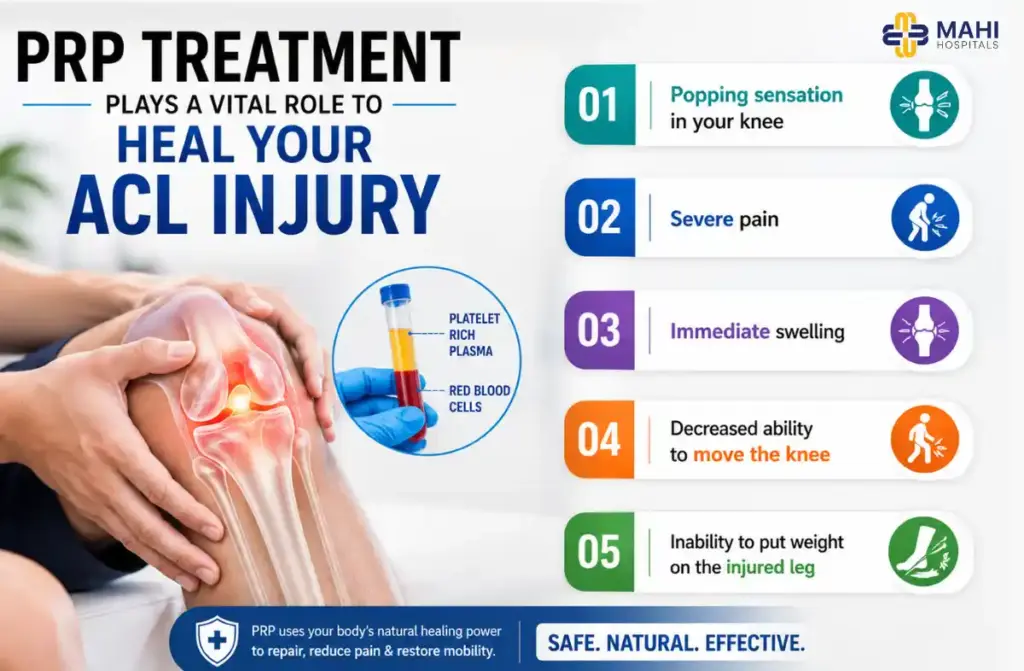
Platelet-Rich Plasma is prepared from a small sample of your own blood. The blood is spun in a centrifuge to concentrate the platelets, which are then re-injected into the arthritic knee.
Platelets are the cells your body sends first to any site of tissue injury; they’re part of the earliest phase of healing, before scar tissue or new growth even begins. PRP is essentially an attempt to deliver a concentrated dose of that early signaling directly to a joint that’s chronically inflamed, in the hope of nudging the local environment toward less inflammation and better tissue health.
Two things are worth being upfront about. First, the evidence base has actually firmed up over the last couple of years. A 2025 meta-analysis of randomized trials found that PRP produced clinically significant improvement in pain and function compared with placebo, and that higher platelet concentrations tended to produce better results .
A separate 2026 systematic review reached a similar conclusion: outcomes tracked closely with the total number of platelets actually delivered in the injection, not just whether PRP was used at all. That’s a meaningful shift from a few years ago, when most reviews described the evidence as weak or inconsistent, largely because preparation methods varied so much between studies. Second, and this hasn’t changed: regardless of preparation method, PRP does not regenerate lost cartilage or correct deformity. If a clinic promises regrowth of cartilage, that’s a claim to be skeptical of.
Who Tends to Benefit
Not everyone with knee arthritis is a good candidate. In our experience, the patients who respond best tend to share a few characteristics, though every case still needs an individual clinical assessment, not a checklist match.
| Patient profile | Why it matters |
| Early to moderate arthritis (roughly Kellgren-Lawrence grade 1 to 3 on X-ray) | Enough joint structure remains for a preservation-focused treatment to have something to work with |
| Symptoms that limit activity but not independence | There’s meaningful room for improvement without needing to reverse severe damage |
| Willingness to commit to rehab alongside the injection | PRP tends to underperform as a standalone treatment; it works better paired with strengthening work |
| Realistic expectations | Patients expecting a cure are more likely to be disappointed than those expecting “better, for a while” |
Imaging alone doesn’t decide this. Two patients with near-identical X-rays can get different recommendations because one is still working full-time on their feet and the other is largely sedentary and in constant pain. Their functional reality differs even if their scans look similar.
When PRP Stops Being Enough
As arthritis advances, the joint changes in ways an injection can’t meaningfully influence: cartilage thins out further, the joint space narrows, bone alignment can shift, and shock absorption during walking declines. At that stage, improving the biology inside the joint doesn’t translate into better movement, because the underlying mechanical problem is now bigger than the biological one.
That’s not a failure of PRP. It’s a sign the disease has moved into a different phase. Patients tend to have more limited response to PRP when they’re dealing with:
- Severe cartilage loss or bone-on-bone contact on imaging
- Noticeable deformity, such as bow-legged or knock-kneed changes from long-standing arthritis
- Persistent pain despite a genuine trial of physiotherapy, medication, and prior injections
- Significant difficulty with basic activities like stairs or extended walking
None of these automatically mean surgery is the only option left, but they’re strong signals that repeating injections is unlikely to change the trajectory.
Signs it’s Time to Talk About Replacement
There’s no single test or scan cutoff that says “now.” It’s a pattern surgeons look for over time: pain that doesn’t respond to appropriate non-surgical treatment, difficulty walking short distances, pain that regularly disrupts sleep, recurring swelling, growing reliance on a cane or walker, and a general shrinking of what you can do independently.
Age isn’t the deciding factor here, and it shouldn’t be. The deciding factor is whether current treatment is still producing meaningful improvement in daily life. If it isn’t, and hasn’t for a while, that’s the conversation worth having, regardless of whether you’re 55 or 75.
Delaying Surgery Isn’t the Same as Avoiding It
These two goals get conflated constantly, and it’s worth separating them clearly:
- Delaying means keeping the knee functional enough that surgery isn’t needed yet. It’s still likely needed eventually.
- Avoiding means the joint genuinely stays workable long-term, and replacement may not come into the picture at all.
Which one is realistic for you depends almost entirely on how much healthy joint structure remains and how the knee has responded to treatment so far. Early arthritis with reasonably preserved joint space has a real shot at avoiding or substantially postponing surgery. Advanced degeneration, even with a strong PRP response initially, is usually in delaying territory rather than avoiding it.
Rehab Matters Either Way
Whichever path you take, the muscles and tendons around the knee still have to do their job. A knee doesn’t function in isolation: quadriceps and hamstring strength, balance, and flexibility all determine how much load the joint itself absorbs day to day.
That’s why rehabilitation isn’t an optional add-on to either PRP or knee replacement. It’s a core part of both. Strengthening, flexibility work, balance training, and a gradual, supervised return to activity apply regardless of which treatment you choose.
Getting the Timing Right
The two most common mistakes patients make are opposite versions of the same error: some rush toward surgery before genuinely exhausting joint-preserving options, and others keep trying “one more injection” for years past the point where it’s realistically helping, delaying a surgery that would have improved their quality of life much sooner.
A proper orthopedic evaluation, clinical exam, imaging, and an honest look at how your knee has responded so far, is what actually answers “am I too early” or “have I waited too long.” Neither question has a good answer without seeing the knee in person.
PRP for Knee Arthritis at MAHI, by Dr. Vijay Kumar Sohanlal Chennai
At MAHI Multispecialty Hospital in Kilpauk, knee arthritis care is led by Dr. Vijay Kumar Sohanlal, a consultant orthopaedic and joint replacement surgeon with close to two decades of clinical practice. He trained in orthopaedics at Sri Ramachandra Medical College after his MBBS from Mysore University, then went on to fellowships in joint replacement in Mumbai, advanced arthroplasty in Germany, and joint replacement and arthroscopy in Australia. Before founding MAHI, he led orthopaedic units at MGM Healthcare, Medway Hospitals, and Fortis Malar, and performed robotic and navigation-assisted joint replacements alongside sports injury and arthroscopic procedures throughout that time.

That background shapes how PRP is used here. Every knee arthritis evaluation starts with the same question: can this knee still be meaningfully preserved, or is another approach going to serve this patient better? That’s assessed through clinical examination, imaging, a review of what’s already been tried, and an honest conversation about what the patient wants to be able to do, in line with the clinic’s stated approach of recommending surgery only when it’s truly indicated, and conservative care wherever it remains a realistic option.
When the joint is at a stage where preservation-focused treatment makes sense, PRP may be offered as part of a broader plan alongside physiotherapy and activity guidance, not as a stand-alone fix. When the arthritis has progressed past that point, patients are told so directly, along with a clear explanation of what knee replacement would involve, including MAHI’s robotic-assisted options, and why it’s likely to serve them better than continued injections.
Conclusion
PRP can be a genuinely useful tool for the right knee at the right stage, improving symptoms enough to hold off surgery for a meaningful stretch of time. It is not a cartilage-regrowing miracle, and it’s not meant to compete with knee replacement; the two exist to solve different problems at different points in the same disease.
The most useful question isn’t “how do I avoid surgery” or “what’s the newest treatment available.” It’s “what does this knee need right now, based on where it actually is.” Getting an honest answer to that, from an in-person evaluation, is what actually protects your mobility and independence over the long run.