Finding the right hospital in a city like Chennai isn’t always straightforward. You might be looking for a place to manage a parent’s diabetes, get a second opinion on a cardiac report, or simply find a hospital close to home that handles everything under one roof so you’re not running between three different clinics every week. That’s exactly what a multispeciality hospital in Chennai is built for — and Chennai has become one of India’s most trusted cities for exactly this kind of comprehensive medical care.
This guide is written for you — someone trying to understand your options, compare hospitals, and make a decision that’s right for your family. Not a list of features. Not marketing language. Just honest, useful information about what to look for, what questions to ask, and what makes one hospital genuinely better than another for your specific situation.
What is a Multispeciality Hospital?
A multispeciality hospital is a medical facility that brings together doctors, specialists, diagnostic services, surgical units, and emergency care across multiple departments — all in one location. Instead of visiting a separate cardiologist’s clinic, a standalone orthopaedic centre, and a diagnostic lab across different parts of the city, you can access all of these services at a single hospital.
The departments typically cover everything from cardiology, neurology, and orthopaedics to gynaecology, paediatrics, oncology, and dermatology — with shared diagnostic infrastructure like radiology, pathology labs, and imaging centres supporting all departments simultaneously.
How it Differs from Single-Speciality Hospitals
Single-speciality hospitals focus on one area — a dedicated eye hospital, a cardiac centre, or a maternity hospital. They can be excellent at what they do, and for straightforward, isolated conditions, they work well.
The difference becomes significant when your health picture is more complex. An elderly patient with knee pain who also has diabetes and a history of cardiac issues, for example, needs an orthopaedic surgeon, an endocrinologist, and a cardiologist to coordinate before any surgical decision is made. At a single-speciality hospital, that coordination happens across different buildings, different appointment systems, and different sets of records — which creates delays, confusion, and sometimes gaps in care.
At a multispeciality hospital, those specialists are on the same team. They share the same patient records, they can walk across a corridor to consult each other, and decisions get made faster and more safely.
Why it Matters for Patients
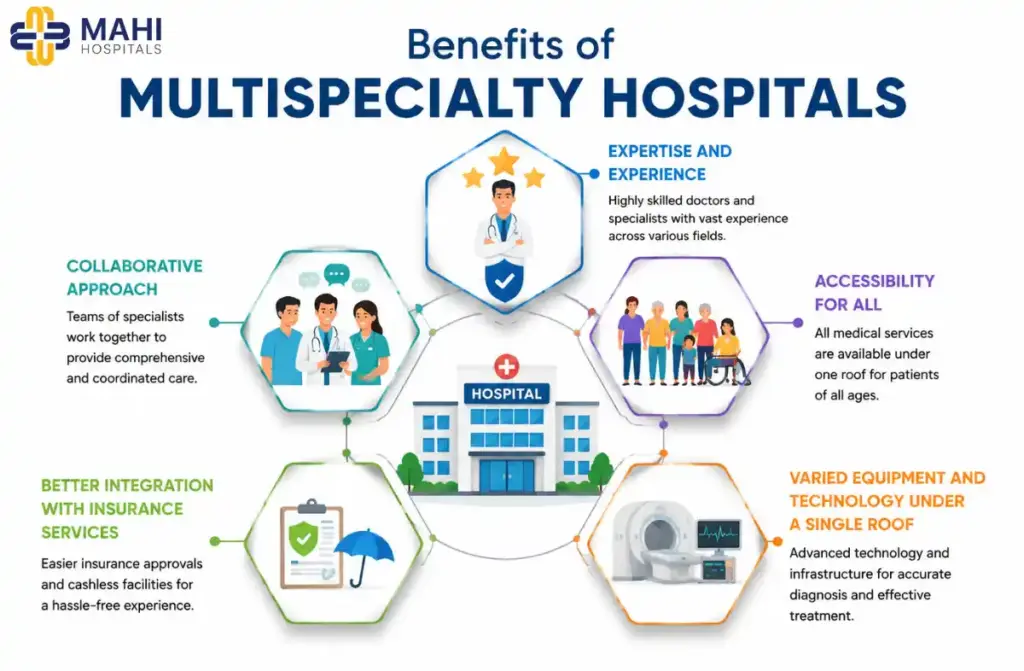
Most people don’t come to a hospital with just one problem. Conditions overlap. Medications interact. A treatment that’s right for one condition might complicate another. When your entire care team works in the same facility with access to your complete medical history, the standard of care is simply higher.
For families with elderly parents or children with chronic conditions, having one hospital you trust for everything — routine checkups, specialist consultations, emergencies, and surgeries — removes an enormous amount of stress from an already difficult situation.
Why Choose a Multispeciality Hospital in Chennai?
Chennai has earned its reputation as one of India’s most important medical destinations — not by accident, but because of decades of investment in healthcare infrastructure, medical education, and specialist talent. Here’s why choosing a multispeciality hospital in Chennai specifically makes sense.

Medical Infrastructure in Chennai
Chennai is home to some of India’s most advanced medical infrastructure. The city has a high concentration of NABH-accredited hospitals, internationally trained specialists, and state-of-the-art diagnostic and surgical equipment. For patients coming from smaller towns in Tamil Nadu, Andhra Pradesh, Puducherry, and beyond, Chennai has historically been the destination for serious medical conditions — and the hospitals here have grown to meet that demand.
The availability of robotic surgery systems, advanced imaging technology, fully equipped ICUs, and blood banks across multiple hospitals in the city means patients have access to the kind of care that would have required international travel just a generation ago.
Availability of Specialists Under One Roof
When you’re dealing with a complex condition — a cancer diagnosis, a complicated pregnancy, a major orthopaedic surgery, a neurological event — you want specialists who can work together, not independently. Chennai’s multispeciality hospitals have built teams where cardiologists, anaesthesiologists, surgeons, and rehabilitation specialists coordinate directly. That team-based approach produces better outcomes, fewer complications, and faster recovery.
For day-to-day needs too — managing a chronic condition, a follow-up after discharge, or a routine health check — having your GP, specialist, and diagnostic lab in one place saves time that most working families simply don’t have.
Cost Advantage vs Travelling Abroad
India’s medical costs are a fraction of what the same procedures cost in the UK, the US, Singapore, or the Gulf — while the quality of care at accredited Chennai hospitals is genuinely comparable. For Non-Resident Indians returning for treatment, or for patients from neighbouring countries like Sri Lanka and the Maldives, Chennai’s multispeciality hospitals offer internationally trained doctors, familiar language support, and cultural comfort at costs that make the travel worthwhile.
For local patients, the consolidated cost of treating multiple conditions at one multispeciality hospital is almost always lower than fragmented care across several clinics — fewer redundant tests, fewer consultations, and faster treatment paths.
Emergency and Critical Care Availability
Emergencies don’t wait for appointments. A hospital that operates 24/7 emergency care with on-call specialists across departments can mean the difference between a full recovery and a permanent disability when time is critical — in cardiac events, strokes, trauma, or sudden-onset conditions. Chennai’s leading multispeciality hospitals maintain dedicated emergency departments, ICUs, and on-call specialist teams around the clock. That round-the-clock availability is something standalone clinics and single-speciality centres simply cannot offer.
Trusted Multispeciality Hospital in Chennai
MAHI Multispeciality Hospitals, Kilpauk
MAHI Multispeciality Hospital in Kilpauk is a growing name in comprehensive hospital care in Chennai, known particularly for its advanced orthopaedic and joint replacement services. The hospital combines specialist-driven care with modern diagnostic and surgical infrastructure in a patient-friendly environment that’s accessible to residents across North and Central Chennai.
- Key Specialities: Orthopaedics and Robotic Joint Replacement, Cardiology, Neurology and Neurosurgery, Obstetrics and Gynaecology, Paediatrics and Neonatology, Gastroenterology, Oncology, Dermatology, Fertility, Nephrology and Urology, Pulmonology, Psychiatry, ENT, Dental and Oral Surgery, Vascular Surgery, Infectious Diseases, Endocrinology, Plastic and Cosmetic Surgery, Podiatric and Diabetic Foot Care, Internal Medicine and Diabetology, Rheumatology, Radiology, Sonology, Anaesthesiology and ICU.
- Location: Kilpauk, Chennai — centrally located with easy access from Chetpet, Aminjikarai, Purasaiwakkam, Egmore, and surrounding areas.
Why They Stand Out MAHI Hospital is one of the few hospitals in Kilpauk offering robotic-assisted knee replacement surgery — a precision-driven procedure that delivers more accurate implant placement, less bone removal, and faster recovery compared to conventional techniques. The hospital’s orthopaedic team, led by Dr. Vijay Kumar Sohanlal with over 18 years of experience, has become a trusted destination for patients dealing with advanced joint conditions. The hospital’s 24/7 emergency care availability and its breadth of specialities make it a practical choice for families looking for one hospital to cover all their healthcare needs.
Key Medical Specialities to Look For
When evaluating a multispeciality hospital, the depth and quality of individual departments matters as much as the overall size of the facility. Here’s what to look for in the specialities that matter most to most families.
- Cardiology: Heart disease is the leading cause of death in India, and Chennai’s patient population reflects that reality. A strong cardiology department should offer both interventional cardiology — procedures like angioplasty and stent placement — and cardiac surgery. Look for hospitals with dedicated cardiac ICUs, 24/7 catheterisation lab access, and experienced interventional cardiologists who handle emergency cases regularly, not just scheduled procedures.
- Orthopaedics: Bone and joint problems affect people across every age group — from sports injuries in younger patients to severe arthritis and fractures in older adults. A capable orthopaedics department should handle everything from fracture management and ligament repairs to complex joint replacement surgeries. Hospitals offering robotic-assisted joint replacement have a meaningful advantage in surgical precision and patient recovery times.
- Neurology and Neurosurgery: Neurological conditions — strokes, epilepsy, Parkinson’s disease, spinal disorders — require both medical management and surgical capability. A strong neurology department needs round-the-clock stroke response, advanced imaging (MRI and CT angiography), and neurosurgeons with experience in both spine and brain procedures. Time is particularly critical in stroke care, making 24/7 availability non-negotiable.
- Oncology: A cancer diagnosis changes everything. The quality of oncology care — the experience of the team, access to chemotherapy, radiation therapy, surgical oncology, and pathology — directly affects treatment outcomes. Hospitals with multidisciplinary tumour boards, where oncologists, surgeons, and radiologists review each case together, generally deliver better-coordinated treatment plans than those where each specialist works independently.
- Obstetrics and Gynaecology: For expectant mothers and women managing gynaecological conditions, the quality of the obstetrics team and the infrastructure supporting high-risk pregnancies matters enormously. Look for hospitals with Level III NICUs for premature or high-risk newborns, experienced maternal-foetal medicine specialists for complicated pregnancies, and a track record in managing conditions like gestational diabetes and preeclampsia safely.
- Paediatrics and Neonatology: Children need more than just smaller doses of adult medicine — paediatric care requires specialists trained specifically in childhood conditions, age-appropriate diagnostic approaches, and facilities designed to put children and parents at ease. A strong paediatrics department should include neonatology for newborn care, a paediatric ICU for critical cases, and specialists in common childhood conditions like respiratory infections, nutritional disorders, and developmental issues.
- Emergency Care: This is the speciality most people don’t think about until they need it. A well-run emergency department has triage systems that identify critical patients quickly, immediate access to imaging and laboratory results, on-call specialists who respond within minutes, and enough beds to handle multiple simultaneous emergencies. When you’re looking at a hospital for your family, ask directly: what is your average response time for cardiac emergencies? Do you have a neurologist available 24/7? These are fair questions, and good hospitals will answer them clearly.
What Makes a Good Multispeciality Hospital?
The difference between a hospital that looks impressive and one that actually delivers good care comes down to a few specific, measurable things.
Accreditations — NABH, JCI, NABL
Accreditations are not just certificates on a wall. They represent a formal, third-party verification that a hospital meets defined standards in patient safety, clinical processes, infection control, and quality management.
NABH (National Accreditation Board for Hospitals) is India’s primary hospital accreditation body. An NABH-accredited hospital has been assessed against hundreds of standards covering everything from medication safety to patient rights. It’s the minimum quality benchmark worth looking for in any hospital.
JCI (Joint Commission International) is the global standard — far more rigorous than NABH and recognised by health systems worldwide. JCI accreditation means the hospital meets international benchmarks in clinical outcomes, patient safety, and operational quality. Very few hospitals in India hold full JCI accreditation.
NABL (National Accreditation Board for Testing and Calibration Laboratories) applies specifically to diagnostic laboratories. An NABL-accredited lab runs accurate, standardised tests — which matters because wrong diagnostic results can lead to wrong treatment.
Technology and Equipment
Advanced surgical and diagnostic technology directly affects what a hospital can offer and how well it can offer it. Robotic surgical systems, high-field MRI machines, digital pathology, minimally invasive laparoscopic equipment, and modern ICU monitoring systems are not luxury additions — they are the tools that enable precise diagnosis and effective treatment. When visiting a hospital, it’s completely reasonable to ask what imaging and surgical technology they have and whether it’s current.
Doctor Experience and Credentials
The most important factor in any clinical outcome is the person performing the procedure. Look for doctors with post-graduate qualifications in their speciality, fellowship training (ideally including international exposure), and a track record of performing the specific procedure you need regularly — not occasionally. A surgeon who performs 200 knee replacements a year will deliver better outcomes than one who performs 20, simply because volume builds the muscle memory and problem-solving instinct that complex surgery requires.
Patient Care and Support Systems
Good medicine delivered poorly still fails patients. Discharge planning, post-operative follow-up, clear communication about medications and recovery, physiotherapy support, dietary counselling, and language accessibility all determine whether a patient’s experience is genuinely helpful or merely clinical. Hospitals that invest in patient support systems — coordinators who help families navigate the system, nurse-to-patient ratios that allow actual attention, and clear written instructions for post-discharge care — produce better long-term outcomes.
Insurance and Billing Support
Healthcare costs cause enormous stress in already difficult situations. Hospitals that work proactively with insurance companies — helping with pre-authorisation, maintaining empanelment with major providers, and providing clear billing breakdowns without hidden charges — make a real practical difference to families. Before choosing a hospital for planned treatment, confirm which insurance providers they are empanelled with and whether someone will actively assist with the claims process.
Types of Doctors Available in a Multispeciality Hospital
We provide comprehensive healthcare services across multiple specialties.
Cardiology and Heart Care Services
We diagnose and treat heart-related conditions such as:
- Heart attacks
- High blood pressure
- Irregular heartbeat
- Preventive cardiac care
Orthopedics and Joint Replacement Care
We provide treatment for:
- Bone fractures
- Arthritis
- Joint pain
- Knee and hip replacement surgeries
Neurology and Neurosurgery Treatments
We manage:
- Stroke treatment
- Brain injuries
- Spine disorders
- Nervous system diseases
Gastroenterology and Digestive Care
We treat digestive and liver-related conditions such as:
- Gastric disorders
- Liver diseases
- Ulcers
- Digestive infections
General Medicine and Preventive Healthcare
We offer routine checkups and preventive care to detect diseases early and maintain overall health.
Patient Care Journey at MAHI Hospitals
We follow a structured and patient-friendly care journey.
- Surgery, Therapy, and Recovery Support: We provide complete post-treatment care including recovery and rehabilitation support.
- Registration and Initial Consultation: Patients are guided through registration and directed to the right specialist.
- Diagnosis and Advanced Testing: We perform detailed tests using modern diagnostic tools for accurate results.
- Personalized Treatment Planning: Doctors create customized treatment plans based on patient condition.
Why Choosing the Right Multispeciality Hospital in Chennai Matters
Choosing the right hospital is one of the most important healthcare decisions for any individual or family. In today’s fast-paced world, medical conditions are becoming more complex, and patients often require care from multiple specialists at the same time.
A best multispeciality hospital in Chennai plays a crucial role in providing integrated healthcare where diagnosis, treatment, surgery, and recovery all happen under one roof. This eliminates the need to visit multiple hospitals or clinics, saving both time and effort during critical situations.
Chennai is one of India’s leading healthcare hubs, offering advanced medical facilities. However, not every hospital provides the same level of expertise, infrastructure, and patient care. That is why selecting a top multispeciality hospital in Chennai becomes extremely important for safe and effective treatment outcomes.
A well-structured multispeciality hospital ensures that patients receive coordinated care, especially in emergency situations where multiple departments must work together quickly.
Importance of Timely and Accurate Medical Care
Timely and accurate medical care is often the difference between life and death in critical situations. Conditions such as heart attacks, strokes, severe infections, or trauma injuries require immediate medical attention.
A well-equipped trusted multispeciality hospital in Chennai ensures that patients receive:
- Immediate diagnosis using advanced medical equipment
- Quick consultation with experienced specialists
- Fast initiation of treatment without delay
- Continuous monitoring of patient condition
When treatment is delayed, even by a few minutes in emergencies, complications can increase significantly. That is why hospitals with emergency readiness and advanced infrastructure are essential for saving lives.
Accurate diagnosis is equally important because wrong or delayed diagnosis can lead to improper treatment, which may worsen the patient’s condition.
Risks of Delayed or Improper Treatment
Delaying treatment or receiving care from an under-equipped facility can lead to serious medical consequences.
Some major risks include:
- Disease progression to a critical stage
- Internal organ damage or failure
- Increased treatment complexity and cost
- Longer recovery time
- Higher risk of complications or mortality
For example, in heart attack cases, even a 10-minute delay can significantly affect survival chances. Similarly, untreated infections or injuries can worsen rapidly.
This is why patients are advised to choose a top multispeciality hospital in Chennai where emergency care, specialists, and advanced equipment are available at all times.
How Multispeciality Hospitals Improve Patient Outcomes
Multispeciality hospitals improve patient outcomes by integrating multiple departments under one system. Instead of treating conditions separately, doctors collaborate to create a combined treatment plan.
This approach ensures:
- Faster decision-making
- Reduced chances of medical errors
- Better coordination between departments
- Holistic treatment for complex conditions
For example, a diabetic patient with heart complications may require both a cardiologist and an endocrinologist. A multispeciality setup ensures both specialists work together for better results.
This integrated care system is one of the key reasons why patients prefer a best multispeciality hospital in Chennai.
Key Procedures Provided by Multispeciality Hospital
The best multispeciality Hospital in Chennai offers a wide range of procedures to address various health issues. Some of the most commonly performed procedures include:
- Robotic Surgery: Minimally invasive surgery for faster recovery.
- Cardiac Bypass Surgery: For patients with heart disease.
- Joint Replacement Surgery: Advanced procedures for treating joint issues.
- Cancer Treatments: Including chemotherapy, radiation therapy, and surgery.
- Neurosurgery: For treating neurological conditions like brain tumors or spinal issues.
These procedures are conducted with the highest standards of care, ensuring the best outcomes for patients
Health Packages Available at MAHI Hospitals
Preventive health checks catch problems before they become serious — and they’re far less expensive than treating a condition that’s been allowed to progress. At MAHI Hospital, health packages are designed for real people at different stages of life, not generic box-ticking exercises.
- Master Health Checkup: A comprehensive evaluation covering the major organ systems — heart, liver, kidneys, thyroid, blood sugar, cholesterol, and blood pressure — along with a full blood count, chest X-ray, ECG, and a physician consultation to interpret the results and advise on next steps. Suitable for adults above 35 who want a clear baseline picture of their overall health.
- Senior Citizen Package: Designed specifically for patients above 60, this package includes all the components of a master health check alongside additional assessments relevant to older adults — bone density evaluation, kidney function monitoring, cardiac stress assessment, vision and hearing screening, and a detailed medication review for those already on long-term prescriptions. The goal is to catch the conditions most common in older age early enough to manage them effectively.
- Well Women Package: A health evaluation built around the specific needs of women — including hormonal health, breast health, bone density, cervical cancer screening, thyroid function, and reproductive health assessments. Recommended annually for women above 30 and particularly important for women with family histories of breast cancer, osteoporosis, or thyroid conditions.
For current package pricing and what each package includes in detail, contact the hospital directly or visit the health packages section on the MAHI Hospitals website.
Conclusion
Choosing a hospital for your family is one of the most important decisions you’ll make — and it’s worth taking the time to get it right. The right multispeciality hospital isn’t necessarily the most famous one or the one with the most beds. It’s the one where the specialists you need are genuinely experienced, the facilities are current, the communication is clear, and the overall system works in your favour rather than against you.
MAHI Multispeciality Hospital in Kilpauk, Chennai offers the breadth of specialities, the surgical technology, and the patient-first approach that families across North and Central Chennai have come to rely on. Whether you’re managing a chronic condition, planning a surgery, or simply looking for a hospital you can trust for your family’s routine and emergency needs — we’re here.
To book a consultation or speak with our team, call +91 91597 11355 or visit mahihospitals.in
Read More: Yoga Asanas for Back Pain.