
Medically reviewed by: Dr. Vijay Kumar Sohanlal, MBBS, MS (Orthopaedics), Orthopaedic and Joint Replacement Surgeon, Founder and Owner, MAHI Multispecialty Hospital, Kilpauk, Chennai
Last medically reviewed: September 2026
Being told that you may need a knee replacement often brings up a very practical question: “What exactly will be put inside my knee?”
It is a completely reasonable concern. A knee replacement implant becomes part of your joint, so naturally you may want to understand what it is made of, how it is chosen, how long it can last and what happens if there is a problem later.
The important thing to know is that there is no single knee replacement implant that is best for everyone. The choice depends on your knee, bone quality, ligament stability, activity level and surgical requirements.
A Knee Replacement is More Than Just an Artificial Knee
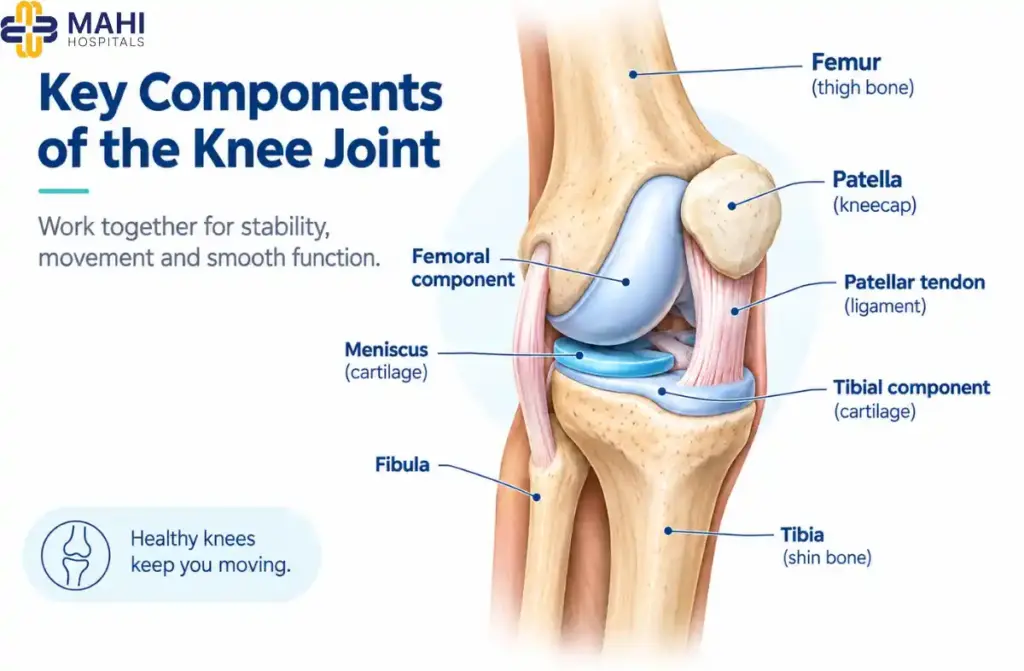
A knee replacement implant is made up of several components that work together to replace damaged joint surfaces and allow smoother movement.
| Component | What it does |
| Femoral component | Covers the damaged end of the thigh bone and provides the new surface that moves against the tibial component. |
| Tibial component | Replaces the damaged upper surface of the shin bone and supports the bearing insert. |
| Polyethylene insert | Sits between the femoral and tibial components and provides a smooth bearing surface. |
| Patellar component | May be used on the underside of the kneecap depending on the patient’s condition and surgical plan. |
The purpose is straightforward: replace the damaged surfaces responsible for pain and loss of function while creating a stable, functional joint.
The implant does not simply replace the entire knee. The surgeon replaces the damaged joint surfaces while preserving healthy bone and soft tissues where appropriate.
Not Every Knee Replacement Implant is the Same
It is natural to start comparing implant brands or materials after hearing that you need a knee replacement.
Knee replacement systems differ in their materials and designs.
- Metal components: The femoral and tibial components are commonly made from medical-grade metal alloys designed for strength and durability.
- Polyethylene bearing: A durable plastic insert provides the smooth bearing surface between the components.
- Fixed-bearing designs: The bearing insert is fixed to the tibial component.
- Mobile-bearing designs: The bearing has some controlled movement within the tibial component.
- Different stability designs: Some implants preserve certain knee ligaments, while others provide additional stability when those structures cannot provide adequate support.
There is no universal winner among these designs. The implant needs to match the patient’s anatomy and the condition of the knee.
The Right Implant is Chosen for the Right Knee
Implant selection is not simply a matter of choosing a particular product.
Your surgeon considers several factors before deciding which implant design and fixation method are appropriate.
- Bone quality: The strength and condition of the bone can influence how the implant is fixed.
- Ligament condition: The knee’s supporting ligaments influence stability and implant design.
- Joint damage: The extent and pattern of cartilage and bone damage help determine the surgical approach.
- Deformity: Significant changes in the knee’s alignment may require a different implant strategy.
- Age and activity: Your activity level and functional expectations are considered alongside your knee’s condition.
- Previous surgery: Earlier procedures can affect available bone and surrounding soft tissues.
How is the Implant Fixed?
Knee replacement components may be fixed to the bone using bone cement or cementless fixation, depending on the implant system and individual circumstances.
The choice can take into account factors such as bone quality, implant design, age and the surgeon’s assessment.
So, two people having knee replacement surgery may receive different implant designs or fixation methods—and that does not mean one received a “better” implant.
It means the treatment was tailored to the individual knee.
The Implant is Only as Good as its Fit
A high-quality implant still needs to be appropriately sized, positioned and balanced within the knee. During surgery, the surgeon works to achieve appropriate alignment and stability while ensuring that the components fit the patient’s anatomy.
Several factors come together:
- Sizing: The components need to be appropriately sized for the patient’s anatomy.
- Positioning: Accurate placement helps the replacement function properly.
- Alignment: The relationship between the implant and the rest of the leg affects knee mechanics.
- Soft-tissue balance: The surrounding ligaments and tissues need to provide appropriate stability through movement.
Modern techniques such as computer navigation or robotic assistance may be used in selected cases to support surgical planning and accuracy. These technologies are tools that assist the surgeon; they do not replace clinical judgement.
The bigger picture is simple:
An implant does not work independently. Its design, size, positioning and relationship with the surrounding knee all contribute to how the replacement functions.
How Long Can a Knee Replacement Implant Last?
One of the first questions patients ask is:
“Will I need another knee replacement later?”
Modern knee replacements can provide long-term function, but no implant comes with a guaranteed lifetime. Longevity varies between individuals.
Several factors can influence how long a replacement continues to function well.
| Factor | Why it matters |
| Activity level | Repetitive high-impact activity can place greater mechanical demands on the replacement. |
| Body weight | Greater loading can increase mechanical stress on the knee. |
| Implant positioning | Appropriate alignment supports better joint mechanics. |
| Bone quality | Healthy bone provides an important foundation for fixation. |
| Muscle strength | Strong supporting muscles help with stability and function. |
| Overall health | Health conditions can influence mobility, recovery and long-term function. |
Rather than thinking of an implant as having an exact expiry date, it is better to understand it as a long-term joint replacement whose durability depends on several factors.
When a Replacement Knee Starts Behaving Differently
Some pain, swelling and stiffness are expected during early recovery.
What deserves attention is a new or increasing problem, particularly after the knee had been functioning well.
Possible causes include:
- Wear: The bearing surface can gradually wear over time.
- Loosening: An implant can sometimes lose secure attachment to the surrounding bone.
- Infection: Infection around a joint replacement requires timely medical evaluation.
- Instability: The knee may feel unreliable or give way.
- Fracture: An injury can cause a fracture around the implant.
- Persistent stiffness or pain: Several conditions can cause these symptoms and need assessment.
One important point is often overlooked:
Pain does not automatically mean that the implant has failed. The cause could involve the implant, bone, surrounding soft tissues, infection or another problem. Clinical examination and appropriate investigations help identify what is actually happening.
Does an Implant Problem Always Mean Another Surgery?
No.
Treatment depends on the cause and severity of the problem. Some symptoms may be managed without replacing the implant. Other problems may require a procedure or revision surgery. When there is significant loosening, substantial wear, infection, instability or another mechanical problem, revision knee replacement may sometimes be necessary.
Revision surgery can be more complex than the first knee replacement because the surgeon may need to work around an existing implant and address factors such as bone loss, scar tissue or changes in the surrounding soft tissues. That is why a painful or unstable knee replacement should be assessed before assuming that another operation is needed.
What Should You Ask Before Choosing an Implant?
You do not need to become an expert in implant technology before your surgery. But understanding why a particular implant is being recommended can make the decision much clearer.
Consider asking your orthopaedic surgeon:
- Why is this implant suitable for my knee?
- What factors influenced the implant choice?
- How will the implant be positioned and fixed?
- What should I realistically expect after recovery?
- Which activities will be appropriate for me?
- What could affect the implant’s long-term function?
These questions are more useful than simply asking for the “best” implant.
The best choice is the one that is appropriate for your knee and your individual circumstances.
The Implant Starts the Journey—Recovery Makes It Functional
Knee replacement surgery addresses the damaged joint surfaces, but recovery does not end when the operation is complete.
The muscles around the knee need to regain strength. Movement needs to improve, swelling needs to settle, and walking and other activities need to be gradually rebuilt.
A structured rehabilitation programme can help with:
- Restoring knee movement
- Improving muscle strength
- Building walking confidence
- Returning to daily activities
- Gradually increasing activity as advised
A useful way to think about it is:
The implant provides the new joint surfaces. Rehabilitation helps you make the most of the new knee.
The Right Implant is the One That Fits the Patient
There is no single knee replacement implant that is automatically right for every patient. Implant design, material, sizing, fixation, positioning and soft-tissue balance all have a role. These decisions need to be considered alongside the condition of the knee, bone quality, ligament stability, activity level and overall health.
Ultimately, a successful knee replacement is not determined by the implant alone. Careful patient assessment, appropriate implant selection, accurate surgery and structured rehabilitation all contribute to the outcome. Understanding these factors can make the decision feel less uncertain.
At MAHI Hospitals, patients can consult Dr. Vijay Kumar Sohanlal, Orthopaedic & Joint Replacement Surgeon, for assessment and guidance regarding knee replacement and joint-replacement concerns.
Read More: Robotic Knee Surgeon in Chennai