
Knee pain often begins quietly. A person may first notice discomfort while climbing stairs, stiffness after sitting for a long time, or difficulty walking the same distance they once managed easily. Initially, these changes seem minor. Many people adjust their routine, reduce activities, and continue hoping the discomfort will settle. But over time, knee arthritis can slowly change the way a person moves, works, exercises, and enjoys daily life.
This is where modern orthopaedic care has evolved. Instead of viewing knee arthritis only as a condition that eventually requires surgery, specialists now focus on understanding the stage of joint damage, controlling inflammation, preserving remaining function, and choosing treatments based on the individual needs of each patient.
PRP treatment for knee arthritis has gained attention as one of these joint-preservation approaches, often discussed alongside other options for arthritis treatment of the knee using Platelet-Rich Plasma.
By using concentrated platelets from a patient’s own blood, PRP injections for knee pain aim to improve the biological environment inside the knee and support the body’s natural healing response. While it is not a cure that can completely reverse arthritis, it may help selected patients reduce pain, improve mobility, and maintain better knee function.
What is PRP Treatment for Knee Arthritis?
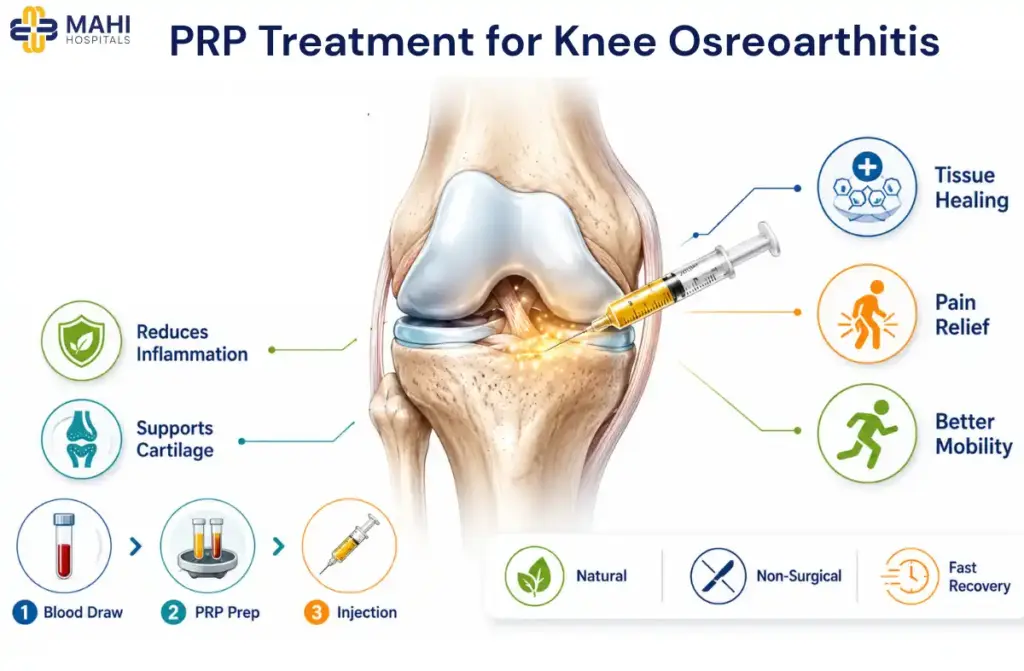
PRP treatment for knee arthritis is a regenerative injection therapy that uses a concentrated preparation of platelets obtained from the patient’s own blood. These platelets release growth factors that may help regulate inflammation, support tissue repair processes, and improve symptoms in suitable patients. Many patients search for PRP injections for knee pain hoping to find a way to manage their symptoms without surgery.
Unlike traditional pain-relieving injections that mainly focus on reducing discomfort, Platelet-Rich Plasma for osteoarthritis aims to influence the internal environment of the joint.
However, realistic expectations are important:
- PRP does not rebuild completely lost cartilage.
- It cannot reverse advanced arthritis where severe structural damage has occurred.
- It is not a replacement for knee replacement surgery when the joint has reached an advanced stage.
Instead, PRP may serve as a valuable option for carefully selected patients who still have meaningful joint preservation potential. Knee Arthritis is More Than “Wear and Tear”
Understanding What Really Happens Inside the Joint
The phrase “wear and tear” often makes knee arthritis sound like a simple mechanical problem — as if the knee is only a machine that becomes old over time.
However, the knee is a complex living structure. It contains cartilage, bone, joint fluid, ligaments, muscles, and delicate tissues that work together to provide smooth movement. When arthritis develops, changes occur throughout this system. This is why two people with the same diagnosis of knee arthritis may experience very different symptoms. One person may have mild discomfort, while another may struggle with everyday activities. The difference often lies in the overall health of the joint environment.
Understanding the Changes Inside an Arthritic Knee
Cartilage Damage
Healthy cartilage acts as the protective surface between the bones of the knee. It allows smooth movement while absorbing pressure during activities such as walking, bending, and climbing stairs. As arthritis progresses, this cartilage gradually becomes affected. The once-smooth surface may become thinner and less resilient, reducing its ability to protect the joint during movement.
Patients may experience this as:
- Pain during weight-bearing activities: Activities like walking longer distances, climbing stairs, or standing for extended periods may place increased stress on the joint.
- Morning or after-rest stiffness: The knee may feel tight or slow to move after periods of inactivity.
- Reduced confidence in movement: Patients often begin avoiding activities because they are uncertain whether pain will appear.
However, cartilage loss alone does not explain the complete arthritis experience. The knee’s response to damage involves several other biological processes.
Inflammation
Many people associate arthritis only with cartilage damage, but inflammation plays a major role in how painful and stiff the knee becomes. When the joint is irritated, inflammatory substances may increase within the knee environment. This can affect how the joint feels and functions.
Inflammation may contribute to:
- Swelling around the knee
- Increased sensitivity to movement
- Stiffness after inactivity
- Fluctuating pain levels from day to day
This explains why some patients experience significant pain even before severe cartilage loss occurs. It also explains why modern treatments increasingly focus not only on the damaged structures but also on improving the biological environment of the joint.
Changes in the Bone and Joint Structure
As cartilage gradually loses its protective role, the underlying bone experiences increased stress. Over time, the body may respond by making structural changes within the joint.
These changes can include:
- Alterations in the bone beneath the cartilage
- Development of bone spurs
- Reduced smooth movement between joint surfaces
As these changes progress, patients may notice that simple activities require more effort and recovery time. A walk that once felt effortless may become something that requires planning.
The Role of Muscles and Movement
The knee does not function alone. Strong muscles around the joint help absorb forces and maintain stability. But when knee pain begins, many people naturally reduce activity.
This creates a cycle:
Pain → Reduced movement → Muscle weakness → Less knee support → More stress on the joint
Breaking this cycle is an important part of arthritis management. This is why treatments such as PRP are often considered alongside:
- Targeted strengthening exercises
- Physiotherapy
- Weight management when appropriate
- Activity modification
The goal is not only to reduce pain but also to restore confidence in movement.
Expert Insight
Knee arthritis is not simply a problem of damaged cartilage. It is a combination of structural changes, inflammation, and functional decline. Treatments that consider the entire joint environment may provide better outcomes than approaches focused only on temporary pain relief.
Why Modern Knee Care is Moving Toward Joint Preservation
For many years, knee arthritis treatment followed a simple progression:
Pain develops → symptoms worsen → surgery becomes necessary.
Today, the approach is more personalised. Modern orthopaedics focuses on a broader question:
“How can we protect knee function for as long as possible while choosing the right treatment at the right time?”
This does not mean avoiding surgery at all costs. Knee replacement remains a highly successful procedure for patients with advanced arthritis. Instead, joint preservation means recognizing that every stage of arthritis requires a different strategy.
A younger patient with early cartilage changes, an active person with moderate arthritis, and an elderly patient with severe joint degeneration may all require completely different treatment plans.
Where Does PRP Fit in the Knee Arthritis Treatment Journey?
PRP occupies an interesting position in modern knee care. It is not the first step for every patient, and it is not the final solution for every stage of arthritis. Instead, PRP injections for knee pain are considered when the goal is to support the knee’s biology while improving symptoms and function.
PRP may be considered for patients who:
- Continue experiencing knee pain despite conservative treatments.
- Have early to moderate arthritis changes.
- Want to explore non-surgical options before considering surgery.
- Have realistic expectations about improvement.
The success of PRP depends heavily on timing, patient selection, and the condition of the knee before treatment.
Can PRP Help Delay Knee Replacement?
This is one of the most common questions behind a PRP consultation. Most patients are not simply looking for pain relief. They want to know whether they can protect their natural knee for longer.
The answer depends on multiple factors, including:
| Factor | Why It Matters |
| Stage of arthritis | Earlier stages usually have more preserved joint structures |
| Cartilage condition | PRP works best when there is still tissue capable of responding |
| Activity level | Strong muscles and healthy movement patterns support better function |
| Overall joint health | Alignment, inflammation, and lifestyle factors influence outcomes |
For suitable patients, PRP may help improve symptoms and maintain function. However, it should be viewed as a joint-supporting treatment, not a guaranteed method to prevent surgery forever.
Expert Insight
The biggest factor in PRP success is not only the treatment itself — it is choosing the right patient at the right stage. Regenerative approaches work best when the goal is supporting a knee that still has healing potential rather than trying to reverse advanced joint destruction.
PRP Treatment for Knee Arthritis
Is PRP Suitable for Every Person With Knee Arthritis?
One of the most important things patients should understand about PRP treatment for knee arthritis is that it is not a universal solution for every arthritic knee. A common misconception is that because PRP uses the body’s own healing factors, it can repair any level of joint damage. In reality, the effectiveness of PRP depends greatly on the condition of the knee before treatment.
The goal of PRP is not to rebuild a completely worn-out joint. Its purpose is to support the biological environment of a knee that still has the ability to respond. This makes patient selection one of the most important parts of successful PRP treatment.
Before recommending PRP, an orthopaedic specialist usually considers:
The stage and pattern of arthritis
- Remaining cartilage quality
- Level of inflammation inside the joint
- Patient’s age and activity goals
- Previous treatments attempted
- Overall knee alignment and function
Understanding PRP Potential Across Different Stages of Knee Arthritis
Knee arthritis does not progress in the same way for everyone. Some patients experience mild symptoms for years, while others develop significant functional limitations in a shorter period.
Understanding where PRP fits in this progression helps create realistic expectations.
| Stage of Knee Arthritis | What Usually Happens Inside the Knee | Role of PRP |
| Early arthritis | Cartilage changes are limited, inflammation may contribute significantly to symptoms | May help improve pain and support joint function when combined with rehabilitation |
| Moderate arthritis | Cartilage damage increases with ongoing discomfort and activity limitations | May provide symptom improvement in selected patients depending on joint condition |
| Advanced arthritis | Significant cartilage loss and structural changes affect joint mechanics | Benefits may be limited when major damage has already occurred |
Early Arthritis
In early arthritis, the knee often still retains considerable functional capacity.
Patients may experience:
- Occasional pain after activity
- Mild stiffness after prolonged sitting
- Discomfort during certain movements
At this stage, the priority is not only reducing current symptoms but also maintaining long-term knee health.
PRP may be considered as part of a broader preservation strategy that includes:
- Muscle strengthening
- Movement correction
- Activity modification
- Healthy lifestyle habits
The aim is to create better conditions for the knee before significant structural deterioration occurs.
Moderate Arthritis
Moderate arthritis is often the stage where many patients begin searching for advanced options.
The symptoms may now interfere with daily routines:
- Walking longer distances becomes uncomfortable.
- Exercise becomes more difficult.
- Stairs may require greater effort.
- Previous activities may need modification.
At this stage, PRP may provide meaningful improvement for some patients, but outcomes depend heavily on the individual knee. A patient with moderate arthritis but good muscle strength and preserved joint space may respond differently compared with someone with similar symptoms but more advanced structural changes. This is why imaging findings alone should not determine treatment decisions.
Advanced Arthritis
When arthritis reaches an advanced stage, the challenge is no longer only inflammation or pain. The structure of the joint itself may have changed significantly. Severe cartilage loss, altered joint mechanics, and bone-related changes can limit how much a regenerative approach can influence the knee.
In such situations, discussing surgical options is not a failure of conservative care — it is about choosing the treatment that provides the best possibility of restoring quality of life.
Why Do PRP Results Differ From One Patient to Another?
Patients often hear success stories about PRP and naturally wonder: “Will it work the same way for me?”
The answer depends on several biological and lifestyle factors. PRP does not create identical results because every knee has a different starting point.
The Remaining Health of the Joint
A knee with preserved cartilage, manageable inflammation, and good movement capacity provides a more favourable environment for PRP.
The treatment works by supporting existing healing potential — not creating new joint structures from nothing.
The Actual Cause Behind the Pain
Two patients may both be diagnosed with knee arthritis but experience pain for different reasons.
For some, pain is strongly influenced by:
- Joint inflammation
- Irritation of surrounding tissues
- Reduced movement tolerance
For others, the dominant problem may be:
- Severe cartilage loss
- Mechanical changes
- Advanced joint degeneration
Understanding the source of pain helps determine whether PRP is likely to provide meaningful benefit.
The Patient’s Role After Treatment
PRP is not a replacement for maintaining a healthy knee.
The injection may support the joint environment, but long-term improvement often depends on what happens afterward.
Patients who combine PRP with appropriate rehabilitation often focus on:
- Building stronger supporting muscles
- Improving flexibility and movement patterns
- Gradually returning to activities
- Reducing unnecessary stress on the knee
The strongest results usually come from combining biological support with functional improvement.
Where Does PRP Stand Among Modern Knee Arthritis Treatments?
Patients often compare treatments as if there is one “best” option.
However, knee arthritis management is not about finding a universal winner.
It is about choosing the treatment that matches:
- The severity of arthritis
- The patient’s goals
- Expected outcomes
- Long-term joint health
| Treatment Approach | Primary Goal | Best Considered When |
| Physiotherapy and exercise | Improve strength, stability, and movement | Throughout most stages of arthritis |
| Medication | Manage pain and inflammation | When symptoms affect daily activities |
| Steroid injection | Provide short-term inflammation control | Pain flare-ups requiring temporary relief |
| Hyaluronic acid injection | Improve joint lubrication and comfort | Selected patients with symptomatic arthritis |
| PRP therapy | Support joint biology and improve symptoms | Suitable early to moderate arthritis cases |
| Knee replacement | Restore function in severely damaged joints | Advanced arthritis affecting quality of life |
PRP vs Steroid Injection
Steroid injections have an established role in managing painful arthritis flare-ups. Their main purpose is to reduce inflammation and provide symptom relief. PRP follows a different philosophy.
Rather than introducing an anti-inflammatory medication, PRP uses concentrated platelets from the patient’s own blood to release biological factors that may influence the joint environment.
The difference can be understood as:
- Steroid injection → Focuses mainly on reducing inflammation and pain
- PRP → Focuses on supporting the biological environment of the joint
The right choice depends on the patient’s condition, expectations, and treatment goals.
Understanding the PRP Treatment Experience
Many patients feel uncertain about what happens during PRP treatment. The process is usually straightforward and personalized. A small amount of blood is collected from the patient and processed to separate the platelet-rich portion. This concentrated plasma contains growth factors that are then injected into the affected knee.
The procedure is generally performed without hospital admission, allowing patients to return home the same day. The most important part of the process is not the injection itself — it is ensuring that PRP is delivered to the right patient at the right stage of arthritis.
What Should Patients Expect After PRP Treatment?
One of the biggest misconceptions about PRP is expecting immediate pain relief. Unlike treatments that temporarily block pain signals, PRP works through biological processes that require time.
Patients may experience:
- Early phase: Some temporary soreness or discomfort may occur after injection.
- Progressive improvement phase: Changes in pain, stiffness, and movement may develop gradually over the following weeks.
- Long-term phase: The goal is better function, improved comfort, and greater confidence in movement.
Results vary because arthritis itself varies from person to person.
Expert Insight
A successful PRP outcome is not always measured by complete elimination of pain. In many patients, meaningful improvement means walking more comfortably, returning to activities, reducing dependence on medications, and improving overall quality of life.
What Happens if Knee Arthritis is Ignored?
Knee arthritis often progresses gradually, which is why many people postpone evaluation until the discomfort becomes difficult to manage. In the beginning, patients may adjust their lifestyle without realizing it. They walk shorter distances, avoid stairs, reduce exercise, or stop activities they once enjoyed.
While these changes may appear harmless, long-term avoidance can create a cycle where both the joint and the person’s confidence in movement gradually decline. When knee arthritis is not addressed appropriately, several changes may occur:
Increasing Loss of Mobility
As pain and stiffness progress, everyday movements can become more challenging. Activities that once required little effort — walking, climbing stairs, sitting and standing — may begin requiring more planning.
Over time, reduced movement can affect:
- Muscle strength around the knee
- Balance and stability
- Overall physical activity levels
The challenge is not only the pain itself, but the gradual loss of freedom that comes with avoiding movement.
Progressive Joint Changes
Arthritis is a progressive condition. As the protective cartilage becomes increasingly damaged, the mechanics of the knee may change.
This can lead to:
- Increased stress on remaining cartilage
- Greater friction within the joint
- Changes in walking patterns
- More persistent discomfort
Early assessment does not mean every patient needs aggressive treatment. It simply creates an opportunity to choose the right approach before limitations become severe.
The Emotional Impact of Chronic Knee Pain
The impact of knee arthritis is often underestimated. Many patients experience frustration because their physical limitations begin affecting their independence. A person may stop playing with grandchildren, avoid travel, reduce social activities, or hesitate to participate in exercise because of fear of worsening pain. This is why modern knee care focuses on more than imaging reports. The goal is to preserve the patient’s ability to live an active and confident life.
PRP Treatment Myths vs Facts
Because PRP has gained popularity, many misconceptions have developed around its benefits. Having realistic expectations is one of the most important parts of making a good treatment decision.
| Common Belief | Reality |
| “PRP can completely cure knee arthritis.” | PRP cannot reverse advanced cartilage loss, but it may help improve symptoms in selected patients. |
| “PRP regrows damaged cartilage completely.” | Current evidence does not support PRP as a complete cartilage replacement therapy. |
| “PRP works the same for everyone.” | Results vary depending on arthritis stage, joint condition, lifestyle, and individual response. |
| “If PRP does not work, nothing else will help.” | Knee arthritis management includes multiple options depending on the patient’s condition. |
| “PRP means surgery can always be avoided.” | PRP may delay progression or improve symptoms in some patients, but advanced arthritis may still require surgical treatment. |
The Future: Moving From Replacement to Preservation
The field of orthopaedics is gradually shifting from a purely damage-control approach toward preservation whenever possible.
This does not mean avoiding knee replacement when it is needed. Knee replacement remains one of the most successful procedures for advanced arthritis.
However, modern care recognises that every knee has a different story.
Some patients may benefit from:
- Early intervention
- Strengthening and rehabilitation
- Injections or regenerative approaches
- Lifestyle optimisation
Others may require surgical solutions to restore function. The most effective treatment is not always the most advanced treatment. It is the treatment that is most appropriate for that individual patient at that particular stage.
What Patients Should Remember About PRP
Timing Matters
PRP is generally more meaningful when used as part of early or moderate-stage arthritis management, where the knee still has the capacity to respond. Waiting until severe structural damage develops may reduce the potential benefits.
PRP Works Best as Part of a Complete Strategy
A successful knee treatment plan rarely depends on one procedure alone. Combining PRP with rehabilitation, muscle strengthening, and healthy movement habits often creates a stronger foundation for long-term improvement.
Realistic Expectations Create Better Outcomes
The goal of PRP treatment for knee arthritis is not to create a brand-new knee. The goal is to help suitable patients experience less pain, improved function, and better confidence in movement.
Meet Your Orthopaedic Specialist for PRP Treatment
Choosing the right specialist matters just as much as choosing the right treatment. At MAHI Hospitals, patients considering PRP treatment for knee arthritis are guided by Dr. Vijay Kumar Sohanlal, an orthopaedic and joint replacement surgeon with decades of experience in advanced knee and joint care, including robotic and navigation-assisted procedures.
Dr. Vijay Kumar Sohanlal evaluates each knee individually before recommending PRP injections for knee pain, considering the stage of arthritis, cartilage condition, and the patient’s activity goals so that treatment decisions remain realistic and personalised. For patients exploring Platelet-Rich Plasma for osteoarthritis or other options for arthritis treatment of the knee using Platelet-Rich Plasma, this individualised assessment is what helps determine whether the knee still has meaningful potential to respond.
Conclusion
Knee arthritis is not only about what appears on an X-ray. It is about how comfortably a person can move through life. For some patients, the biggest fear is not pain itself — it is the possibility of losing independence, activity, and the ability to enjoy everyday moments. PRP treatment for knee arthritis represents a modern approach that focuses on supporting the knee’s natural environment and preserving function when the timing and patient selection are appropriate.
It is not a replacement for every treatment option, and it is not a guaranteed solution for advanced arthritis. But for carefully selected patients, arthritis treatment of the knee using Platelet-Rich Plasma may provide an opportunity to manage symptoms, improve mobility, and continue moving with greater confidence. The best knee treatment is not simply about treating damage. It is about protecting the life built around movement.
Read More: Can PRP Delay Knee Replacement Surgery?