

Medically Reviewed by Dr. Vijay Kumar Sohanlal, MBBS, MS (Orthopaedics), Orthopaedic & Joint Replacement Surgeon, Founder & Owner of MAHI Multispeciality Hospitals, Kilpauk, Chennai
Last medically reviewed: August 2026
If you’re reading this at 11 p.m. with an ice pack on your knee, you’re probably not looking for a marketing pitch. You want clear answers to three important questions: Is this pain serious? Which specialist should I consult? And where can I get reliable orthopedic care nearby?
This guide explains what you need to know about choosing an orthopedic Hospital in Kilpauk, including when joint pain requires medical attention rather than rest, what you can expect during an orthopedic consultation, and how treatment and recovery may vary depending on your condition.
At MAHI Hospitals, located in Vepery near the Kilpauk area, orthopedic care focuses on evaluating the underlying cause of pain and recommending treatment based on the individual patient’s condition. Whether you are dealing with persistent knee pain, joint stiffness, an injury, or difficulty with movement, getting the right assessment can help you understand your treatment options.
We’ll also discuss what the consultation process involves, factors that can influence treatment expenses, and what recovery may look like after an orthopedic procedure. The goal is to provide practical, straightforward information so you can make a more informed decision about your orthopedic care.
Do You Actually Need to See an Orthopedic Doctor?
Most people wait too long before their first ortho visit, mainly because it’s hard to tell the difference between “this will pass” and “this needs attention.” A rough rule that orthopedic surgeons use: if a symptom lasts more than two weeks, gets worse with activity instead of better, or changes how you move, it’s worth an evaluation.
See a doctor sooner rather than later if you notice:
- Knee or hip pain that’s still there after resting overnight, not just during activity
- Swelling that hasn’t gone down within 48 hours of an injury
- A joint that feels unstable, gives way, or locks
- Numbness, tingling, or weakness radiating down an arm or leg, which points to nerve involvement rather than muscle strain
- Difficulty bearing weight after a fall, twist, or accident
- A visible change in how you walk that others have started to notice
None of these automatically mean surgery. Most orthopedic complaints resolve with physiotherapy, medication, or activity modification. But an untreated ligament tear or a slowly worsening arthritic joint tends to get harder to fix the longer it’s left alone, so the honest advice is: get it looked at early, even if it turns out to be nothing.
What a First Visit at MAHI Hospitals Actually Looks Like
There’s a gap between what hospitals promise online and what a patient actually experiences in the room. Here’s the real sequence, so there are no surprises.
Step 1. History and physical exam. Dr. Vijay Kumar Sohanlal or a member of his team spends time understanding when the pain started, what makes it worse, and what you’ve already tried. This isn’t a formality; a large share of orthopedic diagnoses can be narrowed down significantly before any scan is ordered.
Step 2. Imaging, only if needed. Not every visit requires an X ray or MRI on day one. When imaging is warranted, it’s done at the same facility. Digital X ray, MRI, and CT are all available at the Vepery location, so patients aren’t sent elsewhere and asked to return with a disc.
Step 3. A plan, explained in plain language. You’ll be told what the scan actually shows, what the realistic options are, including doing nothing and monitoring, and what each option costs in time and money. If surgery isn’t necessary yet, that’s what you’ll be told, even though a longer treatment plan isn’t always the more profitable one for the hospital.
Step 4. Decision at your pace. Elective procedures like joint replacement are rarely something a patient should decide on the same day. You’re given time to think it over, ask a second opinion elsewhere if you want to, and come back when ready.
The Surgeon Behind the Practice: Dr. Vijay Kumar Sohanlal
Since this is a medical decision, it’s fair to know exactly who you’d be trusting. Dr. Vijay Kumar Sohanlal is an orthopedic and joint replacement surgeon with over 18+ years in practice and more than 10,000 procedures performed, ranging from routine fracture fixation to revision joint replacements, cases where an earlier surgery elsewhere didn’t hold up and had to be corrected.
His caseload skews heavily toward knee and hip replacement using robotic assisted technique, along with arthroscopic (keyhole) surgery for ligament and meniscus injuries, and general trauma care. Revision surgery, fixing a previous, failed implant, is a smaller but telling part of his practice; it’s usually handled by surgeons with deeper experience, since these cases don’t follow a standard playbook.
If you’d like to verify credentials independently before booking, that’s a reasonable thing to do for any medical decision, and we’d encourage it.
Conditions Commonly Treated Here
- Osteoarthritis of the knee, hip, and spine: the gradual wearing down of cartilage that’s the single most common reason people over 45 visit an orthopedic clinic
- Rheumatoid arthritis and other autoimmune joint conditions, managed jointly with rheumatology input where needed
- Ligament and meniscus injuries: ACL tears, PCL tears, and meniscal damage, common in football, badminton, and running injuries
- Fractures, from simple hairline breaks to complex femur and tibia fractures requiring plates or nails
- Frozen shoulder and rotator cuff tears
- Avascular necrosis of the hip, often linked to long term steroid use
- Disc herniation and spinal stenosis, where back pain is actually a nerve compression issue rather than muscular strain
Treatment Options: Surgical and Non Surgical
A responsible orthopedic practice doesn’t default to surgery. Here’s the actual range of options used at MAHI Hospitals, roughly in the order they’re tried:
| Approach | When it’s used |
| Physiotherapy | Used first for most muscular and early joint issues |
| Joint injections (corticosteroid, hyaluronic acid) | Moderate arthritis, to reduce inflammation and improve lubrication |
| PRP (Platelet Rich Plasma) therapy | Tendon and early cartilage damage; results vary by patient and aren’t guaranteed |
| Arthroscopy | Ligament tears and meniscus damage, treated with a minimally invasive approach |
| Fracture fixation | Plates, screws, nails, depending on fracture type |
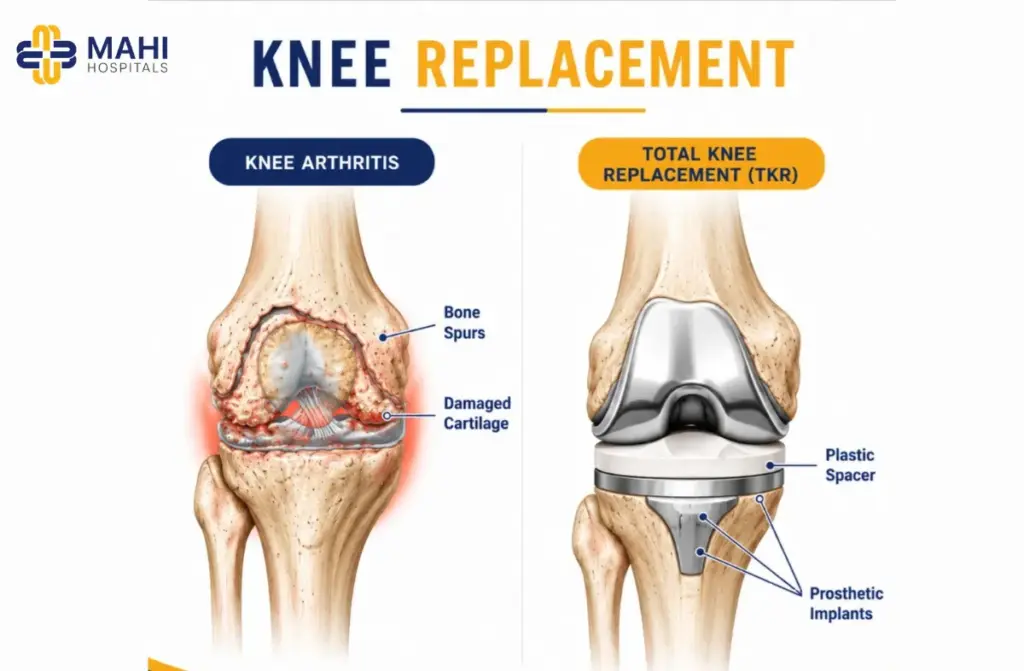
| Robotic assisted joint replacement | Advanced arthritis or joint damage where conservative care hasn’t helped |
A note on PRP and similar regenerative therapies: they help a meaningful subset of patients, particularly with early tendon and cartilage issues, but the evidence base is still developing and results aren’t uniform. Any clinic that promises guaranteed outcomes with these therapies is overselling them, and we’d rather set that expectation correctly upfront.
Meet the Orthopedic Surgeon: Dr. Vijay Kumar Sohanlal
Ask around Kilpauk for a trusted orthopedic name and one comes up again and again:
He is an Orthopedic and Joint Replacement Surgeon with more than 18+ years of clinical experience and over 10,000 surgeries to his name, ranging from routine fracture care to complex revision joint replacement. His practice includes robotic assisted knee and hip replacement, arthroscopy, sports injury management, and orthopedic trauma care.
Experience That Spans Both Ends of the Age Spectrum
Nearly two decades in the operating room means he has treated elderly patients with advanced arthritis and young athletes recovering from ligament tears alike, giving his diagnostic judgment a depth that’s hard to build any other way.
A Surgical Record Measured in the Thousands
More than 10,000 procedures isn’t a number chosen for a brochure. It reflects a surgeon who has refined his technique across thousands of individual cases, each with its own complications and lessons learned.
Focused Expertise in Robotic Assisted Surgery
He is among the more experienced surgeons in Chennai working with computer guided robotic systems for knee and hip replacement, an approach that consistently supports better implant longevity and post surgical comfort.
oss Kilpauk, Chetpet, Aminjikarai, Anna Nagar, and Purasawalkam.
What Robotic Assisted Joint Replacement Actually Adds
Robotic assistance in knee and hip replacement doesn’t replace the surgeon’s skill; it’s a mapping and positioning tool. Before the incision, the system builds a 3D model of the joint, which helps place the implant with tighter tolerances than manual instrumentation alone typically allows. In practice, this has been associated with more consistent implant alignment and, for many patients, a smoother early recovery. It is not a guarantee of a complication free surgery, and not every patient is a candidate. Your surgeon will tell you plainly if robotic assistance isn’t the right fit for your case.
Recovery Timeline: What to Realistically Expect
| Stage | What typically happens |
| Day 1 | Most patients stand and take a few assisted steps within 24 hours of joint replacement |
| Week 1 to 2 | Pain management, wound care, and supervised movement with a walker |
| Week 2 to 6 | Progression from walker to crutches to unaided walking, with increasing physiotherapy intensity |
| Month 2 to 3 | Most patients resume independent daily activity, including stairs |
| Month 3 to 6 | Full functional recovery for the majority of patients; some regain full activity levels sooner, others take longer depending on age, prior fitness, and adherence to physiotherapy |
These figures are averages, not promises. Recovery speed depends heavily on age, weight, prior activity level, and how consistently physiotherapy is followed, a fact that’s often glossed over in hospital marketing but matters a great deal to how your own recovery will actually go.
Cost: What Patients Actually Want to Know
Orthopedic procedures in Chennai vary widely in cost depending on the implant used, the complexity of the case, and whether insurance or cashless treatment applies. Rather than quote a number that may not reflect your specific case, the honest answer is: a detailed cost estimate is only meaningful after a consultation and imaging, since implant type and length of hospital stay are the biggest cost variables. What we can commit to is transparency: you’ll receive an itemized estimate before any procedure, not a surprise bill afterward.
Facilities at the Vepery Location
- Digital diagnostic imaging. Digital X-ray, MRI, and CT scanning are all available on the premises, so a suspected fracture, ligament tear, or degenerated joint can usually be confirmed the same day, rather than a patient carrying a referral slip to an outside diagnostic centre and waiting for a separate appointment.
- Modular operation theatres with laminar airflow. The operating theatres use laminar airflow systems, which continuously filter the air within the theatre to reduce the concentration of airborne particles during surgery. This is a standard infection control measure for joint replacement and other implant based procedures, where a post surgical infection can seriously affect recovery.
- Robotic and navigation assisted surgical systems. For knee, hip, and shoulder procedures, computer guided systems are used to map the joint in three dimensions before the surgeon makes any incision. This supports more precise implant placement and alignment compared with manual instrumentation alone.
- Dedicated physiotherapy unit. A physiotherapy team works with patients starting from the first day after surgery, adjusting exercises as mobility and strength improve, through to full recovery. This continuity means the same team that started rehabilitation in the ward also manages a patient’s outpatient physiotherapy sessions later on.
- Comprehensive intensive and critical care support. Because MAHI Hospitals operates as a multi speciality facility, anaesthesiology and intensive care support are available on site for patients undergoing joint replacement or trauma surgery, particularly relevant for older patients or those with other existing health conditions.
- Round the clock emergency care. Emergency services for fractures, trauma, and acute orthopedic injuries are available 24 hours a day, with the same on site imaging and operation theatre facilities used for planned surgeries.
- Insurance, cashless processing, and multi language support. The hospital’s administrative team handles insurance documentation and cashless treatment processing directly, and multi language assistance is available for patients travelling from outside Tamil Nadu who may be more comfortable in Hindi, English, or another regional language.
What Patients Can Expect From the Care Model at MAHI Hospitals
A few things about how MAHI Hospitals is set up are worth knowing before you book:
- Everything happens at one facility. Imaging, surgery, and physiotherapy all take place at the same Vepery location, so patients move through diagnosis, treatment, and recovery without being redirected elsewhere for scans or rehabilitation.
- Broader specialist support is available on site. MAHI runs 25+ specialities under one roof, including cardiology, anaesthesiology and ICU, and internal medicine. For patients with additional health conditions such as diabetes or heart disease, this means those factors can be managed alongside orthopedic treatment rather than through a separate referral.
- Continuity with a named specialist. Orthopedic care is led by Dr. Vijay Kumar Sohanlal, and dermatology is led separately by Dr. Deepika Lunawat, a gold medalist dermatologist. Patients generally see the same lead doctor through diagnosis, treatment, and follow up.
- Transparent pricing. Cost estimates are itemized before treatment begins, and insurance and cashless processing are handled directly by the hospital’s team.
This setup tends to suit common orthopedic cases well, arthritis, fractures, sports injuries, and elective joint replacement among them. For very high risk trauma requiring a larger intensive care footprint, a bigger tertiary hospital may be the more appropriate setting, and that’s a judgment your doctor can help you make honestly.
Conclusion
No hospital, including this one, is the right fit for every patient every time. What we can promise is a diagnosis that isn’t rushed, a treatment plan that starts with the least invasive reasonable option, and a surgeon who will tell you when surgery isn’t yet necessary, even if that means a longer relationship with physiotherapy before anything else is considered. If that’s the kind of care you’re looking for, we’d be glad to see you.
Read More: Orthopedic Hospital in Chennai.