

Medically reviewed by: Dr. Vijay Kumar Sohanlal, MBBS, MS (Orthopaedics), Orthopaedic and Joint Replacement Surgeon, Founder and Owner, MAHI Multispecialty Hospital, Kilpauk, Chennai
Last medically reviewed: September 2026
Quick Answer
Neither approach wins outright when comparing robotic vs traditional knee replacement. Robotic knee replacement relies on a three dimensional scan and a guided robotic arm to plan and position the implant with tighter precision. Traditional knee replacement, by contrast, depends on manual instruments and the surgeon’s own judgment, and it has delivered excellent, well documented outcomes for over thirty years.
Most published comparisons of robotic vs traditional knee replacement show similar pain relief and function at the one and two year marks. The robotic approach tends to show slightly better implant alignment and, in some studies, a smoother first few weeks. Ultimately, the biggest factor in your outcome in the robotic vs traditional knee replacement debate is still the skill of the surgeon performing the operation, not the machine in the room.
Why This Question Comes Up So Often
Knee arthritis rarely announces itself all at once. It builds slowly through stiff mornings, a knee that aches on stairs, and a walk to the shop that starts taking longer than it used to. Once medication, weight management, and physiotherapy stop giving enough relief, knee replacement becomes the logical next step, and that is usually the moment patients start typing difference between traditional and robotic knee replacement into a search bar at midnight.
Marketing around robotic surgery has made it sound like the obvious upgrade. At the same time, traditional knee replacement is still performed successfully in far greater numbers worldwide and continues to carry decades of long standing safety data behind it. This guide sets both approaches side by side, states plainly where the evidence actually points, and tells you what genuinely changes your outcome more than either technique does.
What Traditional Knee Replacement Actually Involves
Traditional, or conventional, total knee replacement has been the standard treatment for advanced knee arthritis since the 1970s. The surgeon opens the joint, removes the damaged cartilage and bone surfaces using cutting jigs and alignment rods, and positions the implant based on X rays, anatomical landmarks, and years of surgical training.
There is no robotic guidance involved, but that does not make it a lesser procedure. An experienced surgeon working with well proven instruments can achieve highly accurate, reliable results, and this is still the technique used in the overwhelming majority of knee replacements performed in India and globally each year.
What Robotic Knee Replacement Actually Involves
Robotic assisted knee replacement, sometimes shortened to raTKA, is not a robot operating alone. Every cut, every decision, and every step of the surgery is still made by the surgeon. The robotic arm functions as a highly precise extension of the surgeon’s hand, similar to how power steering assists a driver rather than driving the car itself.
Before surgery, a CT scan or other imaging creates a digital three dimensional model of your knee. The surgeon uses that model to plan implant size, position, and alignment in advance. During the operation, the robotic system tracks the knee in real time and keeps the surgeon’s bone cuts within a fraction of a millimetre of the plan, while a screen provides continuous feedback on ligament tension and joint balance.
Robotic vs Traditional Knee Replacement: Side by Side
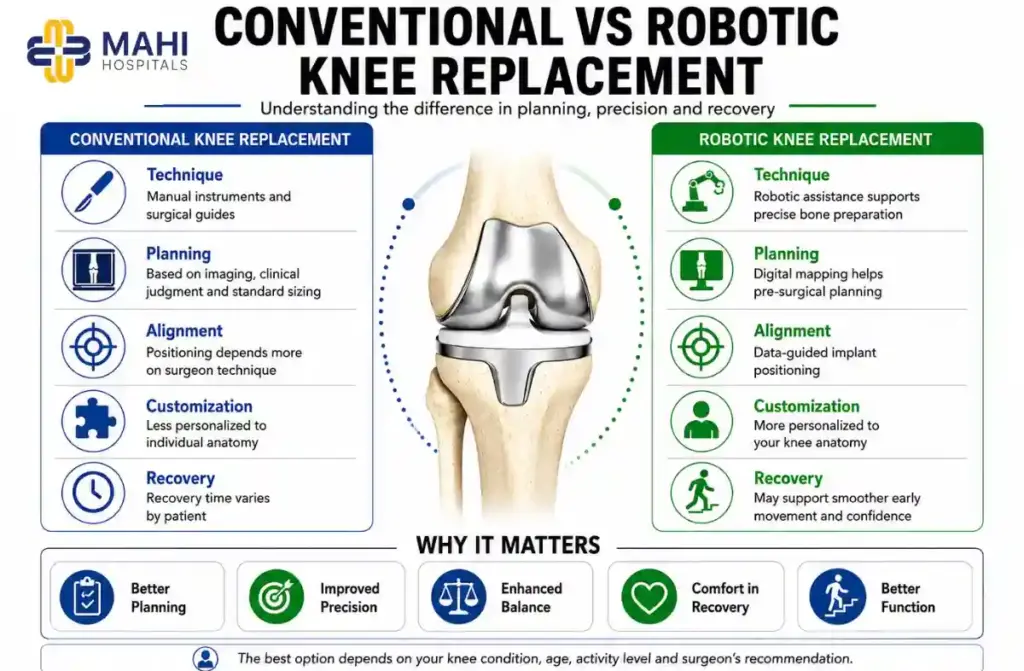
| What Matters | Robotic Knee Replacement | Traditional Knee Replacement |
| Surgical planning | Built from a CT based 3D model of your own knee | Based on X rays and the surgeon’s clinical judgment |
| Implant positioning | Guided by live computer feedback during the cuts | Guided by manual jigs and the surgeon’s experience |
| Soft tissue balancing | Digital readout of ligament tension during surgery | Assessed by feel and clinical experience |
| Track record | Growing, roughly 15 to 20 years of published data | Over 40 years of long term outcome data |
| Typical cost in Chennai | Higher, due to equipment and per case licensing fees | Lower, more widely available across hospital tiers |
| Best suited for | Complex deformity, unusual anatomy, partial replacements | Standard osteoarthritis with typical knee anatomy |
What the Actual Research Shows
It is worth being direct here instead of vague, because vague claims are exactly what erodes trust with both readers and search engines.
A systematic review and meta analysis of randomised controlled trials, covering nearly 2,000 knees, found that robotic assisted replacements achieved measurably better post operative alignment than conventional jig based surgery, while overall range of motion, clinical function scores, and complication rates were statistically similar between the two groups.
In simple terms, robotic assistance appears to improve the accuracy of implant placement, and in some patients that translates into a slightly smoother early recovery. It has not been shown to guarantee better pain relief, better long term function, or a longer lasting implant compared with a well performed traditional replacement. Anyone claiming otherwise without a source is overselling the technology.
Recovery: What to Actually Expect
Recovery timelines are similar for both procedures and depend far more on your rehabilitation effort than on which instruments were used in the operating theatre.
Days 1 to 3. Walking with support begins, usually within 24 hours for both procedures. Pain is managed with medication and ice.
Weeks 1 to 6. Physiotherapy becomes the main driver of progress. Some robotic assisted patients report slightly less early discomfort, likely due to more precise bone cuts and less soft tissue disruption, though this varies by patient.
Months 2 to 3. Most patients in both groups walk without support and resume daily activities.
Months 4 to 6. Near full recovery is typical for both approaches, provided physiotherapy has been consistent.
Cost of Knee Replacement in Chennai
The cost of knee replacement surgery in Chennai can vary depending on several factors, including the type of procedure, implant selected, hospital facilities, surgeon’s expertise, length of hospital stay, and whether one or both knees require surgery. Robotic-assisted procedures may involve additional technology and planning requirements.
Insurance coverage and eligibility for government health schemes may also influence the overall expenses. Patients are advised to discuss their individual requirements with the orthopaedic specialist and request a detailed, itemised estimate covering the surgery, hospitalisation, implant, medications, and rehabilitation or physiotherapy before proceeding.
Common Myths, Corrected
Myth: The robot performs the surgery. Fact: The surgeon controls every cut and decision. The robotic arm cannot move on its own; it only assists within the boundaries the surgeon sets.
Myth: Robotic surgery is always the better choice. Fact: Both procedures are effective. The right choice depends on your knee anatomy, your surgeon’s experience with each technique, and your budget, not on technology alone.
Myth: Traditional knee replacement is outdated. Fact: It remains the most performed and most extensively studied joint replacement technique in the world, with excellent long term survival rates.
Myth: Robotic surgery guarantees a pain free recovery. Fact: Outcomes still depend heavily on implant quality, your general health, and how consistently you follow your physiotherapy plan.
Which One Should You Choose?
There is no single right answer, only the right answer for your knee. As a general guide:
Robotic assisted surgery is often worth discussing if you have significant knee deformity, unusual bone anatomy, a previous knee injury affecting alignment, or if you are a candidate for a partial rather than total knee replacement, where precision matters even more.
Traditional surgery remains an excellent, proven choice if you have typical osteoarthritis with standard anatomy, if cost is a major consideration, or if you simply want the treatment with the longest track record behind it.
The single most reliable predictor of a good outcome in either case is the experience of the surgeon performing it, followed closely by your own commitment to post surgery physiotherapy.
About the Surgeon
Dr Vijay Kumar Sohanlal is a consultant orthopaedic and joint replacement surgeon based in Chennai, with fellowship training in advanced arthroplasty from Germany and in joint replacement and arthroscopy from Australia. He performs both robotic assisted and traditional knee replacement at MAHI Hospitals, and guides patients toward the approach that fits their anatomy and goals rather than defaulting to one technique. Patients considering either procedure can book a consultation for a knee specific evaluation before deciding.
Conclusion
Robotic vs traditional knee replacement is not a contest with one winner. Robotic assisted surgery brings measurable gains in surgical precision, and for certain knees, that precision genuinely matters. Traditional knee replacement brings decades of proven outcomes and remains an excellent, accessible option for the majority of patients with standard arthritis. What decides your result is not the equipment in the operating theatre but the surgeon holding the instruments and your own commitment to recovery afterward. A detailed evaluation with an experienced orthopaedic surgeon remains the only reliable way to know which approach fits your knee.
Read More: PRP Treatment for Knee Arthritis