

Medically Reviewed by Dr. Vijay Kumar Sohanlal, MBBS, MS (Orthopaedics), Orthopaedic & Joint Replacement Surgeon, Founder & Owner of MAHI Multispeciality Hospitals, Kilpauk, Chennai
Last medically reviewed: August 2026
There’s a particular moment a lot of people describe the same way. You’re standing at the bottom of the stairs, and for a second you actually calculate whether it’s worth the pain to go up. Or you skip a family function because you know you’ll have to sit on the floor. If you’ve had that thought recently, you’re not overreacting. That’s your knee telling you something real, and it’s worth taking seriously.
This page is meant to answer the questions people actually ask before they see a knee replacement surgeon in Chennai. Not just what the surgery is, but whether you need it, how long it takes to get your life back, and how to tell a good surgeon from a good sales pitch.
Do You Really Need Knee Replacement Surgery?
This is usually the first question, and it deserves an honest answer rather than a rehearsed one.
Knee replacement is not a first line treatment. It’s what’s recommended after the earlier stages of arthritis management have stopped working. In practice, that usually looks like this: physiotherapy for a stretch of months, anti-inflammatory medication, maybe a steroid or hyaluronic acid injection, and for some patients, PRP therapy. For a lot of people, one or more of these genuinely helps, for a while.
The signal that you’ve moved past the point where these will keep working isn’t one dramatic event. It’s more that the gap between “the injection helped” and “the pain came back” keeps getting shorter, or the medication that used to get you through the day simply stops being enough.
If that’s where you are, surgery isn’t a last resort out of desperation. It’s the option that actually restores function once the joint surface itself is worn down. A cartilage surface that’s gone doesn’t grow back, no matter how good the physiotherapy is.
A straightforward way to check where you stand:
- Pain interrupts your sleep, not just your activity
- You’ve stopped doing something you used to enjoy, like walks, temple visits, or stairs, because of the knee, not because you decided to
- Injections or physiotherapy still help, but the relief window keeps shrinking
- You notice your knee starting to look different, bowing in or out
- Getting up from a chair or the floor now needs your hands
Two or three of these, and it’s worth getting an X-ray and an honest opinion, even if that opinion turns out to be “not yet.”
What Happens Inside Your Knee During Replacement Surgery
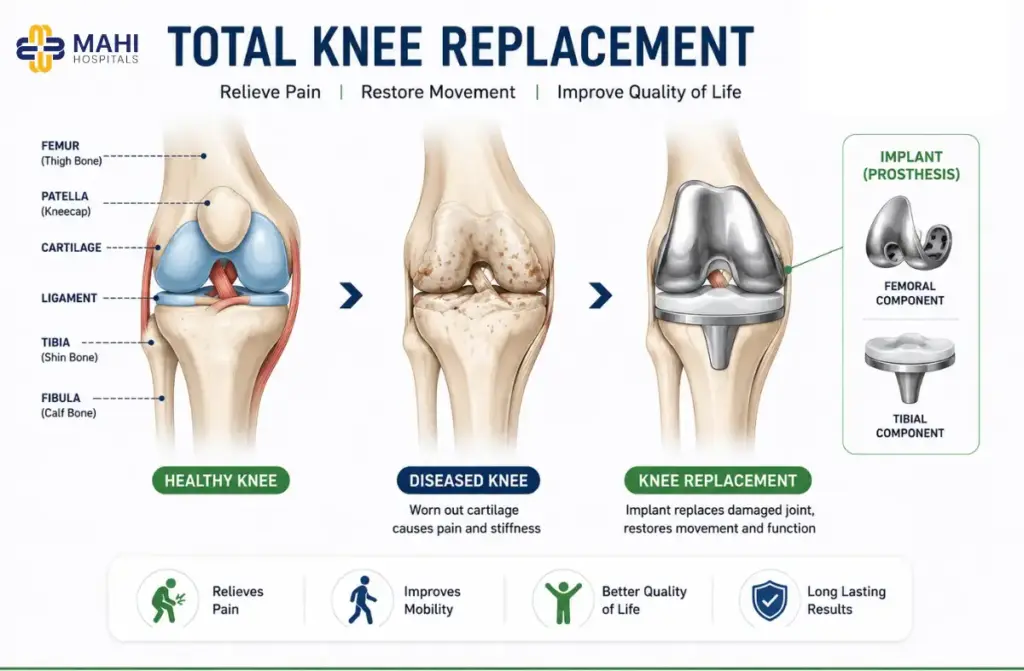
Your knee joint normally has a layer of cartilage that lets the femur and tibia glide against each other without friction. Think of it as the cushioning between two moving bones. Arthritis, an old injury, or straightforward wear and tear over the years wears that cushioning down. Once it’s gone, you get bone moving against bone, and that’s where the grinding pain, swelling, and stiffness come from.
During replacement surgery, the surgeon resurfaces the damaged ends of the bone and caps them with metal and medical grade plastic components engineered to move the way healthy cartilage did. It’s a resurfacing procedure, not an amputation or a full bone replacement. That’s worth knowing, because a lot of first time patients picture something far more drastic than what actually happens.
Modern implants are built to last 15 to 20 years or longer for most patients, and knee replacement remains one of the most extensively studied and commonly performed orthopedic procedures in the world.
Which Type of Knee Replacement Fits Your Case
Not every damaged knee needs the same procedure. This is decided after reviewing your X-rays or MRI, not before.
- Total Knee Replacement (TKR): Both sides of the joint are resurfaced. Used when arthritis has affected the whole joint, which is the most common presentation. Most patients are up with support within a day.
- Partial (Unicompartmental) Knee Replacement: Only the damaged side of the knee is replaced, leaving healthy bone, cartilage, and ligaments untouched. A smaller cut, a quicker recovery, and many patients say the knee feels more like their own afterward.
- Robotic Assisted Knee Replacement: A CT based 3D model of your knee is built before surgery, and the robotic arm helps carry out the plan with very high accuracy during the procedure. It doesn’t replace the surgeon’s judgment. It removes the margin for manual error in positioning.
- Bilateral Knee Replacement: For patients with both knees badly affected. Can be done together or in two staged surgeries, depending on overall health.
- Revision Knee Replacement: For a previous implant that has loosened, worn out, or become infected. Technically more demanding, and best handled by a surgeon with specific revision experience, not just general replacement volume.
Meet Dr. Vijay Kumar Sohanlal, Your Knee Replacement Surgeon in Chennai
Choosing a surgeon for your knee is not a decision you should have to make on faith. Here’s what’s actually on record.
Dr. Vijay Kumar Sohanlal is an orthopedic surgeon based in Chennai with over 18+ years of dedicated practice in joint replacement, and has personally performed more than 10,000 surgeries.
He trained at Sri Ramachandra Medical College for his MS in Orthopedics, then went on to fellowships in joint replacement at Breach Candy and Lilavati Hospital in Mumbai, an advanced arthroplasty fellowship in Germany at St. Josef Bruderkrankenhaus, and a further fellowship in joint replacement and arthroscopy in Australia at Sportsmed Hospital. His earlier roles include Clinical Lead for Robotic Joint Replacement at Medway Group of Hospitals, Senior Joint Replacement Surgeon at MGM Healthcare, and Orthopedic Consultant at Fortis Malar Hospital.

Two international fellowships in joint replacement specifically, not general orthopedics, is genuinely uncommon among surgeons practicing in Chennai, and it’s the kind of detail worth asking about when you’re comparing surgeons.
How to Choose the Right Knee Replacement Surgeon in Chennai
Chennai has no shortage of orthopedic surgeons claiming to be the best. Here’s what to actually check, in order of how much it matters:
- Personal surgery volume, not hospital volume. Ask how many knee replacements this surgeon has personally performed, not the hospital’s combined number.
- Whether they offer robotic or navigation assisted surgery, and how long they’ve been doing it. Precision technology is only as good as the surgeon operating it, but it does reduce alignment error.
- Whether non surgical options are explored first. A surgeon who wants to operate on every knee that walks in isn’t necessarily a good sign.
- Hospital accreditation and infection control record. Ask directly. A credible practice won’t dodge this.
- What happens after discharge. In house physiotherapy under the same team beats being handed off to a random rehab center.
- How clearly they explain the whole treatment plan upfront, so you’re making an informed decision rather than a rushed one.
Signs You Should See a Knee Replacement Surgeon
- Painkillers barely work anymore. If you’re relying on medication just to function, and it’s giving you less relief than it used to, the joint has likely progressed past what medicine can manage.
- Pain that wakes you up at night. Daytime pain with activity is common in arthritis. Night pain at rest is a different signal. It usually means the joint damage has advanced further.
- Swelling that doesn’t fully settle. Occasional swelling after a long day is normal. Swelling that’s basically always there is not.
- Morning or after rest stiffness that takes a while to work through.
- Visible bowing of the leg inward or outward, a sign that arthritis has progressed unevenly across the joint.
- Stairs, longer walks, or getting out of a car have become genuinely difficult, not just uncomfortable.
- Injections and physiotherapy used to help, and now the relief period keeps shrinking.
Knee Conditions That Often Lead to Replacement Surgery
- Osteoarthritis: The most common reason, driven by age, weight, and cumulative wear on the cartilage.
- Rheumatoid Arthritis: An autoimmune condition that inflames and gradually destroys the joint lining.
- Post Traumatic Arthritis: Arthritis that develops faster than usual after a fracture, ligament tear, or old meniscus injury.
- Avascular Necrosis: Loss of blood supply causes bone tissue in the joint to collapse.
- Severe Knee Deformity: Advanced bow leg or knock knee alignment from long standing arthritis.
- Failed Previous Surgery: A prior arthroscopy, osteotomy, or replacement that hasn’t held up and now needs revision.
How Robotic Knee Replacement Improves Your Outcome
Most patients worry about the same three things. Will the implant feel natural? Will it wear out fast? Will recovery drag on forever? All three come down to one variable: how precisely the implant is positioned.
In a robotic procedure, a CT scan is used to build a 3D model of your knee before surgery. The surgeon plans the bone cuts and implant angles on that model in advance. During the actual procedure, the robotic system holds the surgeon to that plan in real time and corrects for any drift beyond the planned path.
Practically, that translates to implants that sit more naturally, less soft tissue disruption (so less swelling and pain early on), and more consistent long term wear characteristics. MAHI Hospitals runs robotic knee replacement as its default standard of care, not an optional upgrade.
Which Treatment Suits Your Stage of Arthritis
| Condition or Severity | Likely Treatment | Surgery Needed | Typical Recovery |
| Early arthritis (Grade 1 to 2) | Physiotherapy and PRP or GFC | No | 2 to 6 weeks |
| Moderate arthritis, persistent pain | Injections and physiotherapy | No | 4 to 8 weeks |
| Single compartment arthritis | Partial Knee Replacement | Yes | 4 to 6 weeks |
| Advanced arthritis (Grade 3 to 4) | Total Knee Replacement | Yes | 6 to 12 weeks |
| Advanced arthritis, precision priority | Robotic Knee Replacement | Yes | 6 to 10 weeks |
| Both knees, severely affected | Bilateral Knee Replacement | Yes | 8 to 14 weeks |
| Failed prior implant | Revision Knee Replacement | Yes | 10 to 16 weeks |
Every recommendation here is made only after a full clinical evaluation. This table is a starting orientation, not a diagnosis.
Knee Replacement vs Knee Arthroscopy: What’s the Difference
A common point of confusion at the first consultation is whether someone needs a replacement or just a knee cleanup.
| Knee Replacement | Arthroscopy | |
| What it does | Resurfaces the damaged joint with implants | Repairs internal structures through keyhole surgery |
| Best suited for | Advanced arthritis (Grade 3 to 4) | Meniscal tears, ACL injury, early cartilage damage |
| Implant involved | Yes | No |
| Hospital stay | 3 to 5 days | Day care |
| Recovery | 6 to 12 weeks | 2 to 6 weeks |
| Durability | 15 to 20 years or longer | Depends on the underlying condition |
If your arthritis is already Grade 3 or beyond with significant cartilage loss, arthroscopy alone won’t hold. It’s simply not designed for that level of joint damage.
Your Recovery Journey, Step by Step
- Consultation and evaluation. A full history, physical exam, and an honest conversation about how the pain is actually affecting your life, not a rushed five minute visit.
- Diagnostic imaging. Digital X-ray, MRI, and CT are all available on site, so you’re not shuttling between centers for scans.
- A personalized treatment plan, built around your age, activity level, bone quality, and what you actually want to get back to doing.
- Pre surgery preparation. Blood work, cardiac clearance, and a physiotherapy and nutrition plan to prepare you before the operating table.
- Surgery day. The procedure typically runs 1.5 to 2 hours. For robotic cases, the pre planned 3D map is verified before the first cut is made.
- Recovery from day one. Most patients stand and take their first assisted steps within 24 hours. Early mobilization isn’t just encouragement. It actively reduces clot risk and kick starts joint function.
- In house physiotherapy, under the same team that operated on you, not a handoff to a separate provider.
- Long term follow up, with checkpoints at 2 weeks, 6 weeks, 3 months, and 6 months to make sure recovery is genuinely on track.
Recovery Timeline at a Glance
| Timeframe | What to Expect |
| Day 1 | Assisted standing, first steps with physiotherapy support |
| Day 3 to 5 | Most patients discharged |
| Week 2 | Noticeable drop in pain and swelling, stitches removed |
| Week 4 to 6 | Walking independently for most daily tasks |
| Month 3 | Stairs, light work, better strength and flexibility |
| Month 6 | Near full recovery, back to preferred activities |
| Year 1 and beyond | Implant fully settled, stable function for 15 to 20 years |
Risks You Should Know Before Surgery
No surgery is risk free, and you deserve a straight answer here rather than a page that only talks about benefits.
Reported complication rates for knee replacement, including infection, blood clots, or implant related issues, are generally low, typically around 1 to 2 percent at experienced centers with proper protocols. Risk is reduced through sterile operation theatre environments with laminar airflow, early mobilization to prevent clots, and structured post operative monitoring. Ask your surgeon directly what their personal infection and revision rates have been. A confident surgeon will have an answer ready.
Why Patients Across Chennai Choose MAHI Hospitals
- Surgery only when it’s genuinely needed, with non surgical options explored first, every time
- Robotic precision as the default, not a paid add-on
- One team from start to finish: consultation, surgery, physiotherapy, and follow up with the same core team
- On site diagnostics, with X-ray, MRI, and CT all available in one place
- In house rehabilitation, not outsourced to a third party
- Clear communication at every stage, so you always know what happens next and why
What Our Patients Say
What Our Patients Say
Real experiences from patients who regained mobility and improved their quality of life with expert orthopedic care.
“I underwent knee replacement surgery last year under Dr. Vijay Kumar Sohanlal, and my experience was excellent. From the initial consultation to post-surgery follow-ups, he was very professional, patient, and reassuring. The surgery went smoothly, and the recovery process was well guided with proper care and support. Before the surgery, I had severe knee pain and difficulty walking, but now I can move comfortably and perform my daily activities with much less pain. Dr. Vijay Kumar Sohanlal explained every step clearly and made me feel confident throughout the treatment. I sincerely thank him and his team for their dedication, expertise, and compassionate care. I would highly recommend Dr. Vijay Kumar Sohanlal to anyone considering knee replacement surgery..”
– subash jain Jain.
“I just wanted to say thanks for the incredible care, patience, and approach you showed by mahi hospital and the doctor with my father. The way dr.vijay sohanlal handled the entire CFRA Procedure without general anesthesia — calming him, explaining each step, and keeping him at ease — was amazing. My father struggles with anxiety, yet you managed everything without letting his BP fluctuate. You gave him comfort and confidence when he needed .wishing good luck for hospital…..as the hospitality higene,supporting doctors.. management.. everything was an great experience. I truly recommend this hospital and the doctor because of its higine and dedication shown by the whole team in the hospital. We’re truly grateful for your compassion and skill. Thank you so much.”
– Deepika Jain.
Conclusion
Knee pain doesn’t have to be something you simply live with. Whether you’re in the early stages of arthritis and unsure if treatment is even necessary, or you’ve been managing severe pain for years and feel ready to act, the right knee replacement surgeon in Chennai can change that story. At MAHI Hospitals, every consultation starts with an honest, thorough evaluation, not a rushed push toward surgery, so you always know exactly where your knee stands and what your real options are.
Read More: Orthopedic Surgeon in Chennai.