

Medically Reviewed by Dr. Vijay Kumar Sohanlal, MBBS, MS (Orthopaedics), Orthopaedic & Joint Replacement Surgeon, Founder & Owner of MAHI Multispeciality Hospitals, Kilpauk, Chennai
Last medically reviewed: August 2026
Every winter, we hear some version of the same worry: “My knees were fine all year, and now suddenly they’re not. Is the cold damaging them?”
The short answer is reassuring. Cold weather almost never causes new joint damage. What it usually does is turn up the volume on something that was already there, quietly, and easy to ignore when the weather was warmer. Once you understand that difference, knee pain in winter stops being something to fear and becomes something you can actually manage.
Quick Answer
Knee pain often feels worse in winter because cold temperatures tend to stiffen joints, tighten surrounding muscles, and make existing conditions like osteoarthritis or old injuries more noticeable. Winter itself rarely causes lasting knee damage. Staying active, strengthening the muscles around the knee, keeping the joint warm, and getting persistent symptoms checked all help. If the pain is new, worsening, or sticking around, that’s worth a proper evaluation rather than waiting it out.
Why Does Winter Make Knee Pain Worse?
The knee is a coordinated system: cartilage, bone, ligaments, tendons, muscle, and joint fluid all working together every time you move. None of that changes chemically because the temperature dropped.
What does change is how the muscles around the knee behave. After a long night’s sleep or hours sitting still in the cold, those muscles tend to stay tighter for longer, which is exactly why the first few steps in the morning can feel stiff and awkward in winter in a way they didn’t in July. That stiffness usually eases once you’re actually moving.
Winter also quietly changes habits. Walks get shorter or skipped. People spend more time indoors, sit longer, move less. None of that sounds dramatic, but a joint that’s used to regular movement doesn’t love the sudden drop-off, and stiffness has room to build.
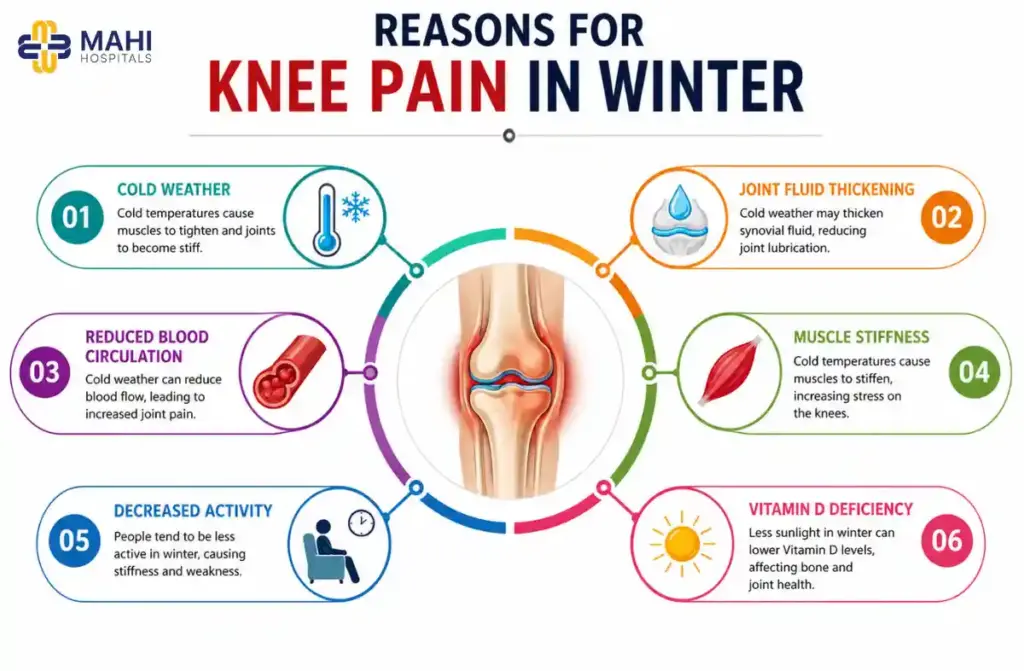
For a knee with no underlying issue, this is mild and temporary. For a knee already dealing with arthritis or an old injury, winter can make symptoms that were easy to shrug off suddenly hard to ignore. The weather isn’t creating a new problem. It’s just making an existing one louder.
Does Cold Weather Actually Cause Arthritis?
No, and this is worth being direct about, because it’s the most common misconception people bring into a winter consultation.
Osteoarthritis develops over years, shaped by age, past injuries, genetics, body weight, and repetitive stress on the joint. A cold morning doesn’t rewrite any of that. What’s actually happening is more mundane: muscles get less flexible in the cold, joints stiffen after inactivity, and most people simply move less in winter. Stack those together and an already-sensitive knee feels worse, even though nothing structural has changed overnight.
This lines up with what larger research bodies have found. The notes that cold temperatures can heighten pain sensitivity and slow circulation without actually worsening joint damage, and a 2023 systematic review of osteoarthritis and weather found only a correlation between colder temperatures and increased pain reporting, not clear evidence that cold accelerates joint degeneration itself. Researchers still note that the weather-pain link isn’t fully settled, and study results have been mixed across the years.
A useful way to hold onto this: winter doesn’t create arthritis. It amplifies symptoms that were already there.
Who Notices Knee Pain in Winter is the Most?
Almost anyone can feel a bit stiff on a cold morning. But some people notice it consistently more than others, and the reason isn’t the season itself. It’s the state of the joint going into winter.
| Group | Why Winter Hits Harder |
| People with osteoarthritis | Existing cartilage wear makes the joint more sensitive to stiffness |
| Those with old knee injuries | Previous ligament tears, meniscus, or cartilage damage tends to respond more to cold |
| Older adults | Muscles and connective tissue naturally lose some flexibility with age |
| People who move less in winter | Reduced activity lets stiffness build up unchecked |
| People carrying excess weight | Added pressure on the knee compounds seasonal stiffness |
Falling into one of these groups doesn’t mean winter has to be painful. It just means your knees are worth a bit more attention during the colder months, not less.
Movement Matters More Than the Temperature
Here’s something orthopedic specialists notice often: the drop in temperature isn’t usually the biggest factor in worsening winter symptoms. The drop in activity is.
When people naturally cut back on walks, skip workouts, and sit more, the muscles that support the knee, mainly around the thighs and hips, gradually weaken. Weaker support muscles mean the knee itself has to absorb more force with every step, climb, and stand-up from a chair.
That’s why a knee that feels stiff and awkward at the start of a walk often loosens up within a few minutes. Movement lubricates the joint, improves circulation, and restores flexibility to the muscles around it. The goal in winter isn’t to protect the knee by resting it. It’s to keep moving, just sensibly.
What Actually Helps
Keep moving, even in the cold
Resting a stiff knee feels like the right instinct, and short rest after an unusual strain is genuinely useful. But prolonged inactivity tends to backfire, since joints depend on regular movement to stay flexible and keep joint fluid circulating properly.
This doesn’t mean pushing through real pain or starting an intense new routine in the middle of winter. A daily walk, some light stretching, or a program your physiotherapist has set up is usually enough. Most people find the first few steps are the hardest and comfort builds from there, which is part of why specialists tend to recommend staying active over resting completely for most chronic knee conditions.
Build strength around the joint
The knee doesn’t work alone. It relies on the thighs, hips, and lower legs to stabilize it and absorb the load from walking, climbing, and standing. When those muscles weaken, and winter inactivity is a common reason they do, the knee ends up carrying more than its share.
Strengthening exercises are one of the more effective long-term tools for managing knee pain, especially with osteoarthritis, precisely because they address one of the actual contributors to the problem rather than just numbing the symptom.
Keep the joint warm
Warmth doesn’t treat arthritis or repair cartilage, but a lot of people genuinely feel better after it, likely because it helps the surrounding muscles relax. Dressing appropriately, warming up before heading outdoors, or using heat therapy your doctor has approved can ease temporary stiffness. Think of warmth as preparation for movement, not a treatment on its own.
Watch your weight
Every step sends load through the knee, and more body weight means more force with each one. Over time that adds up, especially for a knee already dealing with arthritis. Combined with regular exercise and strengthening, maintaining a healthy weight is one of the more practical ways to take pressure off the joint.
Can Winter Knee Pain Be Prevented?
It depends on what’s causing it. If the discomfort is mostly muscle stiffness from reduced movement, staying active through winter usually keeps it in check. If there’s an underlying condition like osteoarthritis or an old injury, some seasonal flare-up may still show up regardless of how careful you are.
In that case, the goal shifts from prevention to management. Strong muscles, consistent activity, a healthy weight, and getting persistent symptoms looked at early all help, and they matter year-round, not just from November to February.
When Winter Knee Pain Needs a Proper Look
A stiff knee on a cold morning that loosens up after a few minutes of walking is normal and rarely worth worrying about. But not every ache is “just the weather,” and sometimes winter is simply the moment an underlying issue becomes hard to ignore.
Get it evaluated if you notice:
- Pain that persists despite rest and basic self-care
- Swelling that keeps coming back or won’t go down
- Difficulty walking, climbing stairs, or standing up from a chair
- A knee that locks, catches, or feels like it might give way
- Pain that’s disrupting your sleep
- Knee pain following a fall, sports injury, or accident
- Redness, warmth, fever, or sudden significant swelling, which needs urgent attention
Catching a problem early tends to keep it from becoming a bigger limitation later.
How Specialists Actually Find the Cause
A good evaluation doesn’t stop at “it’s winter.” It starts with a real conversation: when symptoms began, how they’ve changed, any past injuries, daily habits, and how the pain is affecting everyday life. That’s followed by a physical exam checking movement, stability, strength, swelling, and gait. When needed, X-rays or an MRI fill in the picture of what’s happening to the cartilage, bone, or soft tissue.
All of it points toward the same thing: finding the actual cause, so treatment addresses the problem rather than just the season’s symptoms.
Knee Pain Treatment at MAHI, Chennai
At MAHI, winter knee pain isn’t treated as its own category. It’s treated as a signal, one that might point to early arthritis someone hadn’t noticed yet, an old sports injury resurfacing, or something that needs a closer look regardless of the calendar.
Dr. Vijay Kumar Sohanlal’s evaluation approach combines a clinical exam, imaging when it’s genuinely needed, and a conversation about the patient’s actual goals and daily life, whether that’s getting back to a morning walk without wincing or simply staying independent through the colder months. From there, care might mean a strengthening program, lifestyle changes, non-surgical management, or an advanced procedure such as robotic knee replacement when clinically appropriate.
MAHI’s Hospital own patient testimonials reflect this pattern: one knee replacement patient describes going from “severe knee pain and difficulty walking” before surgery to moving comfortably and managing daily activities with far less pain afterward, under Dr. Vijay Kumar Sohanlal’s care. It’s the kind of outcome that tends to matter most to someone bracing for another difficult winter on a knee that’s already been giving them trouble.
Conclusion
Winter changes how your knees feel far more often than it changes what’s actually wrong with them. For most people, the cold isn’t creating a new problem; it’s making an existing one, whether that’s arthritis, an old injury, or simple muscle stiffness, harder to ignore.
Staying active, building strength around the joint, keeping warm, managing weight, and getting persistent symptoms checked make a real difference through the colder months. The goal isn’t just getting through winter comfortably. It’s protecting your mobility all year, so you can keep walking, staying active, and living independently regardless of the season.
Read More: Robotic Knee Surgeon in Tamil Nadu