
Medically reviewed by: Dr. Vijay Kumar Sohanlal, MBBS, MS (Orthopaedics), Orthopaedic and Joint Replacement Surgeon, Founder and Owner, MAHI Multispecialty Hospital, Kilpauk, Chennai
Last medically reviewed: September 2026
When people think about stronger bones, calcium is usually the first nutrient that comes to mind. But building genuinely strong bones takes more than calcium alone. Protein, vitamin D, magnesium, vitamin K, and several other nutrients all play a role in supporting bone and muscle health.
The encouraging part is that finding the right Indian foods for strong bones doesn’t require an expensive or complicated diet. Many familiar staples, from curd and ragi to dal, leafy vegetables, nuts, eggs, and fish, can contribute meaningful nutrients when included as part of a varied, everyday diet.
The real question isn’t which single food ranks as the “best” among Indian foods for strong bones. It’s how to build everyday meals that consistently give your bones and muscles the nutrition they need to stay strong over time.
Why Bone Health Matters Throughout Life
Your bones are living tissues that continuously change. They provide structure, protect important organs and work with your muscles and joints to support almost every movement you make.
Bone health can be influenced by age, genetics, hormonal changes, physical activity, nutrition, certain medical conditions and some medications. Over time, these factors can affect how quickly bone is formed and how quickly it is lost.
There is also an important relationship between bones and muscles. Strong muscles support stability, movement and balance, while maintaining physical function can help reduce the risk of falls and related fractures, particularly as we age.
The Nutrients Your Bones Need
A bone-friendly diet is not simply a high-calcium diet. Different nutrients contribute to different aspects of bone and muscle health.
| Nutrient | Why it matters | Indian food sources |
| Calcium | Provides an important mineral component of bone | Milk, curd, paneer, ragi, sesame |
| Vitamin D | Helps the body absorb and use calcium | Fatty fish, egg yolk, fortified foods |
| Protein | Supports bone tissue and muscle mass | Dairy, eggs, fish, pulses, soy, nuts |
| Magnesium | Supports bone structure and mineral metabolism | Nuts, seeds, legumes, whole grains, greens |
| Vitamin K | Contributes to normal bone metabolism | Green leafy vegetables |
| Vitamin C | Supports collagen formation | Amla, guava, citrus fruits and vegetables |
You do not need to calculate every nutrient at every meal. What matters more is the overall nutritional pattern across your day and week.
Indian Foods That Can Support Strong Bones
Indian cuisine already offers a wide range of foods that can contribute to bone and muscle health. The key is understanding what each group brings to the table and how easily it fits into everyday eating.
Calcium-rich foods
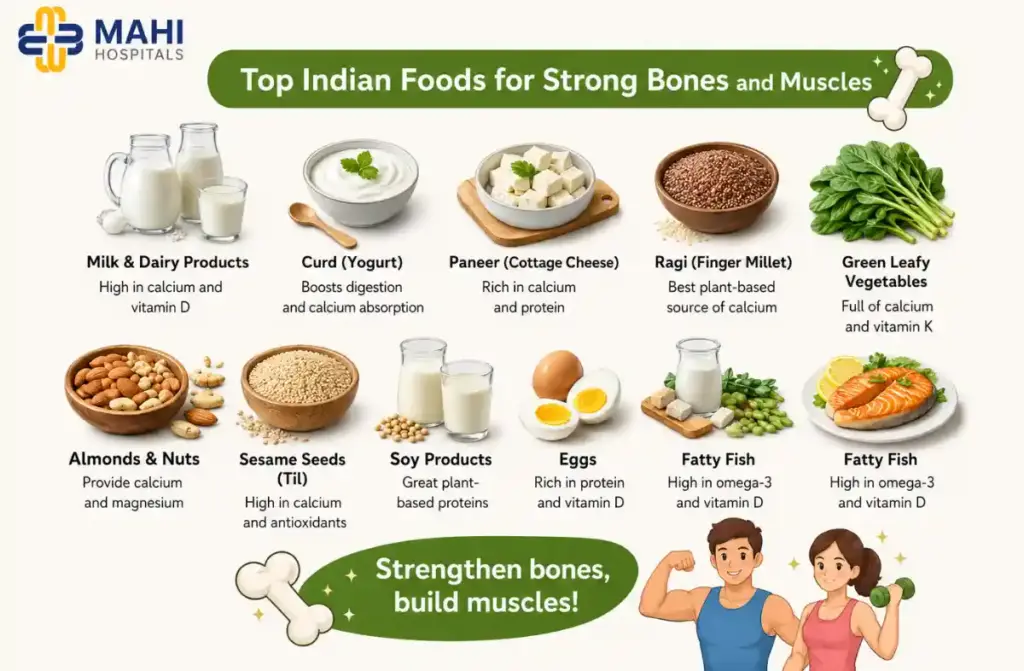
- Milk, curd and paneer: These provide calcium along with protein and are particularly practical because they can be incorporated into familiar meals. Curd with lunch, milk with breakfast or paneer in a meal can all contribute to daily intake.
- Ragi: This traditional finger millet is a useful calcium-containing grain. Ragi dosa, porridge, idli and roti are simple ways to include it without making major changes to your usual diet.
- Sesame seeds (til): Sesame provides calcium along with other minerals and can be incorporated into chutneys, podis and vegetable preparations. It works best as part of the diet rather than as a stand-alone “bone-strengthening” remedy.
Protein-rich foods for bones and muscles
Protein deserves attention because bone health and muscle health are closely connected. Maintaining muscle becomes especially important as we get older.
- Eggs and fish: Both provide high-quality protein, while fish can also provide vitamin D depending on the variety.
- Dal, beans and other pulses: These provide plant-based protein, fibre and minerals and can form a regular part of Indian meals.
- Soy and tofu: These are useful plant-based protein options and can be particularly helpful for people who do not eat meat or prefer to reduce animal-based foods.
- Dairy products: Milk, curd and paneer can conveniently provide both calcium and protein in the same food group.
- Nuts and seeds: Almonds and other nuts and seeds contribute protein, healthy fats and minerals. Because they are energy-dense, sensible portions are more appropriate than simply eating large quantities.
Vegetables and fruits that add nutritional variety
- Green leafy vegetables: Amaranth, drumstick leaves and other local greens can provide vitamin K, magnesium and several other micronutrients that contribute to overall nutritional quality.
- Vitamin C-rich fruits: Amla, guava, oranges and other fruits provide vitamin C, which supports collagen formation and adds nutritional variety to the diet.
- A variety of vegetables: Different vegetables provide different vitamins, minerals and protective plant compounds. Variety across the week is more useful than focusing on one “super vegetable.”
How to Build a Bone-Friendly Indian Plate
Knowing which foods are nutritious is useful. Knowing how to combine them into meals you can actually maintain is even more important.
A simple approach is to include a combination of protein, calcium-rich foods, vegetables or fruits and appropriate whole grains across your meals.
| Meal | Practical combination |
| Breakfast | Ragi dosa with curd, or eggs with a whole-grain option and vegetables |
| Lunch | Rice or roti with dal, vegetables and curd |
| Snack | Fruit with a modest portion of nuts or seeds |
| Dinner | Roti with paneer/tofu and vegetables, or fish with vegetables and grains |
These are examples rather than a fixed diet plan. Your nutritional requirements can change with age, activity level, dietary pattern and existing health conditions.
The goal is not to make every meal perfect. It is to create a pattern that is nutritious, practical and sustainable.
What if You Follow a Vegetarian Diet?
A vegetarian diet can provide many of the nutrients needed for healthy bones when it is well planned.
- For calcium: Dairy products, ragi, sesame and suitable fortified foods can provide useful sources, depending on your dietary preferences.
- For protein: Dal, beans, soy, tofu, dairy, nuts and seeds can be combined across the day to support adequate protein intake.
- For variety: Including different pulses, vegetables, fruits, whole grains, nuts and seeds helps prevent the diet from becoming overly dependent on a small number of foods.
One nutrient that deserves particular attention is vitamin D, because relatively few foods naturally contain substantial amounts. People following vegetarian or vegan diets may need to pay closer attention to their overall nutritional intake.
Vitamin D: The Part of Bone Health That is Easy to Miss
Calcium receives most of the attention, but vitamin D helps the body absorb and use calcium effectively.
Food sources include fatty fish, egg yolk and certain fortified foods. However, dietary sources may not always provide enough vitamin D for an individual.
Sun exposure can contribute to vitamin D production, although the amount produced varies depending on factors such as skin type, season, time of day, clothing and location.
For this reason, supplements should not simply be taken because someone wants stronger bones. If deficiency is suspected or there are risk factors for poor bone health, individual assessment is more appropriate than self-prescribing supplements.
Clinical Insight: Bone health is influenced by the combination of nutrition, physical activity, muscle strength and individual risk factors. Maximising one nutrient cannot compensate for gaps in the bigger picture.
Foods and Habits Worth Limiting
Supporting your bones does not mean following a restrictive diet. It is more useful to look at how often certain foods appear in your routine.
- Highly processed foods: When they regularly replace nutritious whole foods, they can make it harder to maintain a balanced nutrient intake.
- Excessively salty foods: A consistently high-sodium diet is not desirable for overall health, so heavily salted and highly processed foods are better kept in moderation.
- Sugary drinks: They can add substantial sugar without providing the range of nutrients found in more nutritious food and drink choices.
- Excessive alcohol and smoking: Both can negatively affect overall health and are important lifestyle factors to address when protecting long-term bone health.
The emphasis should be on improving the overall dietary pattern, rather than creating a long list of foods you are forbidden to eat.
Strong Bones Need Movement Too
Food provides important building blocks, but nutrition is only one part of maintaining bone health. Bones respond to mechanical loading, while muscles need regular use to maintain strength. Weight-bearing activities and resistance exercises can therefore support both bone and muscle health.
For a healthy adult, activities such as walking and appropriate strength training may be useful. But someone with osteoporosis, a recent fracture, significant joint pain or another musculoskeletal condition may need a more individualized exercise plan. As we age, bone health should also be viewed through the lens of strength, balance and mobility. Protecting these abilities can help people remain independent and physically active.
When Diet Alone May Not Be Enough
This is where general nutrition advice has its limits.
If you have:
- Experienced a fracture after a relatively minor injury, it may be important to investigate whether underlying bone fragility is contributing to the problem.
- Been diagnosed with osteoporosis or osteopenia, dietary improvements are useful but may need to be combined with appropriate medical management.
- Persistent bone or joint pain, assuming that the problem is simply a calcium deficiency can delay identification of the actual cause.
- Repeated falls, reduced mobility or declining strength, a broader assessment may be more useful than changing food choices alone.
Certain medical conditions and medications can also affect bone health. Depending on the individual situation, a healthcare professional may consider medical history, nutritional factors, medications and bone density assessment.
Clinical Pearl: If bone strength is already a concern, the question is not simply “What should I eat?” It is “Why is my bone health affected, and what does my body actually need?”
A More Practical Way to Think About Bone-Healthy Eating
Instead of searching for one food that promises stronger bones, think about your diet as a nutritional pattern. A meal containing curd and ragi contributes differently from one containing dal and vegetables. Adding nuts, seeds, fruits or other nutrient-rich foods throughout the day broadens the range of nutrients available to your body.
The goal is therefore not perfection. It is to consistently make choices that provide:
Calcium + protein + vitamin D + other micronutrients + adequate physical activity.
That approach is much more realistic than trying to eat a particular “bone food” every day.
Conclusion
Strong bones are built through consistent nutrition, movement and attention to the factors that influence bone health—not through a single superfood. A balanced Indian diet can provide many of the nutrients your bones and muscles need. Including calcium-rich foods, adequate protein, vegetables, fruits, whole grains, nuts and seeds creates a strong nutritional foundation, while appropriate physical activity supports strength, mobility and function.
At the same time, diet should not replace medical evaluation when there are signs of an underlying bone problem. Previous fractures, low bone density, persistent pain, reduced mobility or other risk factors deserve proper attention.
At MAHI Hospital, bone and musculoskeletal care is approached with the broader goal of helping patients protect movement, function and quality of life. Understanding what influences bone health is an important part of making informed decisions—not only after a problem appears, but throughout the years that follow.
Because stronger bones are ultimately about more than preventing fractures. They are about preserving your ability to move, stay active and live independently for years to come.
Read More: Robotic knee replacement Surgeon in Kilpauk.