

Medically Reviewed by Dr. Vijay Kumar Sohanlal, MBBS, MS (Orthopaedics), Orthopaedic & Joint Replacement Surgeon, Founder & Owner of MAHI Multispeciality Hospitals, Kilpauk, Chennai
Last medically reviewed: October 2026
Hip pain can gradually affect everyday activities, from walking and climbing stairs to getting out of bed or sitting comfortably. When the discomfort continues despite treatment, it may be time to understand what is happening inside the hip joint and whether further orthopaedic care is needed.
Consulting a hip replacement surgeon in Chennai can help you understand the cause of your symptoms, the extent of joint damage, and the treatment options available. Hip replacement is not necessary for every person with hip pain. The decision depends on the diagnosis, the severity of symptoms, and how much the condition affects daily life.
At MAHI Hospitals, patients can consult Dr. Vijay Kumar Sohanlal for an orthopaedic assessment and discuss appropriate treatment options for hip joint conditions.
When Should You See a Hip Replacement Surgeon?
Hip problems can develop gradually or occur following an injury. Osteoarthritis is one possible cause, although other joint conditions can also produce similar symptoms.
An orthopaedic assessment may be helpful if you experience:
- Persistent pain around the hip, groin, or upper thigh.
- Stiffness that makes it difficult to bend or move the leg.
- Discomfort while walking, standing, or climbing stairs.
- Difficulty getting up from a chair or putting on footwear.
- Reduced walking distance because of hip pain.
- Sleep disturbances caused by ongoing discomfort.
- Limited improvement with previously recommended treatment.
These symptoms do not necessarily mean that you need surgery. A clinical examination helps identify possible causes and determine whether further investigations are required.
Sudden, severe hip pain following a fall or injury, particularly when you cannot put weight on the affected leg, requires urgent medical assessment.
What Should You Consider When Choosing a Hip Replacement Surgeon in Chennai?
Choosing an orthopaedic surgeon involves more than finding someone who performs joint replacement procedures. It is important to understand the surgeon’s qualifications, relevant training, clinical experience, and approach to treatment planning.
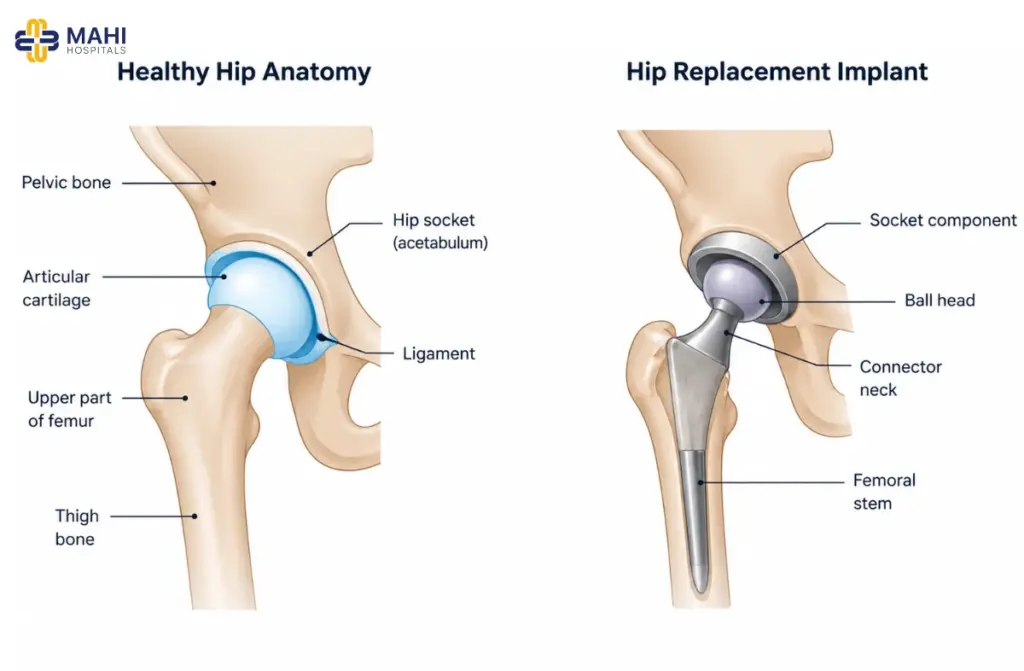
Consider the following factors before making a decision:
Relevant qualifications and training: Check the surgeon’s recognised medical qualifications, postgraduate orthopaedic training, and additional training relevant to hip joint surgery.
Experience with your condition: Hip pain can have different causes. Ask about the surgeon’s experience in assessing and treating your specific diagnosis.
Clear explanations: Your consultation should help you understand the findings, available treatments, expected outcomes, and possible limitations.
Discussion of alternatives: A responsible treatment plan considers suitable non-surgical options before recommending an operation when clinically appropriate.
Hospital and rehabilitation support: Ask about surgical facilities, anaesthesia assessment, postoperative monitoring, physiotherapy, and follow-up arrangements.
You should feel comfortable asking questions and taking time to understand your options. The final decision should be based on your medical needs and an informed discussion with your treating team.
What Are the Treatment Options for Hip Joint Problems?
Treatment depends on the underlying condition, the degree of joint damage, your general health, and how the symptoms affect your activities.
Non-surgical treatment
For some patients, treatment may begin with physiotherapy, appropriate activity modification, walking aids, or medication prescribed by a healthcare professional. These approaches may help manage symptoms and maintain mobility, depending on the diagnosis.
The suitability of each option varies. Medication should be used according to medical advice, particularly if you have other health conditions or take medicines regularly.
Total hip replacement
Total hip replacement may be considered when substantial joint damage causes persistent pain and functional limitations, and appropriate non-surgical treatments have not provided sufficient relief.
During the procedure, the damaged parts of the hip joint are replaced with artificial components. The operation aims to reduce pain and improve joint function, although the results and recovery experience vary between individuals.
The surgeon evaluates factors such as bone condition, joint damage, general health, and mobility before recommending surgery. Potential complications, including infection, blood clots, dislocation, and differences in leg length, should also be discussed before treatment.
Is surgery always necessary?
No. A hip replacement is not the first treatment for every case of hip pain. Some conditions can be managed without an operation, while others may require a different surgical approach.
The appropriate treatment should follow a clinical assessment rather than symptoms or scan findings alone.
What Happens During a Hip Replacement Assessment?
An initial consultation helps establish whether your symptoms are related to the hip joint and which investigations or treatments may be appropriate.
The assessment may include:
- Medical history: The doctor asks about your symptoms, when they started, previous injuries, existing medical conditions, and treatments you have tried.
- Physical examination: Hip movement, discomfort, walking pattern, and functional limitations may be assessed.
- Imaging: X-rays are commonly used to evaluate joint changes. Additional investigations may be recommended when clinically necessary.
- Treatment discussion: The findings help determine whether non-surgical care, further investigation, or a surgical opinion is appropriate.
- Planning, if surgery is indicated: Your general health, medication history, rehabilitation needs, and potential surgical risks are reviewed.
This process helps ensure that treatment recommendations are based on the individual’s condition rather than a standard approach for every patient.
What Should You Expect During Hip Replacement Recovery?
Recovery after hip replacement involves more than healing from the operation. Movement, rehabilitation, pain management, and follow-up care all contribute to the recovery process.
The healthcare team will explain when and how to begin moving the operated leg. Depending on your condition and the surgical plan, physiotherapy may help improve strength, balance, and walking ability. A walker or other walking aid may be needed initially.
Recovery varies according to age, general health, the reason for surgery, and individual progress. Some activities can be resumed earlier than others, and returning to work or driving requires appropriate guidance from your treating team.
Before surgery, discuss the expected hospital stay, rehabilitation arrangements, wound care, follow-up appointments, and warning signs that require medical attention. Following the instructions provided by your healthcare team is important throughout recovery.
Dr. Vijay Kumar Sohanlal – Orthopaedic and Joint Replacement Care in Chennai
Dr. Vijay Kumar Sohanlal is an orthopaedic surgeon associated with MAHI Hospitals, Chennai. His professional profile lists an MBBS from Mysore University and an MS in Orthopaedics from Sri Ramachandra Medical College, Chennai.
His reported professional training includes international fellowship experience in Germany and Australia relating to arthroplasty, joint replacement, and arthroscopy. His previous professional roles include work at Fortis Malar, Medway Hospitals, and MGM Healthcare.
His clinical areas of focus include hip and knee joint replacement, joint reconstruction, robotic-assisted joint replacement, and orthopaedic trauma care.
Patients experiencing persistent hip pain can discuss their symptoms, previous treatment, imaging reports, and difficulties with everyday movement during an orthopaedic consultation. If hip replacement is being considered, the assessment can help clarify whether the procedure may be appropriate and what alternatives are available.
The choice of treatment depends on the patient’s diagnosis, overall health, and individual circumstances. The need for surgery cannot be determined by symptoms alone.
Orthopaedic Consultation at MAHI Hospitals, Vepery, Chennai
MAHI Hospitals is located on Poonamallee High Road in Purasaiwakkam, Chennai. Patients seeking orthopaedic care from Kilpauk and nearby neighbourhoods may enquire about consultation availability with Dr. Vijay Kumar Sohanlal.
During an appointment, you can discuss hip pain, stiffness, reduced mobility, existing scan reports, and previous treatments. If joint replacement is a possible option, the surgeon can explain the assessment process, expected benefits, potential risks, and rehabilitation requirements relevant to your condition.
Hospital details
MAHI Hospitals
No. 118, Poonamallee High Road,
Purasaiwakkam, Chennai – 600084.
Appointment enquiries: +91 91597 11355
Please confirm the doctor’s availability and consultation arrangements with the hospital before visiting.
Read More: Knee Ligament Surgery.