

Medically reviewed by: Dr. Vijay Kumar Sohanlal, MBBS, MS (Orthopaedics), Orthopaedic and Joint Replacement Surgeon, Founder and Owner, MAHI Multispecialty Hospital, Kilpauk, Chennai
Last medically reviewed: September 2026
It often starts with a little shoulder discomfort that seems easy to ignore. Then reaching overhead becomes difficult. Putting on a shirt, combing your hair, fastening a seat belt or sleeping on the affected side may start causing pain.
As the condition progresses, the shoulder can feel increasingly stiff, as though it is slowly losing its normal range of movement. This is where frozen shoulder treatment becomes important. The aim is not simply to reduce pain for a few days. Treatment focuses on controlling symptoms, maintaining or restoring movement, and helping you get back to normal daily activities. The approach can vary from person to person because the frozen shoulder does not behave the same way throughout its course.
The First Goal is Not Always to “Fix” the Stiffness
When the shoulder is very painful, reducing that pain may be the first priority. As the pain settles, stiffness can become the bigger problem, making restoration of movement increasingly important. That is why there is no single treatment that is automatically best for everyone.
Depending on the condition, treatment may include:
- Pain relief: Used when pain is interfering with sleep, daily activities or rehabilitation.
- Physiotherapy and exercises: A structured programme can help maintain and gradually improve shoulder movement.
- Corticosteroid injection: May be considered when pain and inflammation are significantly limiting progress.
- Hydrodilatation: May be considered in selected cases where stiffness remains substantial.
- Procedures or surgery: Considered when significant stiffness continues despite appropriate non-surgical treatment.
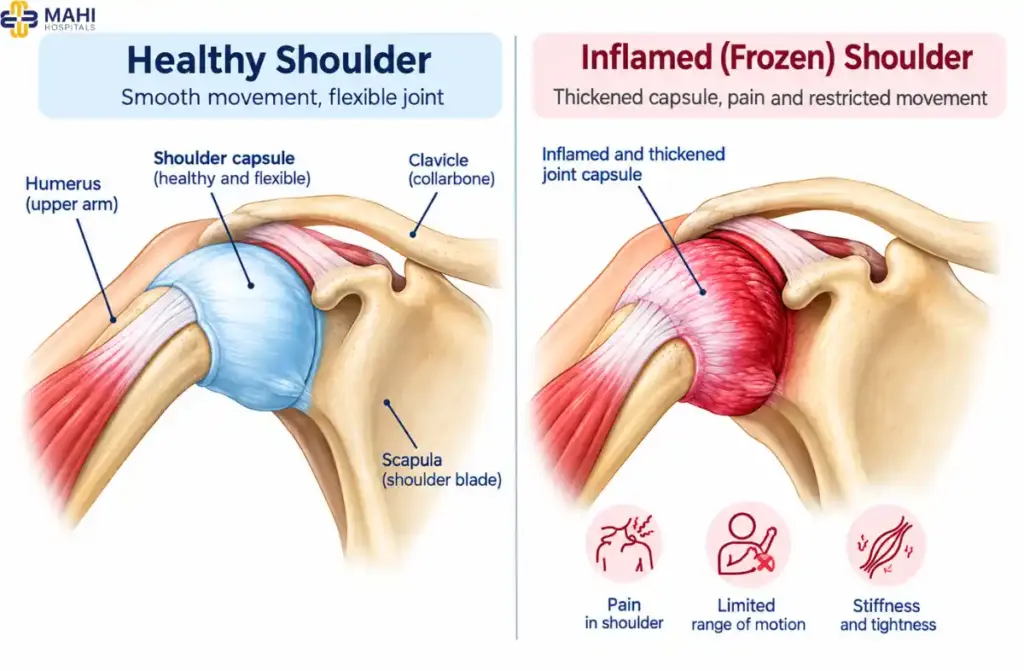
The goal throughout is the same: make the shoulder more comfortable and progressively restore useful movement.
Frozen Shoulder Changes Over Time—and Treatment May Need to Change With It
Frozen shoulder commonly progresses through three phases, although not everyone experiences them in exactly the same way.
| Phase | What You May Notice | Main Treatment Focus |
| Freezing | Pain increases and shoulder movement gradually becomes restricted | Controlling pain and maintaining comfortable movement |
| Frozen | Pain may reduce, but stiffness can become the main limitation | Improving flexibility and range of motion |
| Thawing | Movement gradually starts returning | Restoring strength, mobility and everyday function |
Understanding this progression matters because pain and stiffness do not always peak at the same time. A shoulder that is extremely painful may not tolerate the same exercise intensity as one where stiffness has become the dominant problem. Treatment therefore needs to respond to what the shoulder is doing now, not simply how long ago the symptoms began.
Before Choosing Treatment, Find Out What is Actually Limiting Your Shoulder
Not every painful, stiff shoulder is a frozen shoulder. An orthopaedic assessment can help determine the cause of the symptoms and how severely shoulder movement has been affected.
Several things are considered:
- Pain: Is it occasional, constant or severe enough to disturb sleep?
- Movement: Can you lift your arm, reach behind your back or rotate the shoulder normally?
- Progression: Is the shoulder becoming steadily stiffer, or has movement started improving?
- Daily function: Are dressing, grooming, driving or working becoming difficult?
- Other conditions: Problems such as rotator cuff injuries, arthritis or previous shoulder trauma can produce similar symptoms.
This assessment helps avoid an important mistake: treating every stiff shoulder as though it has the same cause. Once the diagnosis and severity are clearer, treatment can be matched to the actual problem.
The Road Back to Movement Usually Starts Without Surgery
For many people, the first approach to frozen shoulder is conservative treatment. The focus is usually on controlling symptoms while gradually working towards better shoulder movement.
Pain Relief Makes Movement Easier
When pain is significant, appropriate pain-relief measures may make daily activities more manageable and allow rehabilitation to be performed more comfortably.
The exact medication depends on your overall health, other medicines and any conditions that may make certain painkillers unsuitable.
Pain relief, however, is usually one part of treatment rather than the whole solution. A shoulder can hurt less while still remaining significantly stiff, so improvement in pain does not always mean the shoulder has fully recovered.
Physiotherapy Helps the Shoulder Move Again
Physiotherapy and prescribed exercises are an important part of treatment for many people with frozen shoulder. The aim is not to force the shoulder back to normal in a few sessions. Instead, movement is generally progressed according to the person’s pain, stiffness and functional ability.
- Regular practice matters: Consistent exercises are more useful than occasionally pushing the shoulder through an intense workout.
- Exercises need to be appropriate: A programme should take into account the stage and severity of the condition.
- Progress can be slow: A stiff shoulder may take time to respond, and small improvements in daily activities can be meaningful signs of progress.
- The goal is function: The purpose of rehabilitation is ultimately to make movements such as dressing, reaching and grooming easier.
A common misconception is that more pain means a better exercise. It does not. Rehabilitation should be progressive and purposeful rather than based on how much discomfort you can tolerate.
When Pain Becomes the Barrier to Rehabilitation
Sometimes pain itself makes movement and physiotherapy difficult. In selected patients, a corticosteroid injection into the shoulder joint may be considered to reduce pain and inflammation. This can sometimes make movement and rehabilitation more manageable.
An injection is not necessary for everyone. It is better viewed as an additional treatment option when symptoms are significantly limiting progress. The decision should be based on the individual’s examination, symptoms and overall health.
Importantly, reducing pain is not the same as restoring movement. The injection may help create a better window for rehabilitation, while the longer-term goal remains functional recovery.
When the Shoulder Seems to Have Hit a Wall
Some shoulders remain significantly stiff even after initial treatment. In selected cases, hydrodilatation may be considered. The procedure involves introducing fluid into the shoulder joint to stretch the tight joint capsule, with the aim of improving movement.
It may be used alongside other treatments rather than replacing rehabilitation. If progress has slowed, that does not automatically mean that treatment has failed. It may simply mean the shoulder needs reassessment and a different level or combination of treatment.
The Balance Between Resting and Moving Matters More Than it Seems
When movement hurts, avoiding the shoulder completely can feel sensible. But prolonged inactivity can allow stiffness to persist. At the same time, aggressively forcing a painful shoulder is not necessarily helpful.
| Approach | What May Happen | Better Direction |
| Complete prolonged rest | The shoulder may remain increasingly stiff and everyday movement can become harder | Maintain appropriate movement |
| Forcing severe pain | May increase discomfort and make rehabilitation harder to continue | Avoid aggressive, unplanned movements |
| Guided gradual movement | Allows mobility to be worked on progressively | Match exercise to symptoms and recovery |
The aim is not to keep the shoulder completely still, and not to fight through every painful movement. It is to find the right level of movement for the shoulder at that stage of recovery.
What You Do Between Appointments Matters Too
Frozen shoulder treatment is not limited to the consultation room. Small decisions made every day can support recovery.
- Stay consistent with your exercise programme: Improvement may be gradual, so stopping as soon as pain decreases can leave stiffness unresolved.
- Modify difficult activities rather than abandoning movement: Temporary adjustments may make daily tasks easier while allowing comfortable shoulder use to continue.
- Do not copy random exercises from the internet: An exercise suitable for one shoulder problem may not be appropriate for another.
- Give the shoulder time: Recovery can be frustratingly slow, but repeatedly changing approaches because improvement is not immediate may make progress harder to judge.
- Watch for changes: New weakness, a sudden increase in pain or a sudden loss of movement deserves reassessment.
When Progress Slows, It is Time to Reassess—Not Simply Give Up
Not every person improves at the same pace. If the shoulder remains significantly painful or stiff despite appropriate treatment, the next step is usually to review the diagnosis, treatment plan and progress.
Depending on the findings, the approach may be adjusted. This can include changing the rehabilitation programme, considering an injection or hydrodilatation, or discussing further intervention when severe stiffness continues.
The important point is that persistent symptoms do not automatically mean surgery is required. They mean the shoulder needs another look so that the next step is based on what is actually limiting recovery.
For Persistent Stiffness, Further Treatment May Be Considered
Surgery is generally not the starting point for frozen shoulder. However, when substantial stiffness continues to interfere with daily life despite appropriate non-surgical treatment, an orthopaedic specialist may discuss procedural or surgical options.
Two approaches that may be considered in selected cases are:
- Manipulation under anaesthesia: The shoulder is carefully moved while the patient is under anaesthesia to address persistent restriction.
- Arthroscopic capsular release: A minimally invasive procedure used to release tight portions of the shoulder capsule and improve movement.
These options are not appropriate for everyone. The decision depends on the severity of stiffness, previous treatment, overall health, expected benefits and potential risks.
Recovery is Often Measured in Small Wins
One of the most difficult things about frozen shoulder is not knowing exactly when normal movement will return. Recovery varies between individuals, and improvement can be gradual.
You may first notice that you can sleep more comfortably. Then reaching a little higher becomes easier. Later, putting on a shirt or reaching behind your back may no longer require the same effort. These small changes matter. Pain may improve before movement returns fully. So a reduction in pain does not necessarily mean the shoulder has completely recovered. Likewise, slow progress does not automatically mean treatment is failing. The real goal is to see a gradual improvement in pain, movement and everyday function.
When the Shoulder Needs More Than Home Care
Persistent shoulder symptoms deserve attention when they begin interfering with normal life.
Consider an orthopaedic evaluation if:
- Stiffness is progressively increasing: Especially when normal movements are becoming more difficult week by week.
- Pain is disturbing sleep: Persistent night pain can significantly affect recovery and quality of life.
- Daily activities are becoming difficult: Dressing, bathing, grooming, driving or reaching may all be affected.
- Your current treatment is no longer helping: A stalled recovery may require reassessment.
- Sudden weakness develops: Particularly after an injury or alongside a sudden change in shoulder function.
- You are uncertain about the diagnosis: Another shoulder condition may sometimes produce similar symptoms.
Moving Forward With the Right Treatment
Frozen shoulder treatment is not about finding one medicine, one exercise or one procedure that works for everybody. The approach needs to reflect what is happening in the shoulder at that stage—whether pain is the main problem, stiffness has become dominant, or movement has remained restricted despite treatment.
With appropriate assessment and a structured treatment plan, the focus is on reducing discomfort, gradually restoring movement and helping you return to the activities that matter in everyday life.
For people with persistent shoulder pain or restricted movement, an orthopaedic assessment can help identify the underlying problem and guide the next step. At MAHI Hospitals, patients can consult Dr. Vijay Kumar Sohanlal for evaluation and guidance regarding shoulder and joint problems.
Read More: எலும்பு முறிவு குணமடையாததன் அறிகுறிகள்