

Living with severe knee arthritis can slowly take away the freedom to enjoy everyday life. Walking to the nearby store, climbing a flight of stairs, standing for long periods, or even getting a good night’s sleep may become increasingly difficult despite medications, physiotherapy, and lifestyle modifications. When conservative treatments no longer provide adequate relief, knee replacement surgery often becomes the next step toward restoring mobility and improving quality of life.
At this stage, many patients face another important decision: Should I choose robotic knee replacement or traditional knee replacement? This question is often framed as robotic vs traditional Knee Replacement, and the growing popularity of robotic-assisted surgery has created the impression that it is automatically better than conventional techniques. At the same time, traditional knee replacement has been successfully performed for decades and continues to deliver excellent outcomes for millions of people worldwide.
The truth lies somewhere in between. Both procedures share the same goal, replacing the damaged knee joint with an artificial implant that relieves pain and restores movement. The difference lies in how the surgery is planned and performed, the technology involved, and the level of precision achieved during implant placement.
This guide offers an unbiased comparison of robotic and traditional knee replacement, explaining their advantages, limitations, recovery expectations, and the factors that truly influence long-term success. By the end, you’ll have a clearer understanding of which approach may be better suited to your individual needs.
Understanding Knee Replacement Surgery
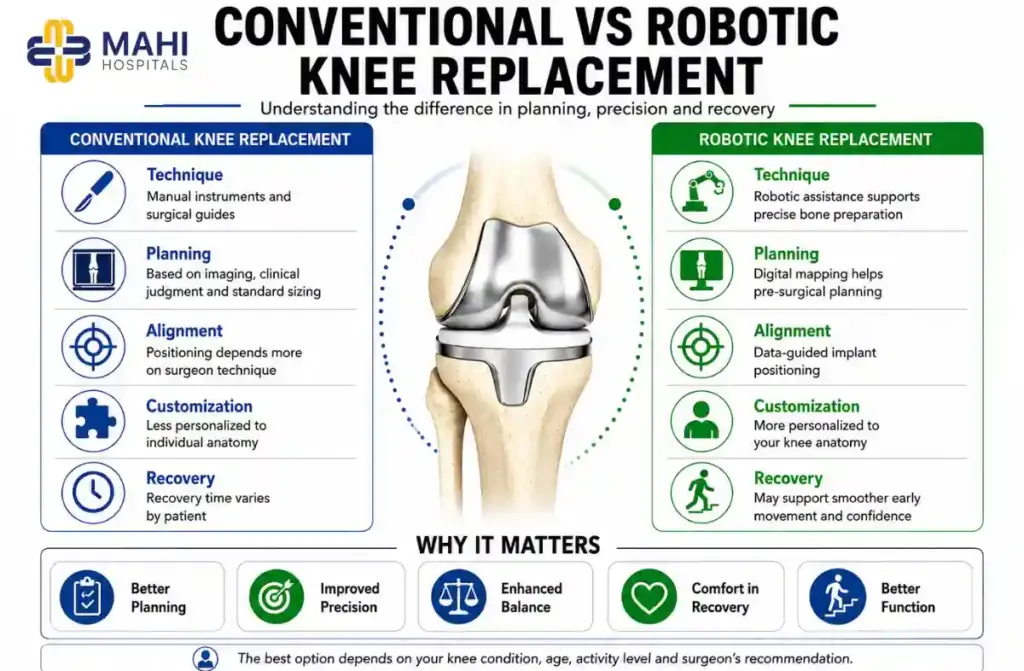
Both robotic and traditional knee replacement are effective surgical options for treating advanced knee arthritis. When comparing Traditional vs Robotic Assisted Knee Replacement Surgery, robotic-assisted surgery uses computer-guided technology to help surgeons plan the procedure with greater precision and optimize implant positioning, while traditional knee replacement relies on the surgeon’s expertise and established surgical techniques. Neither approach is universally superior. The best choice depends on your knee condition, overall health, lifestyle, and the experience of your orthopedic surgeon.
Understanding the Common Goal of Both Procedures
Before comparing robotic and traditional knee replacement, it’s important to understand that both surgeries are designed to achieve the same outcome.
In either procedure, the damaged cartilage and worn surfaces of the knee joint are removed and replaced with artificial components that allow smoother movement. The primary objective is to relieve chronic pain, correct deformity, improve joint function, and help patients return to everyday activities with greater comfort and confidence.
The difference is not what the surgery accomplishes but how the surgeon plans and performs each step of the operation, which is really the core difference between traditional and robotic knee replacement.
Robotic vs Traditional Knee Replacement
The easiest way to understand the Robotic Knee Replacement vs. Regular Knee Replacement debate is by looking at how each procedure approaches surgical planning, implant positioning, and execution.
| Feature | Robotic Knee Replacement | Traditional Knee Replacement |
|---|---|---|
| Surgical planning | Uses advanced imaging and computer-assisted planning | Based on clinical assessment and conventional surgical planning |
| Bone preparation | Assisted by robotic technology for high precision | Performed manually using specialized surgical instruments |
| Implant positioning | Real-time computer guidance helps optimize alignment | Depends on the surgeon’s expertise and manual technique |
| Soft tissue balancing | Digital feedback assists intraoperative adjustments | Achieved through the surgeon’s clinical judgment |
| Technology | Robot-assisted under surgeon control | Conventional surgical approach |
| Clinical success | Excellent outcomes in appropriate patients | Proven long-term success over several decades |
Although these differences may appear significant, they represent only one part of the overall picture. Understanding how each procedure works provides better insight into when one approach may offer additional advantages.
What is Robotic Knee Replacement?
Robotic knee replacement is an advanced form of joint replacement surgery that combines the expertise of an orthopedic surgeon with computer-assisted technology. Despite its name, the surgery is not performed by a robot independently. Every step of the procedure remains under the complete control of the surgeon, while the robotic system provides detailed planning, real-time guidance, and enhanced precision during surgery.
Before the operation begins, specialized imaging is used to create a three-dimensional model of the patient’s knee. This digital model allows the surgeon to study the individual’s anatomy in detail, determine the ideal implant size and position, and develop a personalized surgical plan even before entering the operating room.
During the procedure, the robotic system continuously provides feedback, helping the surgeon make highly accurate bone cuts while preserving as much healthy bone and surrounding soft tissue as possible. This is often the clearest illustration of the difference between traditional and robotic knee replacement techniques.
Why Robotic Assistance Matters
Rather than replacing surgical expertise, robotic technology enhances it by improving consistency and precision throughout the operation.
- Personalized surgical planning allows every procedure to be tailored to the patient’s unique anatomy instead of relying on a one-size-fits-all approach. This individualized planning helps optimize implant positioning and may contribute to more natural joint movement after surgery.
- Greater surgical precision enables the surgeon to remove only the amount of bone required while maintaining better alignment of the implant. Accurate implant placement can improve joint mechanics and may reduce uneven wear over time.
- Real-time intraoperative guidance provides continuous feedback throughout the procedure, allowing small adjustments to be made whenever necessary. This additional layer of information helps the surgeon achieve the planned alignment with greater confidence.
- Improved soft tissue balancing supports smoother knee movement by ensuring that ligaments surrounding the joint are appropriately tensioned. Balanced soft tissues often contribute to better stability and a more comfortable range of motion during recovery.
Expert Insight
Robotic technology functions as an advanced surgical navigation system. It enhances planning and precision, but every critical decision, from implant selection to surgical execution, remains entirely in the hands of the orthopedic surgeon.
What is Traditional Knee Replacement?
Traditional knee replacement has been the gold standard for treating advanced knee arthritis for several decades. It is one of the most thoroughly studied orthopedic procedures, with millions of successful surgeries performed worldwide and long-term clinical outcomes that continue to demonstrate excellent pain relief and functional improvement.
In this approach, the surgeon removes the damaged portions of the knee joint using specialized surgical instruments and carefully positions the artificial implant based on anatomical landmarks, clinical experience, and well-established surgical principles.
Although robotic technology is not involved, traditional knee replacement remains a highly precise procedure when performed by an experienced orthopedic surgeon, and it continues to hold its own in any honest Robotic vs Traditional Knee Replacement comparison.
Why Traditional Knee Replacement Continues to Be Trusted
Its greatest strength lies in the combination of surgical expertise, proven techniques, and decades of clinical evidence.
- Extensive long-term success makes traditional knee replacement one of the most reliable orthopedic procedures available today. Numerous studies have demonstrated excellent implant survival and significant improvements in pain, mobility, and quality of life for many years after surgery.
- Established surgical techniques have been continuously refined through decades of clinical experience. These standardized methods enable orthopedic surgeons to consistently achieve predictable outcomes across a wide range of patients.
- Suitable for most patients because it effectively treats advanced osteoarthritis, deformities, and other conditions requiring knee replacement without depending on robotic technology.
- Widely available and cost-effective in many healthcare settings, making high-quality knee replacement accessible to a larger number of patients while maintaining excellent clinical outcomes.
As robotic technology continues to gain popularity, many people naturally begin comparing the two approaches. However, understanding which option may be better requires looking beyond technology alone and examining how they differ in precision, recovery, long-term results, and overall patient experience.
Robotic vs Traditional Knee Replacement: A Head-to-Head Comparison
Both robotic and traditional knee replacement are designed to relieve pain and restore mobility, but they differ in how the procedure is planned and performed. While robotic technology introduces advanced computer guidance, traditional surgery continues to achieve excellent outcomes through established techniques and surgical expertise.
The following comparison highlights the key differences that matter most to patients.
| Aspect | Robotic Knee Replacement | Traditional Knee Replacement |
|---|---|---|
| Precision | Computer-assisted planning and real-time guidance help optimize implant placement. | Implant positioning relies on the surgeon’s expertise and conventional surgical techniques. |
| Personalization | Surgical plan is tailored to the patient’s unique anatomy using advanced imaging. | Planning is based on clinical assessment, imaging, and anatomical landmarks. |
| Recovery | Some patients may experience improved early comfort and quicker functional recovery. | Recovery is generally excellent with proper rehabilitation and physiotherapy. |
| Implant Alignment | Enhanced accuracy may improve implant positioning and joint balance. | Proven alignment techniques deliver successful long-term outcomes when performed by experienced surgeons. |
| Technology | Uses robotic assistance under the surgeon’s complete control. | Uses specialized surgical instruments without robotic assistance. |
| Clinical Evidence | Growing evidence supports excellent outcomes in appropriate patients. | Backed by decades of long-term clinical success worldwide. |
While these differences are important, they should always be interpreted alongside the surgeon’s experience, your knee condition, and your rehabilitation plan.
Comparing the Most Important Factors
Choosing between robotic and traditional knee replacement is rarely about one feature alone. Most patients are interested in understanding how each procedure may influence recovery, comfort, long-term results, and overall quality of life. Looking closely at the difference between traditional and robotic knee replacement across these factors often makes the decision clearer.
Precision During Surgery
One of the biggest advantages of robotic-assisted surgery is its ability to support highly accurate surgical planning and implant positioning. By using a three-dimensional model of the knee and providing real-time guidance during the procedure, the technology helps surgeons execute their surgical plan with exceptional precision.
Traditional knee replacement, however, has consistently delivered excellent results for decades. Experienced orthopedic surgeons rely on refined techniques and anatomical expertise to achieve accurate implant placement and restore proper joint function. For many patients, both approaches can provide excellent outcomes when performed appropriately.
Recovery After Surgery
Recovery depends on far more than the surgical technique itself. Your overall health, commitment to physiotherapy, pain management, and rehabilitation all play major roles in determining how quickly you regain mobility.
Some studies suggest that robotic-assisted surgery may contribute to slightly improved comfort and earlier functional recovery in selected patients because of more precise bone preparation and soft tissue preservation. However, traditional knee replacement patients also achieve excellent recovery when they actively participate in rehabilitation. The difference is often measured in weeks, not years, and both procedures require dedication to postoperative exercise and physiotherapy.
Pain and Comfort After Surgery
Pain after knee replacement gradually improves as healing progresses. Regardless of the surgical technique, patients can expect temporary discomfort during the early stages of recovery.
Robotic-assisted surgery may reduce unnecessary soft tissue trauma in selected cases, potentially leading to improved early comfort. However, long-term pain relief depends primarily on successful implant function, proper rehabilitation, and adherence to recovery instructions rather than technology alone.
Longevity of the Implant
Many patients wonder whether robotic surgery automatically means the implant will last longer. Robotic assistance aims to improve implant positioning and joint alignment, factors that may contribute to optimal long-term function. However, the lifespan of a knee replacement is influenced by multiple factors, including implant quality, surgical technique, body weight, activity level, and long-term joint care.
Traditional knee replacements already have an excellent track record, with many implants functioning successfully for 15–20 years or longer.
Cost Considerations
Robotic-assisted knee replacement often involves additional technology and specialized equipment, which may increase the overall cost of treatment.
Traditional knee replacement remains a highly effective and more widely available option, particularly in healthcare settings where robotic systems are not available.
Rather than focusing solely on cost, patients should consider the complete value of treatment, including surgical expertise, hospital infrastructure, rehabilitation services, and long-term outcomes, an important part of any Robotic Knee Replacement vs. Regular Knee Replacement discussion.
Expert Insight
The most advanced technology cannot replace an experienced surgeon. A well-performed traditional knee replacement often delivers better results than a poorly executed robotic procedure. Technology enhances surgery. It does not replace surgical expertise.
Myths vs Facts About Robotic Knee Replacement
As robotic-assisted surgery becomes more common, misconceptions often create unnecessary confusion. Understanding the facts helps patients make informed decisions based on evidence rather than marketing claims, especially when weighing Traditional vs Robotic Assisted Knee Replacement Surgery options.
| Myth | Fact |
|---|---|
| The robot performs the surgery independently. | The orthopedic surgeon performs the entire operation while the robotic system provides guidance and precision. |
| Robotic surgery is always better than traditional surgery. | Both procedures are highly effective. The right choice depends on the patient’s condition and the surgeon’s expertise. |
| Traditional knee replacement is outdated. | Traditional surgery remains one of the most successful orthopedic procedures performed worldwide. |
| Robotic surgery guarantees a perfect outcome. | Successful results depend on surgical planning, rehabilitation, implant quality, and patient commitment, not technology alone. |
Which Procedure May Be Right for You?
There is no universal answer because every knee, every lifestyle, and every patient is different. The most appropriate treatment is the one that matches your clinical condition and personal goals.
| Your Situation | Consideration |
|---|---|
| You have complex knee anatomy or significant deformity. | Robotic-assisted surgery may offer additional planning and precision. |
| You have advanced osteoarthritis with standard anatomy. | Both robotic and traditional knee replacement can provide excellent outcomes. |
| Cost is an important consideration. | Traditional knee replacement may be a more economical option while still delivering outstanding results. |
| You prioritize proven long-term clinical evidence. | Traditional knee replacement has decades of successful long-term follow-up. |
| You prefer advanced surgical technology when appropriate. | Robotic-assisted surgery may be worth discussing with your orthopedic surgeon. |
The final recommendation should always be based on a detailed orthopedic evaluation rather than technology alone. This is ultimately what should guide any Robotic vs Traditional Knee Replacement decision.
Factors That Influence Success More Than Technology
Many patients believe that choosing robotic surgery automatically guarantees a better outcome. In reality, several other factors have a greater impact on the success of knee replacement.
- The experience and expertise of the orthopedic surgeon remain the single most important factor. Surgical judgment, planning, and technical skill influence every stage of the procedure regardless of the technology used.
- Commitment to physiotherapy and rehabilitation determines how well strength, flexibility, and confidence return after surgery. Consistent rehabilitation is essential for achieving the best possible functional outcome.
- Overall health and lifestyle also play a significant role. Maintaining a healthy weight, controlling diabetes and other medical conditions, avoiding smoking, and staying physically active support better healing and long-term implant performance.
- Choosing the right implant and following postoperative advice help maximize the lifespan of the replacement joint while reducing the risk of complications over time.
Meet Your Orthopaedic Surgeon for Knee Replacement
Whichever path you’re weighing in the Robotic vs Traditional Knee Replacement decision, the surgeon behind the procedure matters more than the technology itself. At MAHI Hospitals, patients are guided by Dr. Vijay Kumar Sohanlal, a consultant orthopaedic and joint replacement surgeon in Chennai with fellowship training in advanced arthroplasty from Germany and joint replacement and arthroscopy from Australia.
Dr. Vijay Kumar Sohanlal performs both robotic-assisted and traditional knee replacement, and helps patients understand the Robotic Knee Replacement vs. Regular Knee Replacement decision based on their knee anatomy, activity goals, and overall health rather than technology alone. For patients weighing Traditional vs Robotic Assisted Knee Replacement Surgery, this individualised, ethical evaluation is what determines the most suitable approach.
Conclusion
Robotic and traditional knee replacement are both highly effective procedures that have helped millions of people regain mobility and enjoy a better quality of life. While robotic-assisted surgery offers enhanced planning and precision through advanced technology, traditional knee replacement continues to deliver excellent long-term outcomes backed by decades of clinical success.
Rather than asking which procedure is universally better, the more meaningful question is which approach is best suited to your knee, your lifestyle, and your individual health needs. A thorough evaluation by an experienced orthopedic surgeon remains the most reliable way to determine the right treatment plan, and to settle the difference between traditional and robotic knee replacement for your specific case. When combined with expert surgical care, a structured rehabilitation program, and a commitment to recovery, both robotic and traditional knee replacement can provide lasting pain relief and help you return to the activities that matter most.
Read More: PRP Treatment for Knee Arthritis