Medically Reviewed by Dr. Vijay Kumar Sohanlal, MBBS, MS (Orthopaedics), Orthopaedic & Joint Replacement Surgeon, Founder & Owner of MAHI Multispeciality Hospitals, Kilpauk, Chennai
Last medically reviewed: August 2026
“Viruses continue to evolve, but so does medical science. The best protection against misinformation isn’t fear—it’s understanding what the latest evidence actually tells us.”
Over the past few years, COVID-19 has changed dramatically. What began as a global pandemic disrupting everyday life has gradually transitioned into an ongoing infectious disease that healthcare systems continue to monitor closely. While emergency restrictions have largely ended in many countries, the coronavirus has not disappeared. Instead, it continues to evolve, producing new variants that scientists and public health agencies track to understand how they may affect transmission, immunity, and disease severity.
This is why people continue searching for the latest coronavirus update. Questions such as “Is COVID still spreading?”, “Are new variants more dangerous?”, “Do vaccines still work?”, and “Should I still be concerned?” remain highly relevant.
The good news is that the world is in a much stronger position today than it was during the early years of the pandemic. Better surveillance systems, improved treatments, updated vaccines, and widespread immunity from previous infections and vaccination have significantly reduced the overall impact of COVID-19. At the same time, healthcare professionals continue monitoring the virus because its evolution remains unpredictable.
This guide explains the latest coronavirus situation, the variants currently being monitored, what symptoms people are experiencing today, who remains at higher risk, preventive measures that still matter, and what current scientific evidence says about living safely alongside COVID-19.
Quick Answer
The latest coronavirus update shows that COVID-19 continues to circulate globally, although the situation is very different from the peak pandemic years. Several Omicron-related variants are currently under monitoring, but there is no evidence that the newest variants are causing substantially more severe illness than previous circulating strains. Public health authorities continue to recommend vaccination for eligible individuals, staying home when sick, maintaining good respiratory hygiene, and seeking medical care if severe symptoms develop. While most infections today are mild because of widespread immunity, older adults, people with chronic medical conditions, and those with weakened immune systems remain at greater risk of serious illness.
What’s the Latest Coronavirus Update?
One of the biggest changes since the start of the pandemic is how COVID-19 is now monitored.
Instead of focusing only on the number of reported cases, scientists today pay close attention to hospitalizations, severe disease, deaths, and the emergence of new variants. This approach provides a more meaningful picture of how the virus is affecting public health.
According to the latest updates from the World Health Organization (WHO), SARS-CoV-2 continues to circulate globally, with several Omicron-derived variants under routine surveillance. Current monitoring shows that variants such as NB.1.8.1, XFG, and PQ.16.1.1 are among those being tracked because of changes in their genetic makeup. However, these are classified as Variants Under Monitoring (VUMs) rather than variants known to cause substantially more severe disease.

Equally important, current evidence indicates that the newer circulating variants have not demonstrated a consistent increase in disease severity compared with previously circulating Omicron lineages. Researchers continue to study them carefully, but ongoing surveillance has so far focused more on their ability to spread than on causing more serious illness.
This reflects an important shift in how healthcare professionals now view COVID-19.
Rather than asking, “Is the virus gone?”, the more appropriate question is:
“Is the virus behaving differently enough to require changes in public health recommendations?”
At present, health authorities continue monitoring the virus closely, but there has been no global return to the emergency conditions seen during the early pandemic years.
Research Update: Modern genomic surveillance allows scientists to detect new coronavirus variants within weeks of their emergence. This early warning system helps researchers evaluate whether a new variant affects transmission, immune protection, or disease severity before it becomes widespread.
Another encouraging development is that healthcare systems are now better equipped to respond to COVID-19 than they were in 2020. Hospitals have established treatment protocols, antiviral medications are available for eligible patients in many regions, and clinicians have years of experience managing both mild and severe infections.
This combination of scientific progress and population immunity has fundamentally changed how COVID-19 affects communities today.
Why is Coronavirus Still Being Monitored?
A question many people ask is:
“If the pandemic is over, why are scientists still talking about coronavirus variants?”
The answer lies in how viruses naturally evolve.
Every time the coronavirus infects a person, it makes millions of copies of itself. During this process, small genetic changes—known as mutations—can occur. Most of these mutations have little or no effect, but occasionally a combination of changes allows a new variant to spread more efficiently or partially evade existing immunity.
This process is completely normal for viruses and does not automatically mean that a new variant is more dangerous.
Did you know? Thousands of coronavirus mutations have been identified since the pandemic began, but only a small proportion have changed the way the virus behaves enough to warrant international monitoring.
When researchers identify a new lineage, they study several important questions:
- Does it spread more easily? A variant that infects more people can become dominant even if it does not cause more severe illness.
- Can it partially escape existing immunity? Scientists evaluate whether immunity from vaccination or previous infection continues to protect against severe disease.
- Does it change disease severity? Researchers compare hospitalization and mortality data to determine whether a variant causes more serious illness than earlier strains.
- Can current diagnostic tests still detect it? Reliable testing remains essential for surveillance and patient care.
Monitoring these factors allows public health agencies to update recommendations based on evidence rather than assumptions.
Clinical Insight: A mutation is simply a genetic change. It does not automatically make a virus stronger, more contagious, or more dangerous. This is why scientists evaluate each new variant individually instead of assuming every mutation represents a major threat.
Another reason surveillance continues is that coronavirus behaves differently from many seasonal viruses. Although infections often rise during colder months in some regions, COVID-19 has shown the ability to cause increases in transmission during different seasons depending on population immunity, travel, and the emergence of new variants.
Continuous monitoring therefore helps health authorities identify meaningful changes early while reassuring the public when circulating variants continue to behave similarly to previous ones.
Current COVID-19 Symptoms: Have They Changed?
One of the most common concerns people have today is whether the symptoms of COVID-19 have changed with newer variants.
The answer is yes and no.
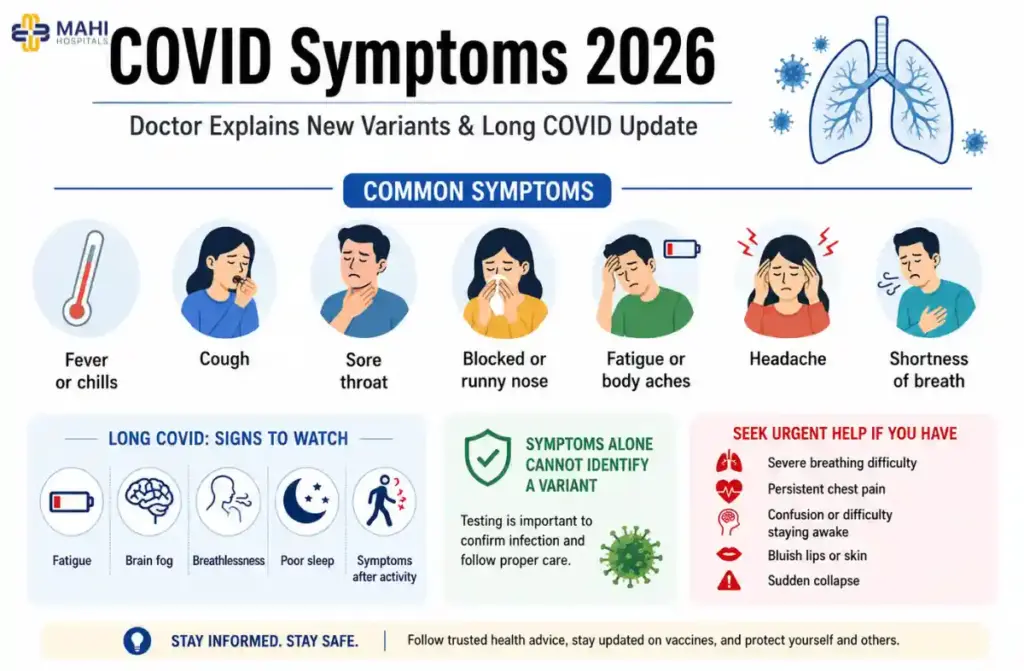
The virus has evolved over time, and the way symptoms appear can vary between individuals. However, the core symptoms remain broadly similar, particularly because most people now have some level of immunity from vaccination, previous infection, or both.
Today, many COVID-19 infections resemble other common respiratory illnesses, making symptoms alone unreliable for confirming the diagnosis.
Early symptoms
Most people initially experience symptoms such as:
- Sore throat: Often one of the earliest complaints and sometimes the first symptom people notice before fever develops.
- Runny or blocked nose: Nasal congestion has become increasingly common with recent Omicron-related variants.
- Fatigue: Many people report feeling unusually tired even before other symptoms become obvious.
- Headache and body aches: These occur as the immune system responds to the infection and are common across many respiratory viruses.
- Mild fever or chills: Some people develop a noticeable fever, while others may have only a slight rise in temperature or none at all.
Common symptoms as the illness progresses
As the infection develops, people may also experience:
- Persistent cough
- Sneezing
- Loss of energy
- Reduced appetite
- Hoarse voice
- Muscle aches
- Occasionally nausea or diarrhea
Fortunately, most infections today remain mild and improve with supportive care, particularly in otherwise healthy individuals who have existing immunity.
Did you know? Two people infected with the same coronavirus variant may experience very different symptoms. Age, underlying health conditions, prior immunity, and vaccination history all influence how the illness develops.
While most people recover without complications, some groups remain more vulnerable to severe disease. Understanding who is still at higher risk—and why— is an important part of interpreting the latest coronavirus updates.
Who is Still at Higher Risk of Severe COVID-19?
Although COVID-19 is generally less severe today than during the early years of the pandemic, the risk is not the same for everyone. Most healthy individuals recover with mild to moderate illness, but certain groups remain significantly more vulnerable to complications, hospitalization, and severe disease.
Understanding why these groups are at higher risk is just as important as knowing who they are.
Older adults
As we age, the immune system naturally becomes less effective at responding to new infections. This process, known as immunosenescence, reduces the body’s ability to control viral replication quickly and mount a strong immune response.
Older adults are therefore more likely to experience:
- Pneumonia
- Reduced oxygen levels
- Hospitalization
- Longer recovery periods
This is one reason public health agencies continue recommending updated vaccinations for older populations.
People with chronic medical conditions
Individuals living with certain long-term health conditions may have less physiological reserve to cope with respiratory infections.
Conditions associated with a higher risk include:
- Heart disease
- Chronic lung diseases such as COPD and severe asthma
- Diabetes
- Chronic kidney disease
- Chronic liver disease
- Obesity
These conditions do not necessarily increase the chance of catching COVID-19, but they can increase the likelihood of developing more serious complications if infection occurs.
People with weakened immune systems
Individuals receiving chemotherapy, organ transplant recipients taking immunosuppressive medications, or people with certain immune disorders may have a reduced ability to fight infections effectively.
For these individuals, COVID-19 can sometimes persist longer and may require closer medical monitoring.
Pregnant individuals
Pregnancy naturally alters the immune, cardiovascular, and respiratory systems to support fetal development. While most pregnant individuals recover well, studies have shown that pregnancy can increase the risk of severe illness compared with non-pregnant women of similar age, particularly when other risk factors are also present.
Young, healthy adults
One of the encouraging findings from recent years is that most otherwise healthy adults experience mild illness, especially if they have immunity from vaccination, previous infection, or both.
However, “low risk” should never be confused with “no risk.”
Anyone can develop complications, although they remain considerably less common in healthy populations.
Clinical Insight: Doctors assess COVID-19 risk by looking at the whole person—not just their age. Underlying medical conditions, vaccination status, immune function, and the severity of symptoms all influence treatment decisions.
What Do We Know About the Latest Variants?
Whenever a new coronavirus variant appears in the news, it often creates understandable concern.
Many people immediately wonder:
“Is this variant more dangerous?”
The reassuring reality is that most new variants do not fundamentally change the course of the pandemic.
Viruses naturally evolve over time, and SARS-CoV-2 is no exception. Scientists continuously monitor newly emerging variants to determine whether they behave differently from previous strains.
Researchers generally evaluate four important questions:
- Does it spread more easily?
- Does it cause more severe illness?
- Can it partially bypass existing immunity?
- Do current vaccines and treatments continue to work?
At present, the variants under international monitoring are primarily being observed because of genetic changes that may influence transmission or immune escape. Current evidence has not shown that these variants consistently cause more severe disease than previous Omicron-related strains.
This distinction is important.
A variant may spread efficiently simply because it is better at infecting people who already have some immunity—not because it is inherently more dangerous.
Research Update: Scientists around the world share genetic sequencing data through international surveillance networks, allowing new variants to be identified and studied long before they become widespread.
Another encouraging finding is that existing immunity continues to provide meaningful protection against severe illness, even when protection against mild infection gradually decreases over time.
This is why vaccination remains focused on preventing hospitalization and death rather than eliminating every infection.
Did you know? A virus that spreads more easily is not necessarily a virus that causes more severe disease. These are two completely different biological characteristics, and scientists evaluate them separately.
Although research continues, the current evidence supports a reassuring conclusion: new variants are expected, but they do not automatically represent a return to the conditions experienced during the early pandemic years.
What Should You Do If You Develop COVID-19 Symptoms?
For most people today, COVID-19 can be managed safely at home with rest and supportive care. The key is recognizing when home management is appropriate—and when professional medical advice becomes necessary.
If you develop symptoms consistent with COVID-19:
- Stay home if possible, especially during the early stages of illness, to reduce the risk of spreading infection to others.
- Rest adequately and allow your body time to recover. Pushing through illness may delay recovery for some individuals.
- Drink plenty of fluids to help prevent dehydration, particularly if fever is present.
- Monitor your symptoms carefully. Pay attention to whether they are improving, remaining stable, or becoming progressively worse.
- Consider testing if recommended by your healthcare provider or local public health guidance, particularly if you belong to a higher-risk group or the result would influence treatment decisions.
If you are older, pregnant, immunocompromised, or have significant underlying medical conditions, contacting a healthcare professional early is advisable because antiviral treatments may be appropriate for some eligible patients when started soon after symptoms begin.
Clinical Insight: Early medical advice is most valuable for people at higher risk of severe disease because some antiviral medications are most effective when initiated within the first few days after symptoms appear.
When Should You Seek Immediate Medical Attention?
Although the majority of COVID-19 infections improve without hospitalization, certain symptoms should never be ignored.
Seek urgent medical care if you experience:
- Difficulty breathing or rapidly worsening shortness of breath
- Persistent chest pain or pressure
- Confusion or difficulty staying awake
- Bluish lips, fingertips, or face
- Oxygen saturation levels lower than recommended by your healthcare provider (if monitoring at home)
- Symptoms that suddenly worsen after initially improving
Children, older adults, and individuals with chronic medical conditions should also be evaluated promptly if they become unusually lethargic, have difficulty eating or drinking, or show signs of dehydration.
Did you know? Many severe COVID-19 complications develop because the body’s oxygen levels fall gradually. Some individuals may not feel severely breathless despite significantly reduced oxygen saturation, which is why clinical assessment remains important when symptoms worsen.
Recognizing these warning signs allows treatment to begin before complications become more advanced.
Can COVID-19 Still Be Prevented?
Although complete prevention is not always possible, the strategies for reducing the risk of COVID-19 have become clearer through years of scientific research.
Rather than relying on a single measure, healthcare professionals recommend a layered approach, where multiple protective steps work together.
These include:
- Stay up to date with recommended vaccinations, particularly if you belong to a higher-risk group.
- Practice good hand hygiene, especially after coughing, sneezing, or visiting crowded public places.
- Cover coughs and sneezes using a tissue or your elbow to reduce the spread of respiratory droplets.
- Improve indoor ventilation whenever possible, as fresh air helps reduce the concentration of airborne respiratory particles in enclosed spaces.
- Wear a well-fitting mask in high-risk settings if recommended by local public health guidance or if you are at increased risk of severe illness.
- Stay home when unwell, allowing yourself to recover while reducing the chance of transmitting infection to others.
Interesting fact: One of the most lasting lessons from the pandemic is that simple public health measures—such as staying home when sick, improving ventilation, and practicing good respiratory hygiene—help reduce the spread of many respiratory infections, not just COVID-19.
These practical habits continue to benefit individuals, families, workplaces, and communities long after the end of the global public health emergency.
The final question is perhaps the most important: What have we learned from COVID-19, and how can those lessons help us prepare for future infectious disease challenges?
What Have We Learned Since the COVID-19 Pandemic?
COVID-19 changed far more than healthcare systems—it changed how the world understands infectious diseases.
Before 2020, terms such as genomic surveillance, viral variants, mRNA vaccines, and public health preparedness were familiar mainly to scientists and healthcare professionals. Today, these concepts have become part of everyday conversations because the pandemic highlighted how interconnected global health truly is.
Perhaps the most important lesson is that preparedness is more effective than panic.
Over the past few years, remarkable progress has been made in several areas:
- Faster disease surveillance: Countries now share genomic data more rapidly, allowing scientists to identify and monitor emerging variants much earlier than before.
- Improved vaccine technology: The development of mRNA and updated vaccine platforms has demonstrated how modern science can respond more quickly to emerging infectious diseases.
- Better clinical care: Doctors now have a far deeper understanding of how COVID-19 affects the body, leading to improved treatment strategies and significantly better patient outcomes.
- Greater public awareness: Simple practices such as hand hygiene, respiratory etiquette, staying home when ill, and improving indoor ventilation have become widely recognized as effective ways to reduce the spread of respiratory infections.
At the same time, the pandemic also reminded us of another important truth:
Reliable information saves lives.
Throughout the pandemic, misinformation often spread faster than the virus itself, creating confusion about treatments, vaccines, preventive measures, and disease severity. This reinforced the importance of relying on evidence-based guidance from trusted public health organizations and qualified healthcare professionals.
Research Update: COVID-19 accelerated international scientific collaboration on an unprecedented scale. Researchers around the world shared data, clinical findings, and genomic information in real time, allowing vaccines, treatments, and public health recommendations to evolve far more rapidly than during previous global outbreaks.
Another lasting lesson is that public health is a shared responsibility. Individual decisions—such as staying home when sick, protecting vulnerable family members, and following evidence-based recommendations during outbreaks—can collectively reduce the impact of infectious diseases on entire communities.
Looking Ahead: Will Coronavirus Continue to Evolve?
The short answer is yes.
Like influenza and many other viruses, SARS-CoV-2 will continue to mutate over time. This is a normal part of viral evolution and should be expected rather than feared.
Most mutations have little or no meaningful impact. Occasionally, a new variant may spread more efficiently or partially evade existing immunity, which is why global surveillance continues.
However, today’s situation is fundamentally different from the early stages of the pandemic.
Several factors now provide greater protection against severe disease:
- Widespread immunity from vaccination and previous infections
- Updated vaccines designed to improve protection against circulating variants
- Effective antiviral treatments for eligible patients
- Better hospital preparedness and clinical management
- Continuous international surveillance that detects important changes early
Rather than aiming to eliminate every infection, current public health strategies focus on reducing severe illness, preventing hospitalizations, and protecting vulnerable populations.
Did you know? Many infectious disease experts now manage COVID-19 similarly to other continuously evolving respiratory viruses—through ongoing surveillance, updated vaccines when appropriate, and evidence-based clinical care.
This approach reflects how healthcare systems have adapted to living with COVID-19 while remaining prepared for future changes.
Conclusion
The latest coronavirus update confirms that COVID-19 remains part of our global health landscape, but it is no longer the unknown threat it was during the early years of the pandemic. Scientific advances in surveillance, vaccination, diagnostics, and treatment have transformed how the virus is managed, allowing healthcare systems to respond more effectively while reducing the burden of severe disease.
Although new variants will continue to emerge, current evidence shows that most are being monitored because of changes in transmission or immune characteristics not because they consistently cause more severe illness. This is why health authorities emphasize continuous surveillance, research, and evidence-based recommendations rather than unnecessary alarm.
For individuals, the message is both reassuring and practical. Staying informed through credible sources, keeping vaccinations up to date when recommended, practicing good respiratory hygiene, and seeking medical care if severe symptoms develop remain the most effective ways to protect yourself and those around you.
COVID-19 has taught the world that preparedness, scientific collaboration, and public trust are essential components of public health. As research continues and our understanding evolves, informed decisions not fear, remain the strongest foundation for protecting individual and community health.