Medically Reviewed by Dr. Vijay Kumar Sohanlal, MBBS, MS (Orthopaedics), Orthopaedic & Joint Replacement Surgeon, Founder & Owner of MAHI Multispeciality Hospitals, Kilpauk, Chennai
Last medically reviewed: August 2026
“Fear spreads fastest when facts are missing. Understanding how a virus actually spreads allows us to replace assumptions with informed decisions and protect ourselves with confidence.”
When news about Mpox appears, one question almost always follows:
“How does the Mpox virus spread?”
It sounds like a simple question, but the answer is often misunderstood. Some people believe they can become infected simply by being in the same room as someone with Mpox. Others assume the virus spreads only through sexual contact, while some worry that touching everyday objects or travelling on public transport is enough to put them at risk.
These misconceptions are understandable. Many of us naturally compare every new viral disease with illnesses such as COVID-19 or influenza. However, Mpox follows a different pattern of transmission, and understanding that difference is the key to separating genuine risk from unnecessary concern.
Current scientific evidence consistently shows that Mpox usually requires close, meaningful exposure to spread from one person to another. The virus is far less likely to spread through brief, casual encounters than many people imagine. This distinction is reassuring because it means prevention is not about avoiding people altogether—it is about recognizing situations where close exposure is more likely and responding appropriately.
In this guide, you’ll learn exactly how the Mpox virus spreads, why certain interactions carry a higher risk than others, which common myths are unsupported by evidence, and the practical measures that help reduce transmission based on current medical knowledge.
Quick Answer
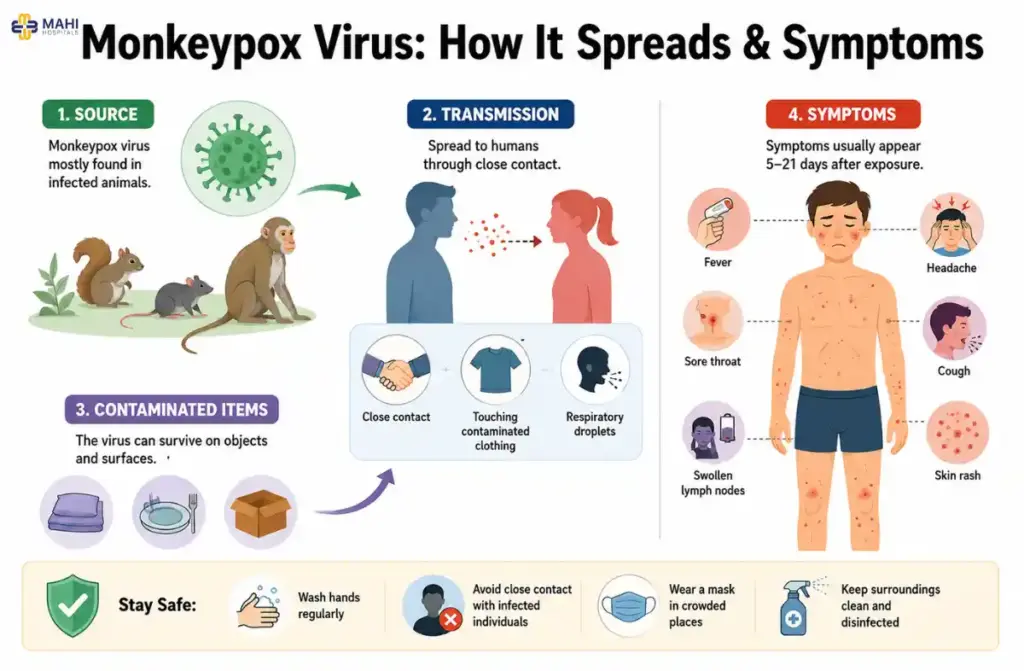
The Mpox virus spreads primarily through close physical contact with an infected person’s skin lesions, body fluids, or contaminated materials such as bedding and clothing. It can also spread through prolonged face-to-face exposure involving respiratory secretions, but it does not spread through the air as efficiently as highly airborne viruses like measles. Most infections occur after sustained, direct exposure rather than brief everyday interactions, making an understanding of transmission far more valuable than unnecessary fear.
What is Mpox?
Mpox is a viral infectious disease caused by the Mpox virus, which belongs to the Orthopoxvirus family—the same group of viruses that includes the one responsible for smallpox.
Although scientists have known about Mpox for decades, global outbreaks in recent years brought renewed attention to the disease because cases began appearing in countries where it had not traditionally been reported. As investigations progressed, researchers learned much more about how the virus spreads, who is most likely to be exposed, and which preventive measures are genuinely effective.
You may remember hearing the disease referred to as monkeypox.
In 2022, the World Health Organization recommended using the name Mpox to reduce stigma while maintaining scientific accuracy. The change reflected evolving public health communication rather than any change in the virus itself.
Did you know? Despite its former name, monkeys are not believed to be the virus’s primary natural host. Current evidence suggests that several species of wild rodents are more likely to serve as the natural reservoir in endemic regions.
Knowing what Mpox is provides useful background, but for most people the more important question is not its history—it’s understanding how the virus actually moves from one person to another.
How the Mpox Virus Spreads?
One of the most important facts to understand about Mpox is that not every interaction carries the same level of risk.
Unlike viruses that spread efficiently through the air, Mpox usually needs an opportunity to move from an infected person’s body into another person’s body through close and direct exposure. In practical terms, this means the type of contact matters much more than simply being in the same location.

Think of transmission as a chain.
For infection to occur, the virus must first leave an infected source, survive long enough to reach another person, and then enter the body through broken skin or mucous membranes, such as those lining the eyes, nose, or mouth. Breaking any link in this chain—by avoiding direct contact with infectious lesions, maintaining good hand hygiene, or following appropriate infection-control measures—significantly reduces the risk of infection.
This is why healthcare professionals focus on how people interact, not merely where they are.
Before looking at each transmission route individually, it’s helpful to understand the situations that generally involve a higher or lower likelihood of exposure.
| Higher likelihood of transmission | Lower likelihood of transmission |
| Direct contact with an active Mpox rash or lesions | Walking past an infected person |
| Prolonged skin-to-skin physical contact | Brief conversations in open spaces |
| Caring for an infected person without appropriate precautions | Being in the same large public area |
| Handling contaminated bedding or clothing before cleaning | Passing someone in a supermarket or on public transport without direct contact |
The table doesn’t define every possible situation, but it highlights an important principle:
The closer, longer, and more direct the contact, the greater the opportunity for transmission.
Understanding this principle makes each transmission route much easier to interpret.
Close Skin-to-Skin Contact: The Main Route of Transmission
When scientists investigated recent outbreaks, one finding appeared consistently across different countries and healthcare settings:
Most Mpox infections were linked to direct physical contact with an infected person’s skin lesions.
This makes biological sense. The rash, blisters, sores, and scabs associated with Mpox contain the virus, meaning direct contact with these lesions provides the most efficient opportunity for transmission.
However, this doesn’t mean every touch carries the same level of risk.
The likelihood of infection depends on how much contact occurs, how long it lasts, and whether infectious lesions are involved. A brief accidental brush against someone is very different from prolonged physical contact where active lesions come into direct contact with another person’s skin.
Situations where this type of exposure may occur include:
- Providing personal care for someone with Mpox: Family members or caregivers helping with dressing, bathing, or wound care naturally spend more time in close physical contact, increasing opportunities for exposure if appropriate precautions are not followed.
- Intimate physical contact: Activities involving prolonged skin-to-skin contact allow infectious lesions to come into direct contact with another person’s skin or mucous membranes, making this one of the most recognized settings for transmission.
- Direct contact with uncovered lesions: Touching visible blisters, sores, or scabs during an active infection presents a higher risk than simply sharing the same environment with an infected individual.
The important message is not that physical contact should be feared, but that the virus depends on meaningful direct exposure to spread efficiently. Understanding this principle explains why public health guidance consistently emphasizes avoiding contact with active skin lesions until they have completely healed.
Clinical Insight: Healthcare professionals evaluate exposure based on the quality of contact rather than the quantity of people nearby. Being surrounded by people does not automatically increase risk, but prolonged direct interaction with infectious skin lesions does.
Once researchers understood the role of skin lesions, another question naturally followed.
If the virus is present in the body, can it also spread through body fluids or through the air—and if so, how significant are those routes compared with direct skin contact?
Can Body Fluids Spread the Mpox Virus?
Once people learn that skin lesions are the primary source of transmission, the next question is usually:
“What about body fluids?”
The answer is yes—but understanding the context is important.
The Mpox virus can be present in certain body fluids, which means transmission may occur if these fluids come into direct contact with another person’s broken skin or mucous membranes, such as the eyes, nose, or mouth.
However, this should not be interpreted as meaning body fluids are a major source of infection during everyday life.
In reality, this route is most relevant in situations involving close personal care, intimate physical contact, or healthcare settings, where repeated direct exposure is more likely. For the average person going about daily activities, opportunities for this type of transmission are uncommon.
This distinction illustrates an important principle seen throughout Mpox transmission:
The virus is not looking for casual encounters—it relies on opportunities created by close, direct exposure.
Understanding that principle helps explain why healthcare workers wear gloves, gowns, and other protective equipment when caring for infected patients. These precautions are designed to interrupt the chain of transmission before the virus has an opportunity to enter another person’s body.
What people often get wrong: Many people hear the phrase “body fluid transmission” and assume routine daily interactions become dangerous. Current evidence does not support this. Outside situations involving close physical exposure, this route contributes far less to transmission than direct contact with infectious skin lesions.
Can Mpox Spread Through the Air?
This is perhaps the most common misconception surrounding Mpox.
After living through the COVID-19 pandemic, it’s natural for people to wonder whether every emerging virus behaves in the same way. Fortunately, Mpox follows a very different pattern of transmission.
Current scientific evidence indicates that Mpox is not considered an airborne disease in the same sense as measles. It does not spread efficiently through tiny airborne particles that remain suspended over long distances or infect people after brief encounters in shared public spaces.
Instead, when respiratory transmission occurs, it is believed to happen through prolonged, close face-to-face exposure involving respiratory secretions.
In practical terms, this means situations such as:
- Living in the same household as an infected person.
- Providing prolonged care during an active illness.
- Spending extended periods in very close proximity while someone has symptoms.
These scenarios differ significantly from passing someone in a shopping mall, sitting several rows away on public transport, or briefly sharing an elevator.
To better understand this difference, consider how public health professionals assess exposure.
| Situation | General Risk of Mpox Transmission |
| Caring for an infected family member over several days | Higher because of repeated close contact |
| Sharing a bed or prolonged skin-to-skin contact | Higher due to direct exposure to lesions |
| Walking past someone in a public place | Very low |
| Sitting briefly in the same waiting room | Generally low unless there is prolonged close interaction |
| Brief conversation at normal social distance | Generally low |
The purpose of this comparison is not to assign exact levels of risk but to illustrate an important concept:
Distance alone doesn’t determine transmission—meaningful exposure does.
Clinical Insight: When doctors investigate a suspected exposure, they rarely ask only “Were you in the same room?” Instead, they ask how long you were together, how close the interaction was, and whether direct physical contact occurred. These details provide a much clearer picture of actual risk.
Understanding this difference is reassuring because it prevents unnecessary anxiety while encouraging sensible precautions where they matter most.
Is Mpox a Sexually Transmitted Infection?
Few topics surrounding Mpox have generated as much misunderstanding as this one.
During recent outbreaks, many reported cases were linked to intimate contact. As a result, some people concluded that Mpox should be considered a sexually transmitted infection (STI).
The science tells a more nuanced story.
Mpox is not classified as a traditional sexually transmitted infection. Instead, it spreads through the close physical contact that often occurs during sexual activity.
This distinction is important.
Sex itself is not what transmits the virus. Rather, it is the prolonged skin-to-skin contact, exposure to infectious lesions, contact with body fluids, and close face-to-face interaction that commonly occur during intimacy.
This explains why transmission is not limited to sexual relationships.
The same biological principles apply whenever someone has prolonged, direct contact with infectious lesions, whether that involves caring for a sick family member, close household contact, or other forms of sustained physical interaction.
Understanding this prevents two common misconceptions:
- It avoids incorrectly labeling Mpox as an infection that affects only certain groups of people.
- It reminds us that the virus responds to exposure—not identity, lifestyle, or background.
What people often get wrong: Associating Mpox exclusively with sexual transmission creates unnecessary stigma and can distract attention from other genuine routes of spread. Public health guidance focuses on how exposure occurs, not who becomes infected.
This evidence-based perspective helps ensure that prevention efforts remain focused on reducing risk rather than reinforcing misconceptions.
Who is More Likely to Be Exposed to Mpox?
A person’s likelihood of exposure is determined far more by their circumstances than by who they are.
In other words, doctors don’t simply ask whether someone lives in a particular city or attended a crowded place. Instead, they look at whether meaningful exposure to an infected person has actually occurred.
People who are more likely to encounter these situations include:
- Household members and caregivers: Looking after someone with Mpox often involves assisting with daily activities, handling clothing or bedding, and spending extended periods in close physical contact. These circumstances naturally increase opportunities for exposure if appropriate precautions are not followed.
- Healthcare professionals: Doctors, nurses, and other healthcare workers may come into contact with infected patients during examinations or treatment. Following established infection-control practices and using appropriate personal protective equipment significantly reduces this occupational risk.
- Close personal or intimate contacts: Individuals who spend prolonged periods in direct physical contact with someone who has active skin lesions are more likely to be exposed than those who have only brief or casual interactions.
- People exposed to infected animals in endemic regions: In parts of Central and West Africa where Mpox occurs naturally, contact with infected wildlife or animal products remains an important route of transmission. Outside these regions, however, most reported cases have involved human-to-human spread.
Notice what this list has in common.
Every situation involves close, direct, or repeated exposure—not ordinary day-to-day social interaction.
Did you know? During contact tracing, public health teams focus on identifying people who had meaningful close exposure, not everyone who happened to be nearby. This reflects decades of epidemiological evidence showing that the nature of the contact is far more important than simple proximity.
Understanding who is more likely to be exposed naturally leads to another practical question:
If someone becomes infected, for how long can they pass the virus to others, and when is it considered safe to resume normal contact?
How Long is a Person With Mpox Contagious?
Knowing how long someone can spread the virus is just as important as knowing how the virus spreads. It helps families, caregivers, employers, and healthcare professionals make informed decisions about isolation, returning to normal activities, and protecting others from unnecessary exposure.
Current medical guidance indicates that a person with Mpox is generally considered contagious from the onset of symptoms until every skin lesion has completely healed, all scabs have fallen off naturally, and a new layer of healthy skin has formed.
This process may take two to four weeks, although recovery varies depending on the individual and the severity of the infection.
The reason is closely linked to how the disease behaves.
Throughout the illness, the rash evolves through several stages—from flat spots to raised bumps, fluid-filled blisters, pustules, and finally scabs. During these stages, the lesions contain the virus and can serve as the primary source of transmission if another person comes into direct contact with them.
Once healing is complete, that source is effectively removed, which is why healthcare professionals use complete skin healing—not simply the absence of fever or feeling better—as the benchmark for ending isolation.
Clinical Insight: Feeling well and being non-contagious are not always the same thing. A person may recover from fever and fatigue several days before their skin lesions have fully healed, which is why following medical guidance throughout the recovery period remains important.
Can Mpox Spread Before Symptoms Appear?
This is one of the questions researchers have studied most carefully because it influences how outbreaks are investigated and controlled.
Current evidence suggests that Mpox spreads primarily after symptoms develop, particularly once the characteristic rash or lesions become visible.
This differs from some respiratory viruses, where individuals may unknowingly infect others before they realize they are ill.
For Mpox, the highest risk of transmission is closely associated with active skin lesions and other symptoms, making early recognition of illness an important part of preventing further spread.
That said, medical science continues to evolve.
Researchers continue monitoring new outbreaks to better understand every stage of the infection. If future evidence changes our understanding, public health recommendations will be updated accordingly. This ongoing evaluation is a normal part of infectious disease surveillance and reflects how evidence-based medicine adapts as new information becomes available.
Research Update: Modern public health surveillance allows researchers to continually evaluate how diseases spread in real-world settings. Recommendations regarding isolation and infection control are reviewed regularly to ensure they reflect the best available scientific evidence.
The encouraging takeaway is that identifying symptoms early, limiting close physical contact, and seeking medical advice when appropriate remain highly effective strategies for reducing transmission.
How Can You Reduce the Risk of Mpox?
One of the most reassuring aspects of Mpox is that its transmission pathways are well understood, which means the preventive measures are equally clear.
Rather than relying on a single intervention, healthcare professionals recommend combining several practical habits that interrupt the chain of transmission before infection can occur.
The table below summarizes the most effective preventive measures and explains why each one matters.
| Preventive Measure | Why It Helps |
| Avoid direct contact with active skin lesions | Prevents exposure to the virus’s primary source of transmission. |
| Wash hands regularly with soap and water or use an alcohol-based sanitizer | Removes viral particles that may have been picked up from contaminated surfaces or materials. |
| Avoid sharing bedding, towels, clothing, or personal items during active infection | Reduces the possibility of indirect transmission through contaminated materials. |
| Clean and disinfect frequently touched surfaces when caring for an infected person | Helps lower the chance of transferring viral particles to others within the household. |
| Follow medical advice regarding isolation until all lesions have healed | Protects close contacts during the period when transmission is most likely. |
| Consider vaccination if recommended by public health authorities | Provides additional protection for people with a higher likelihood of exposure in specific situations. |
Although these recommendations are straightforward, they are effective because they target every stage of the transmission chain. The goal is not to eliminate all human interaction but to prevent the virus from finding an opportunity to move from one person to another.
Did you know? Many of the infection-control practices used for Mpox—such as careful hand hygiene, cleaning contaminated materials, and avoiding direct contact with infectious lesions—are the same principles healthcare professionals use to prevent the spread of numerous other contagious diseases.
When Should You Seek Medical Care?
Not every rash is caused by Mpox, but every unexplained rash deserves appropriate attention, particularly when it appears alongside symptoms of a viral illness.
Seeking medical advice early helps confirm the diagnosis, rule out other conditions that may look similar, and ensure that the right precautions are taken to protect both the patient and those around them.
You should arrange a medical evaluation if you:
- Develop a new rash that progresses into blisters, pustules, or scabs, particularly if it is accompanied by fever, swollen lymph nodes, headache, muscle aches, or fatigue.
- Have had close physical contact with someone diagnosed with Mpox or believe you may have been exposed during an outbreak.
- Notice symptoms after travelling to or living in an area experiencing Mpox transmission, especially if you have had direct physical contact with someone who was unwell.
Certain individuals may require earlier assessment because they have a greater likelihood of developing complications, including young children, pregnant individuals, people with weakened immune systems, and those with significant underlying medical conditions.
Early medical assessment is valuable not because every suspected case is severe, but because an accurate diagnosis allows appropriate treatment, isolation advice, and contact management to begin without unnecessary delay.
Conclusion
Understanding how the Mpox virus spreads is essential for making informed decisions during outbreaks and avoiding the misconceptions that often accompany emerging infectious diseases. Current scientific evidence consistently shows that transmission occurs primarily through close physical contact with infectious skin lesions, exposure to certain body fluids, contaminated materials, and prolonged face-to-face contact involving respiratory secretions. Casual, brief encounters are not considered the main driver of infection.
Perhaps the most important lesson is that risk is determined by the nature of the exposure, not simply by proximity. This understanding allows individuals, families, and healthcare professionals to focus on situations where precautions genuinely matter while avoiding unnecessary fear about routine daily interactions.
As research continues, recommendations may be refined, but the core principles remain remarkably consistent: recognize symptoms early, avoid direct contact with infectious lesions, practice good hand hygiene, and seek medical advice if exposure or symptoms raise concern.
Accurate information remains one of the most effective public health tools. By understanding how Mpox spreads—and equally important, how it does not—we are better equipped to protect ourselves, support our communities, and respond to outbreaks with knowledge rather than uncertainty.