
Medically reviewed by: Dr. Vijay Kumar Sohanlal, MBBS, MS (Orthopaedics), Orthopaedic and Joint Replacement Surgeon, Founder and Owner, MAHI Multispecialty Hospital, Kilpauk, Chennai
Last medically reviewed: September 2026
A hip fracture can change someone’s independence in a matter of hours. A person who was walking, climbing stairs or managing daily activities may suddenly find it difficult or impossible to stand because of severe pain.
For certain femoral neck fractures, repairing the broken bone may not provide a reliable result, particularly when the blood supply to the femoral head has been affected. In such situations, hemiarthroplasty may be recommended to replace the damaged femoral head and create a stable hip that can support rehabilitation.
But being told that surgery is needed often raises practical concerns: What exactly happens during the procedure? Why is hemiarthroplasty chosen instead of fracture fixation or total hip replacement? How soon can you walk? And what will recovery really involve? Understanding these steps can make the treatment journey more predictable and help patients and families prepare for what comes next.
What is Hemiarthroplasty?
Hemiarthroplasty is a type of partial hip replacement in which the damaged femoral head the ball of the hip joint is replaced with an artificial component.
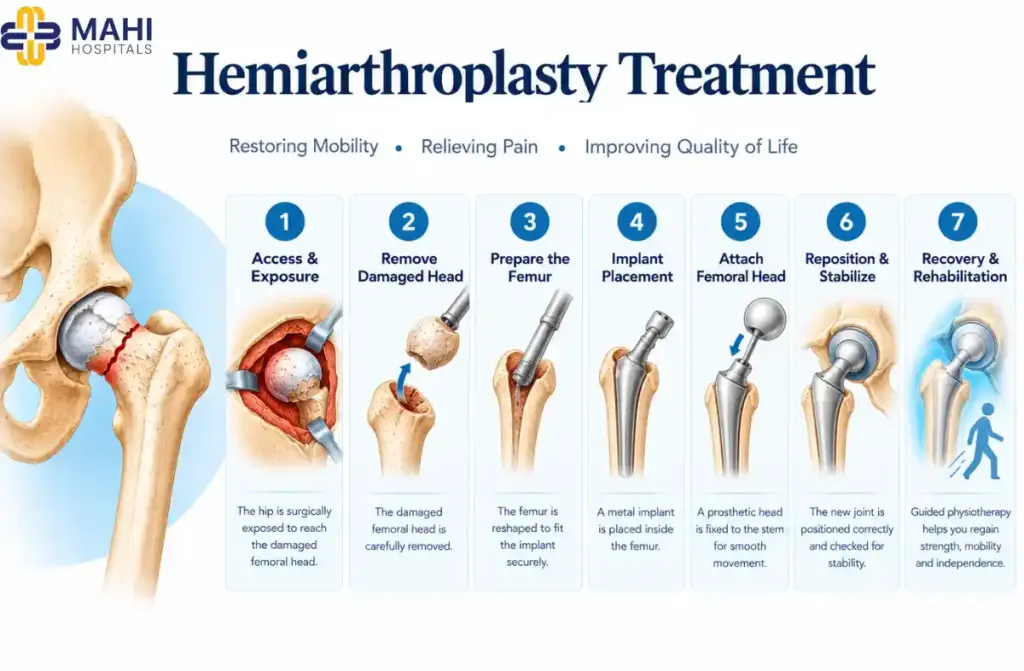
The hip is a ball-and-socket joint. The ball is formed by the femoral head, while the socket is called the acetabulum. During hemiarthroplasty, the damaged femoral head is removed and replaced, while the natural socket is generally preserved.
The procedure is most commonly considered for certain displaced femoral neck fractures, particularly when the fractured femoral head has a poor chance of healing successfully or its blood supply has been compromised.
The purpose, however, goes beyond replacing damaged bone. The broader goal is to provide a stable and functional hip that allows appropriate mobilization and rehabilitation after the fracture.
When is Hemiarthroplasty Recommended?
Hemiarthroplasty is not automatically required for every hip fracture. The decision depends on the location and pattern of the fracture, the condition of the hip joint and the patient’s overall circumstances.
It may be considered when:
- The femoral neck fracture is displaced: Significant displacement can disrupt the blood supply to the femoral head and make reliable healing more difficult.
- The femoral head is unlikely to remain healthy: When its blood supply has been significantly affected, preserving the patient’s own femoral head may carry a greater risk of complications.
- Replacing the damaged portion offers a more predictable route to mobility: In appropriately selected patients, replacing the femoral head can avoid relying entirely on fracture healing to restore hip function.
- The patient’s overall condition supports the procedure: Age, previous mobility, bone quality, existing medical conditions, activity level and functional expectations all contribute to the treatment decision.
Clinical Insight
The X-ray is only part of the decision. A good surgical plan considers the fracture alongside the person who has sustained it how they moved before the injury, their bone and joint health, medical conditions and what level of mobility they hope to regain.
Hemiarthroplasty or Total Hip Replacement?
Patients and families often wonder why the entire hip is not replaced after a fracture.
The fundamental difference is straightforward:
| Hemiarthroplasty | Total Hip Replacement |
| Replaces the damaged femoral head | Replaces the femoral head and the hip socket |
| The natural acetabulum is generally retained | An artificial component is placed in the acetabulum |
| Often considered for selected hip fractures | May be considered in selected patients based on fracture, joint condition and functional needs |
| Treatment is tailored to the individual | Treatment is tailored to the individual |
Neither operation is universally better. The appropriate choice depends on the patient’s fracture, the condition of the existing hip joint, activity level, medical health and expected functional demands.
For some patients, preserving a healthy natural socket with hemiarthroplasty may be appropriate. For others, particularly when significant pre-existing joint disease or other factors are present, total hip replacement may be considered.
This is why the treatment decision should be individualised rather than based simply on the extent of the replacement.
How is the Hemiarthroplasty Procedure Performed?
The exact surgical technique can vary according to the patient’s anatomy, fracture pattern, bone quality and the surgeon’s approach. However, the procedure generally follows a carefully planned sequence.
The procedure in one view
| Surgical stage | What it means for the patient |
| Anaesthesia | Keeps the patient comfortable during surgery |
| Surgical access | Allows the surgeon to reach the fractured hip |
| Femoral head removal | Removes the damaged portion of the joint |
| Femur preparation | Creates the appropriate space for the prosthetic stem |
| Implant placement | Reconstructs the ball portion of the hip |
| Stability assessment | Allows the surgical team to check movement, stability and leg length |
| Closure and recovery | Completes the procedure and begins postoperative monitoring |
The technical steps may appear complex, but they all serve one central purpose: to restore a stable hip that can support the patient’s return to movement.
What is the Goal of Hemiarthroplasty?
The purpose of hemiarthroplasty is not simply to replace a fractured femoral head. For an appropriately selected patient, the procedure aims to create the conditions needed for safe mobilisation and functional recovery.
A successful treatment plan can help:
- Restore a stable hip after the fracture: Replacing the damaged femoral head provides a reconstructed joint surface when reliable fracture healing may not be expected.
- Allow rehabilitation to begin: Once the patient is medically ready, appropriate mobilisation can start rather than leaving them dependent on prolonged immobilisation.
- Support the return of everyday function: Walking, transferring from a bed or chair and gradually becoming more independent are important goals after a hip fracture.
- Address the consequences of the fracture as a whole: Preserving mobility matters because prolonged inactivity can contribute to muscle weakness, loss of independence and other health problems.
The real measure of success, therefore, is not just the implant itself. It is what that implant allows the patient to do again.
What Happens Immediately After Hemiarthroplasty?
Recovery begins as soon as the operation is completed. Initially, the medical team monitors the patient’s vital signs, pain, wound and overall condition. Appropriate measures are also taken to reduce complications associated with surgery and temporary immobility.
As the patient becomes medically stable, rehabilitation becomes an important part of care.
- Pain management helps make movement and physiotherapy more comfortable.
- Blood-clot prevention is considered because hip fracture surgery and reduced mobility can increase the risk of clot formation.
- Wound monitoring helps identify early signs of infection or other problems.
- Physiotherapy and mobilisation can begin when medically appropriate, often progressing from sitting and standing to walking with suitable assistance.
The exact timing is individual. Someone who was independently mobile before the fracture may progress differently from someone who already had significant mobility limitations or other medical conditions.
Recovery After Hemiarthroplasty
Recovery is better understood as a progression rather than a deadline.
| Stage of recovery | Main focus |
| First few days | Pain control, safe mobilisation and prevention of complications |
| Early weeks | Walking with appropriate support and continuing rehabilitation |
| Following weeks | Improving strength, balance and confidence |
| Longer term | Returning to suitable daily activities and maintaining mobility |
Several factors can influence how quickly someone progresses.
- Pre-fracture mobility matters: A person who was independently walking before the fracture may have different rehabilitation needs from someone who already required assistance.
- Overall health affects recovery: Heart, lung and other medical conditions can influence how quickly activity can be increased safely.
- Muscle strength makes a difference: A hip replacement can restore joint structure, but the surrounding muscles still need rehabilitation to support walking and balance.
- Balance and confidence take time to rebuild: After a painful fall and major surgery, fear of falling again can sometimes affect movement even after the hip itself is healing well.
- The home environment can influence independence: Appropriate support, safe surroundings and family assistance can make the transition from hospital to home smoother.
At MAHI Hospital, postoperative care is approached as part of the treatment journey rather than something separate from the operation. Surgical reconstruction, appropriate mobilization and rehabilitation all contribute to the larger goal of helping the patient regain functional independence.
Clinical Pearl
A successful hemiarthroplasty is not measured only by the implant or the X-ray. Being able to stand safely, walk with appropriate support and gradually regain independence are equally important markers of recovery.
Risks and Complications to Know
Like any major surgery, hemiarthroplasty carries potential risks. Understanding them helps patients and families recognise why postoperative monitoring, precautions and follow-up matter.
| Potential risk | What it means |
| Infection | Infection can affect the wound or implant, making proper wound care and monitoring important during recovery. |
| Blood clots | Hip surgery and temporary immobility can increase clot risk, which is why prevention and appropriate mobilisation are important. |
| Dislocation | The artificial joint can become unstable in some situations, particularly during early recovery, so specific movement precautions may be advised. |
| Implant-related problems | Loosening, wear or other implant-related issues can develop and may require medical assessment. |
| Fracture around the implant | The bone surrounding the implant can fracture, particularly after another significant fall or when bone quality is poor. |
| Persistent pain or reduced mobility | Recovery varies between patients, and existing health conditions, muscle weakness or other factors may affect long-term function. |
Individual risk varies from patient to patient. Careful preoperative assessment, appropriate surgical planning, postoperative monitoring and rehabilitation all help support a safer recovery.
Can You Return to Your Previous Level of Mobility?
This is often the question families care about most.
Many patients can regain meaningful mobility and independence after hemiarthroplasty, but the outcome varies from person to person. Someone who was active and independently mobile before the fracture may have a different recovery trajectory from someone who already had difficulty walking or several medical conditions.
The final outcome can be influenced by:
mobility before the fracture + overall health + muscle strength + rehabilitation + balance + complications
For that reason, it is more realistic to think of recovery as a gradual return to function rather than a promise that everyone will walk exactly as they did before the injury.
Reducing the Risk of Another Hip Fracture
Once a hip fracture has occurred, preventing another one becomes an important part of long-term care.
- Bone health deserves attention: Depending on the patient’s age and circumstances, assessment for osteoporosis or reduced bone density may be appropriate.
- Muscle strength and balance should be maintained: Appropriate strengthening and balance exercises can help support safer movement and reduce fall risk.
- The home can be made safer: Better lighting, removing loose rugs and reducing obstacles can make everyday movement safer, particularly for older adults.
- Medications may need review: Some medicines can contribute to dizziness or falls, so a clinician may review the medication list when appropriate.
- Nutrition supports recovery and bone health: Adequate protein and a balanced diet contribute to maintaining muscle and bone health.
The fracture should therefore be viewed not only as an event that required surgery, but also as an opportunity to identify and address factors that could affect future mobility.
When Should You Contact Your Doctor After Surgery?
Some discomfort is expected during recovery, but certain changes deserve prompt medical attention. Contact the treating medical team if you notice increasing redness, swelling or discharge around the wound, fever, worsening hip pain, or a new inability to bear weight. Significant calf pain or swelling can also require assessment because of the possibility of a blood clot.
A sudden change in hip movement or position may indicate a joint problem and should be evaluated promptly. Sudden breathlessness or chest pain requires urgent medical attention.
Choosing the Right Treatment and Recovery Plan
Hemiarthroplasty is not simply a procedure that replaces a damaged femoral head. It is a treatment decision that needs to account for the fracture, the patient’s anatomy, bone quality, medical health, previous mobility and expected recovery.
At MAHI Hospital, this patient-centred approach extends from the initial assessment through surgical planning, implant selection, postoperative monitoring and rehabilitation. The emphasis is on matching treatment to the individual rather than treating every hip fracture in exactly the same way.
For patients and families, that distinction matters. The right treatment is not simply the operation that replaces the fractured part—it is the approach that gives the patient the best opportunity to move safely, rebuild confidence and regain as much independence as possible.
Conclusion
A hip fracture can feel like a sudden loss of independence, particularly for an older person who was managing daily life on their own. Hemiarthroplasty can provide a stable surgical solution for appropriately selected fractures when preserving the damaged femoral head may not offer a reliable outcome.
But the operation is only one part of recovery. Careful treatment selection, appropriate surgical planning, postoperative monitoring, early mobilisation and rehabilitation all contribute to the final result. Just as importantly, attention to bone health, muscle strength and fall prevention can help protect mobility in the years that follow.
At MAHI Hospital, the focus is on treating the fracture while keeping the person at the centre of the treatment journey—because the ultimate goal is not simply a successful operation. It is helping the patient stand, walk, regain confidence and return to as much independence as possible.
Read More: Soft Tissue Injuries.