
Medically Reviewed by Dr. Vijay Kumar Sohanlal, MBBS, MS (Orthopaedics), Orthopaedic & Joint Replacement Surgeon, Founder & Owner of MAHI Multispeciality Hospitals, Kilpauk, Chennai
Last medically reviewed: August 2026
“The best defence against infectious disease is not fear, it’s understanding. Knowing how an illness spreads, how it’s prevented, and when to seek help lets people respond calmly instead of panicking.”
When Ebola makes headlines, the coverage usually leans on the same images, health workers in full protective suits, grim mortality statistics, and words like “outbreak” splashed across the screen. That coverage isn’t wrong, exactly, but it rarely tells the whole story, and it can leave people with a distorted sense of how likely they are to actually encounter this virus.
Here’s the more balanced picture: Ebola Virus Disease (EVD) is genuinely one of the most severe illnesses a virus can cause. It’s also one of the most closely watched and best-understood diseases in modern medicine. Surveillance systems, infection control protocols, targeted antibody treatments, and vaccines have changed outbreak response dramatically over the past decade. And critically, Ebola doesn’t spread the way a cold or flu does. Once you understand how it actually moves from person to person, a lot of the fear built around it starts to fall away.
This guide walks through what Ebola is, how outbreaks start, how the virus spreads (and doesn’t), the symptoms to know, how it’s treated, and when it’s genuinely time to see a doctor.
Quick Answer
Ebola virus causes EVD, a rare but serious illness that spreads through direct contact with the blood or body fluids of an infected, symptomatic person, not through the air, and not through casual contact. Early symptoms look a lot like the flu: fever, fatigue, headache, muscle aches. Without treatment, the illness can progress to vomiting, diarrhoea, and in severe cases, organ failure or bleeding. The encouraging part is that early medical care, strict infection control, and modern vaccines have meaningfully improved how outbreaks are contained and how many patients survive them.
What Exactly is the Ebola Virus?
Ebola belongs to a family of viruses called Filoviridae, and it causes Ebola Virus Disease, once known as Ebola hemorrhagic fever. It infects humans and some primates, including gorillas and monkeys.
What makes Ebola particularly dangerous is that it doesn’t stay confined to one organ system the way many infections do. Once it enters the bloodstream, it hijacks the very immune cells meant to fight it off, using them to spread further through the body instead. As the viral load climbs, the immune system goes into overdrive, inflammation spreads, and organs start to come under increasing strain.
That’s really the key thing to understand about Ebola: it’s not “just a fever.” It’s a systemic illness that can affect the immune system, blood vessels, liver, and kidneys all at once, which is exactly why fast medical attention matters so much.
Reported mortality rates across past outbreaks have ranged widely, from roughly 25% up to 90%, depending on the viral strain, how quickly patients were diagnosed, and what care was available. But that range doesn’t capture where things stand today. Earlier diagnosis, better intensive supportive care, and newer antibody therapies have pushed survival rates meaningfully higher than in the earliest recorded outbreaks.
Worth remembering: how severe a case of Ebola becomes often has as much to do with how fast treatment starts as with the virus itself. Early rehydration and close monitoring genuinely change outcomes.
It’s also worth putting the risk in perspective. Ebola isn’t circulating continuously the way influenza or COVID-19 do. Countries like India rarely see confirmed cases, and when they do, it’s almost always tied to travel history or direct exposure during an active outbreak elsewhere. Preparedness should be grounded in that reality, not in headline anxiety.
A common misunderstanding: Ebola is often labelled a “hemorrhagic fever,” but not every patient bleeds. For many, the bigger danger is severe dehydration and organ strain, bleeding is a possible complication, not a universal symptom.
That raises a natural next question: where does this virus actually come from, and why do outbreaks keep happening in certain regions?
Where Did Ebola Come From?Ebola was first identified in 1976, during two outbreaks that occurred around the same time in what’s now the Democratic Republic of the Congo and in South Sudan. Scientists named it after the Ebola River, deliberately avoiding naming it after the nearby village to prevent stigmatising that community, a naming principle that’s become standard practice in public health today.
The current scientific understanding points to fruit bats as the virus’s natural reservoir, meaning bats can carry the virus without getting seriously sick themselves. Researchers believe the virus occasionally passes from bats to other wild animals, and human outbreaks typically begin when people come into contact with infected wildlife or their fluids. From there, human-to-human transmission can take over if infection control isn’t put in place quickly.
One detail worth knowing: there are several known species of Ebola virus, and not all of them cause disease in humans. Distinguishing between them has actually helped scientists build more targeted vaccines and treatments.
Since 1976, Ebola has caused a series of outbreaks across Central and West Africa, and the largest of these, the 2014-2016 West African epidemic, reshaped how the world handles emerging disease threats. It accelerated progress in several areas:
- Disease surveillance, better systems for spotting unusual illness clusters early, before they spread widely.
- Rapid diagnostics, faster lab testing that lets healthcare teams isolate and treat patients sooner.
- Vaccine development, what was largely experimental research now underpins real, deployable vaccines.
- Emergency preparedness, standardised protocols for isolation, contact tracing, and infection control that are still in use today.
So while Ebola is undeniably a dangerous virus, it’s just as true that decades of research have fundamentally changed our ability to detect it early, treat it effectively, and stop it from spreading.
That brings up the question most people actually want answered: how contagious is Ebola, really?
How Does Ebola Actually Spread?
One of the most persistent myths about Ebola is that it spreads like the flu or COVID-19, through the air, or just by being near someone. It doesn’t. Ebola requires direct contact with infectious body fluids to move from one person to another, and that single fact is a big part of why outbreaks can be brought under control through careful isolation and contact tracing.
A person only becomes contagious once symptoms appear. During the incubation period, the stretch of time between exposure and the first symptom, the virus hasn’t reached levels where it can spread to others.
Good to know: the incubation period ranges from 2 to 21 days, but a person isn’t infectious during that window. That’s a meaningful difference from many respiratory viruses, where people can spread infection before they even feel sick.
Once symptoms do start, the virus can spread through direct contact with infected blood, vomit, diarrhoea, urine, saliva, breast milk, semen, and other body fluids. As illness progresses, the amount of virus in these fluids increases, which is part of why later-stage patients pose a higher transmission risk.
The main ways it spreads:
- Direct contact with infected body fluids, most commonly seen when a family member cares for a sick relative without protective gear, allowing fluids to enter through broken skin or the eyes, nose, or mouth.
- Contaminated medical equipment or surfaces, needles, bedding, or instruments that aren’t properly disinfected.
- Healthcare exposure, workers face higher risk when protective equipment is unavailable or used incorrectly, which is why specialised training matters so much.
- Traditional funeral practices, close physical contact with a body during burial rituals has historically contributed to outbreaks, prompting public health teams to develop safer, culturally respectful burial protocols.
- Contact with infected wildlife, handling or eating infected animals, particularly bats or primates, is believed to be how the virus first enters human populations.
And just as importantly, here’s what does not spread Ebola:
- Casual conversation or sitting near an infected person
- Sharing the same air or room
- Mosquito or insect bites
- Swimming pools or treated drinking water
- Everyday social contact without fluid exposure
Why this matters: because Ebola doesn’t travel through the air, identifying and isolating infected individuals, and monitoring their close contacts, is usually enough to break the chain of transmission. That’s precisely why outbreaks, as devastating as they are locally, don’t spiral into global pandemics the way airborne viruses can.
Understanding transmission naturally leads to the next practical question, what does the illness actually look like as it develops?
How Ebola Symptoms Progress
Part of what makes Ebola tricky to catch early is that its first symptoms look almost identical to common illnesses like flu or malaria. This is exactly why doctors rely as much on a patient’s exposure history as on the symptoms themselves.
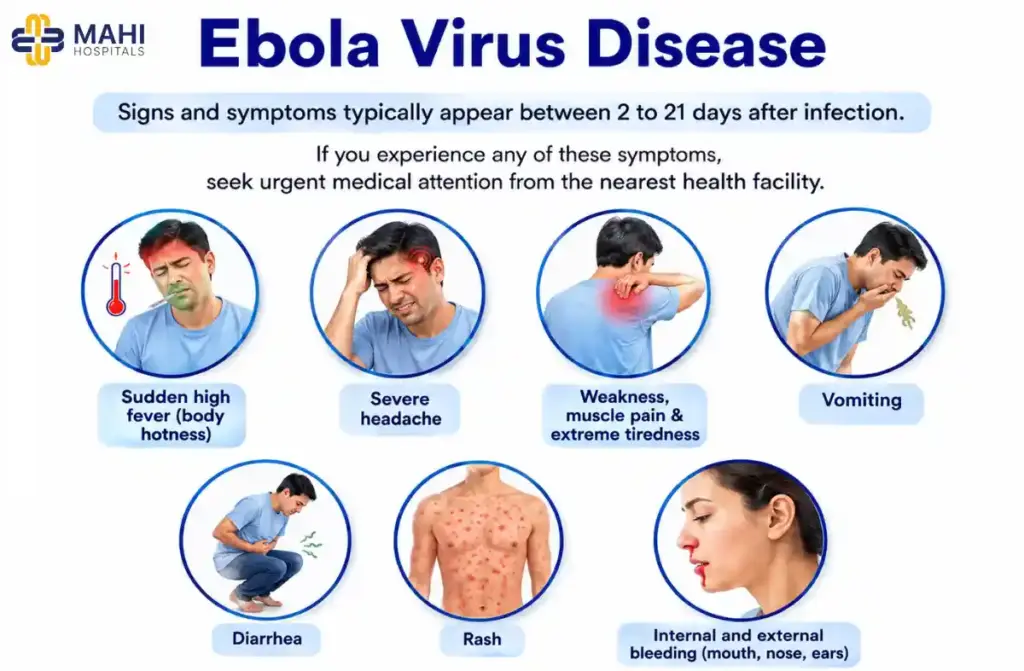
After exposure, symptoms usually show up within 8-10 days, though the window can stretch from 2 to 21 days. And once symptoms begin, they tend to build in stages rather than hit all at once.
Stage 1: Early symptoms, the immune system’s first response
- Sudden high fever, often with chills and fast-worsening fatigue
- Extreme weakness, not ordinary tiredness, but a heavy exhaustion driven by widespread inflammation
- Headache and muscle pain as inflammatory chemicals circulate
- Sore throat and loss of appetite, which tend to show up alongside the fever
At this stage, there’s really no way to distinguish Ebola from several other infections based on symptoms alone. Travel history and exposure risk are what push a doctor to consider Ebola specifically.
Stage 2: As the infection spreads to multiple organs
- Frequent vomiting and diarrhoea
- Severe abdominal pain
- Worsening dehydration
- Skin rash in some patients
- Weakness that continues to intensify
This stage is more dangerous than it might sound, persistent vomiting and diarrhoea can drain the body’s fluid and electrolyte reserves fast, reducing blood volume and making it harder for the heart to keep oxygen flowing to vital organs.
Clinically speaking: dehydration, not bleeding, is often the most urgent concern doctors are managing at this point. Getting fluids back into the patient quickly is priority one.
Stage 3: Severe illness and complications
Without prompt treatment, Ebola can progress to:
- Confusion or reduced consciousness
- Breathing difficulty
- Kidney or liver dysfunction
- Dangerously low blood pressure (shock)
- Internal or external bleeding in some patients
- Multiple organ failure
Movies tend to dramatise the bleeding, but it isn’t a symptom every patient experiences. Many critically ill patients face severe organ dysfunction without visible bleeding at all.
One thing doctors watch for: it’s rarely a single symptom that raises alarm, it’s the combination of symptoms plus a relevant travel or exposure history.
That raises the obvious question: why does something that starts like an ordinary fever turn dangerous so quickly?
Why Ebola Can Become Life-Threatening
The danger isn’t caused by one symptom, it’s a chain reaction across the entire body.
Once the virus is in the bloodstream, it targets the immune cells that would normally coordinate the body’s defence. Instead of neutralising the virus, these cells unintentionally help it spread, which triggers an inflammatory response that spirals out of proportion.
As inflammation builds, blood vessels become more permeable, fluid starts leaking into surrounding tissue, and blood pressure drops, reducing oxygen delivery to critical organs like the brain, kidneys, and liver. At the same time, the liver may struggle to produce the proteins needed for normal clotting, which raises the risk of bleeding in some patients. Combine that with severe dehydration from vomiting and diarrhoea, and the cardiovascular system comes under enormous strain.
This is why Ebola is best understood as a multi-organ disease, not simply “a bad viral fever.”
The good news: this progression isn’t automatic or unstoppable. Modern supportive care, IV fluids, electrolyte replacement, oxygen therapy, close monitoring, can interrupt many of these complications before they become irreversible.
A meaningful fact from the 2014-2016 outbreak: better supportive care alone, independent of any new drug, measurably improved survival rates. Early, attentive treatment matters even before advanced therapies enter the picture.
How Doctors Diagnose Ebola
Because Ebola’s symptoms overlap so heavily with malaria, dengue, typhoid, and influenza, doctors don’t rely on symptoms alone, they follow a structured process starting with exposure risk.
They’ll typically ask:
- Have you recently travelled to a region with an active Ebola outbreak?
- Have you had close contact with someone diagnosed with Ebola?
- Have you handled blood or body fluids from a suspected patient?
- Have you had contact with wildlife linked to Ebola transmission?
If the answers raise concern, the patient is placed under strict infection-control precautions immediately, care doesn’t wait for lab confirmation.
Diagnostic tools include:
- RT-PCR testing, the gold-standard test for detecting the virus’s genetic material during active infection
- Blood work, to assess dehydration, kidney and liver function, and electrolyte balance, which shapes treatment decisions
- Antibody or antigen testing, used in certain clinical or public health contexts depending on illness stage
Why treatment often starts early: correcting dehydration and stabilising blood pressure can’t wait for a lab result, doctors act on clinical suspicion first and confirm afterward.
Treating Ebola: What Modern Medicine Can Do
There’s no home remedy or over-the-counter treatment for Ebola. Every suspected case needs prompt medical evaluation and specialised hospital care.
Treatment focuses on giving the body its best chance to fight the infection while preventing organ damage. Depending on severity, this can include:
- IV fluids to correct dehydration from fever, vomiting, and diarrhoea
- Electrolyte replacement to support heart, nerve, and muscle function
- Oxygen therapy or respiratory support for patients with breathing difficulty
- Blood pressure management to prevent or treat shock
- Treatment of secondary infections, which some patients develop alongside Ebola
One of the more significant recent advances is monoclonal antibody therapy, which helps the immune system recognise and neutralise the virus more effectively, particularly when given early.
Still, supportive care remains the backbone of Ebola treatment. There’s no single “miracle intervention”, better outcomes come from combining early diagnosis, fast rehydration, close monitoring, and, where available, targeted therapy.
Preventing Ebola: What Actually Works
Ebola is severe, but it’s also genuinely preventable when the right precautions are followed consistently.
- Avoid direct contact with blood or body fluids of anyone suspected or confirmed to have Ebola, unless proper protective equipment is used
- Practise good hand hygiene, especially after caring for someone who’s unwell or visiting a healthcare facility
- Use appropriate PPE when caring for patients in hospital or outbreak settings
- Follow infection-control procedures for cleaning surfaces and disposing of medical waste
- Avoid handling sick or dead wildlife in outbreak-affected regions
- Cooperate with public health guidance, contact tracing, isolation, and monitoring during an outbreak
Vaccination has become another important tool. Rather than vaccinating entire populations, health authorities commonly use ring vaccination, vaccinating the close contacts of an infected person, and then the contacts of those contacts, to build a protective barrier around the outbreak.
Worth noting: ring vaccination has directly helped stop several outbreaks by cutting off transmission chains before they could spread further into communities.
That leads to a natural follow-up: who actually needs the vaccine?
The Ebola Vaccine: Who Should Get It?
Effective Ebola vaccines are one of the more significant achievements in infectious disease medicine in recent decades. For a long time, outbreak control depended almost entirely on isolation, contact tracing, and strict infection control. Vaccination now adds another meaningful layer of protection.
Unlike routine childhood or adult immunisations, Ebola vaccines are deployed strategically, targeted at people most likely to be exposed, rather than given broadly across a population.
Typically prioritised for vaccination:
- Healthcare workers, doctors, nurses, lab staff, and emergency responders who may come into direct contact with infectious fluids
- Close contacts of infected individuals, family members and caregivers identified through contact tracing
- Communities in active outbreak zones, to help build a protective barrier around emerging cases
Vaccination works best alongside other public health measures, early diagnosis, isolation, contact tracing, and community education. No vaccine replaces those steps, but together they significantly cut the odds of an outbreak spreading widely.
Can Someone Recover from Ebola?
Yes, and recovery outcomes have genuinely improved over the past decade, thanks to earlier diagnosis, better supportive care, and newer targeted therapies.
That said, recovery is usually gradual, not immediate. Even after the virus clears, some survivors experience what’s known as post-Ebola syndrome, lingering physical and emotional symptoms that can last weeks or months.
Common challenges survivors report:
- Persistent fatigue that takes time and gradual rehabilitation to resolve
- Joint and muscle pain, a lingering effect of the inflammation triggered during illness
- Eye problems, including inflammation that can affect vision if not treated promptly
- Memory and concentration difficulties following a severe systemic illness
- Emotional and psychological stress, which can require professional support after a life-threatening illness and prolonged isolation
Most survivors do improve with regular follow-up care, rehabilitation, good nutrition, and ongoing medical support. Researchers also continue studying survivors long after recovery, their immune response has directly informed better treatments and vaccines for future patients.
Recovering from Ebola isn’t just about surviving the infection. It’s about rebuilding physical, emotional, and social well-being afterward, with proper medical support along the way.
When Should You Seek Medical Care?
Ebola remains extremely rare in India, but any suspected exposure should always be treated as a medical emergency, both for the patient’s sake and to protect family, healthcare workers, and the wider community.
Seek immediate medical attention if you:
- Develop a sudden fever after travelling to a region with an active Ebola outbreak
- Have had direct contact with someone diagnosed with or suspected of having Ebola
- Experience vomiting, diarrhoea, or unexplained bleeding after a known exposure
- Are a healthcare worker who may have been exposed without proper protective equipment
- Have been advised by public health authorities to undergo evaluation after possible exposure
Don’t try to assess or manage suspected Ebola at home. Contact a healthcare facility right away so infection-control precautions can be arranged before you even arrive, wherever possible.
If you or someone you know needs urgent evaluation for a serious infectious illness, MAHI Hospitals is committed to providing timely, evidence-based emergency care with patient safety as the top priority. Our emergency team is available 24/7 to assess patients with severe infections, unexplained high fever following international travel, and other medical emergencies that need rapid stabilisation, every case managed under established clinical protocols and strict infection-control practices to protect both the patient and the wider community.
Conclusion
Ebola remains one of the most serious infectious diseases in the world, but it’s also a strong example of how far science, preparedness, and timely care have come. Decades of research have led to better diagnostics, targeted therapies, working vaccines, and stronger public health systems that have genuinely improved how outbreaks are controlled.
Perhaps the most useful takeaway is this: knowledge protects people almost as much as treatment does. Understanding how Ebola spreads, recognising early symptoms, knowing what prevention actually works, and seeking care quickly after possible exposure protects not just individuals, but entire communities.
Ebola still demands global vigilance. But it’s also proof of what modern medicine can achieve through research, collaboration, and evidence-based care. Staying informed, through reliable medical guidance, not headlines, is what lets us respond with clarity instead of panic.