
Medically Reviewed by Dr. Vijay Kumar Sohanlal, MBBS, MS (Orthopaedics), Orthopaedic & Joint Replacement Surgeon, Founder & Owner of MAHI Multispeciality Hospitals, Kilpauk, Chennai
Last medically reviewed: September 2026
Knee joint pain can make ordinary movements, walking, climbing stairs, standing for long periods, or even getting up from a chair, feel unexpectedly difficult. The instinct may be to rest completely, but prolonged inactivity can leave the knee stiffer and weaker, while continuing activities that clearly aggravate the pain can keep symptoms going.
Learning how to reduce knee joint pain effectively means finding the right balance rather than choosing between total rest and pushing through discomfort. A better approach is to reduce unnecessary stress on the knee while maintaining comfortable movement. What helps most depends on why the joint hurts, how severe the symptoms are, and whether the pain is improving or continuing.
Start by Calming What is Aggravating Your Knee
When knee joint pain first becomes noticeable, the priority is not to force the knee back to normal immediately. It is to reduce the things that are irritating it while allowing comfortable movement to continue.
| What you can do | Why it may help |
| Temporarily reduce aggravating activity | Limiting movements that clearly increase pain gives irritated tissues time to settle. |
| Use cold therapy when appropriate | A wrapped cold pack may help reduce pain and swelling, particularly after activity. |
| Keep the knee gently moving | Comfortable movement can help prevent stiffness that may develop after prolonged rest. |
| Elevate the leg if it is swollen | Raising the leg while resting may help make swelling and discomfort more manageable. |
| Return to activity gradually | Increasing activity in stages gives the knee time to adapt rather than suddenly increasing its workload. |
| Consider support when appropriate | A brace, walking aid or other support may sometimes help, depending on the underlying problem. |
The aim is relative rest, not complete inactivity. If a particular movement repeatedly makes the pain worse, modifying that activity is usually more useful than simply trying to push through it.
Cold, Heat or Movement: Choosing What Your Knee Needs
Not every type of knee discomfort responds to the same approach.
- Cold therapy may be more useful when pain is accompanied by swelling or follows an increase in activity. A cold pack should be wrapped rather than placed directly against the skin.
- Gentle warmth may feel more comfortable when stiffness is the main problem and there is no significant swelling.
- Gentle movement can be particularly helpful when the knee feels stiff after sitting or resting. Simple, comfortable movements can maintain mobility without placing excessive stress on the joint.
The practical rule is straightforward: use the approach that makes the knee feel more comfortable without causing a clear increase in pain or swelling.
Movement Can Help ,But the Knee Should Not Be Forced
Exercise is often an important part of managing knee problems, particularly when weakness or reduced mobility contributes to discomfort. Appropriate strengthening can help improve the muscles that support the knee and make everyday movement easier.
But more exercise is not automatically better. A useful distinction is between muscle effort and worsening joint pain. Feeling that your muscles are working is expected. Sharp pain, increasing joint pain or swelling that continues after activity is a reason to reduce the intensity and reconsider the exercise.
For people with knee osteoarthritis, structured strengthening and other forms of exercise are supported as part of non-surgical management. The appropriate programme, however, should reflect the person’s symptoms, physical ability and underlying condition.
Everyday Activities That Can Make Knee Joint Pain Worse
Sometimes the problem is not one particular exercise but the total amount of stress placed on the knee throughout the day.
| Common aggravator | A more helpful approach |
| Suddenly increasing walking or exercise | Increase activity gradually rather than making a large jump in workload. |
| Repeated high-impact activity | Temporarily choose lower-impact alternatives if these movements consistently worsen symptoms. |
| Sitting or resting for very long periods | Break up prolonged inactivity with comfortable movement when possible. |
| Repeated deep bending or squatting | Modify the depth or frequency if these movements provoke pain. |
| Continuing an activity despite worsening pain | Stop or reduce the aggravating activity and allow symptoms to settle. |
| Returning to full activity too quickly | Build back towards normal activity in stages. |
The goal is not to avoid movement permanently. It is to find the level of activity your knee can currently tolerate and gradually expand it.
Pain Relief Should Match the Problem
Pain relief can be useful, but it should not become a way of masking symptoms while continuing an activity that is aggravating the knee. Depending on the cause of the pain, management may include:
- Activity modification to reduce unnecessary stress on the joint.
- Cold or heat therapy to help manage discomfort depending on the symptoms.
- Exercise or physiotherapy to improve strength, mobility and function when appropriate.
- Pain-relieving medicines when suitable for the individual and used according to medical advice.
- Condition-specific treatment when the pain is caused by an underlying joint, ligament, cartilage or other problem that requires targeted care.
There is no single treatment that is appropriate for every person with knee joint pain. If pain keeps returning despite sensible self-care, the more useful question is why the pain is continuing, rather than simply how to suppress it.
Common Mistakes That Can Keep Knee Pain Going
Even well-intentioned attempts to manage knee pain can sometimes delay improvement.
- Resting completely for too long can contribute to stiffness and loss of strength.
- Doing too much too soon can overload a knee that has not yet adapted to the increased activity.
- Pushing through sharp or worsening pain can turn a manageable problem into a more persistent one.
- Copying someone else’s exercise routine ignores the fact that knee pain can have many different causes.
- Using pain relief to continue an aggravating activity may hide an important warning from the body rather than solve the underlying problem.
A more sustainable approach is simple: reduce the aggravating load, keep the knee comfortably moving and increase activity gradually as symptoms allow.
How Long Does it Take to Reduce Knee Joint Pain?
There is no single recovery time that applies to everyone.
A mild, short-lived episode may improve relatively quickly after the aggravating activity is reduced. Pain related to osteoarthritis, an injury or another underlying condition may require a more structured approach and can take longer to settle.
Several factors influence how quickly symptoms improve:
- The underlying cause of the pain
- How severe and long-standing the symptoms are
- Whether the knee continues to be aggravated
- Muscle strength and joint mobility
- Consistency with appropriate treatment and rehabilitation
- Whether an underlying condition needs specific medical management
Rather than focusing only on the number of days, pay attention to the direction of change. Gradually improving pain, movement and function are generally more encouraging than symptoms that remain unchanged or progressively worsen.
When Knee Joint Pain Needs Medical Attention
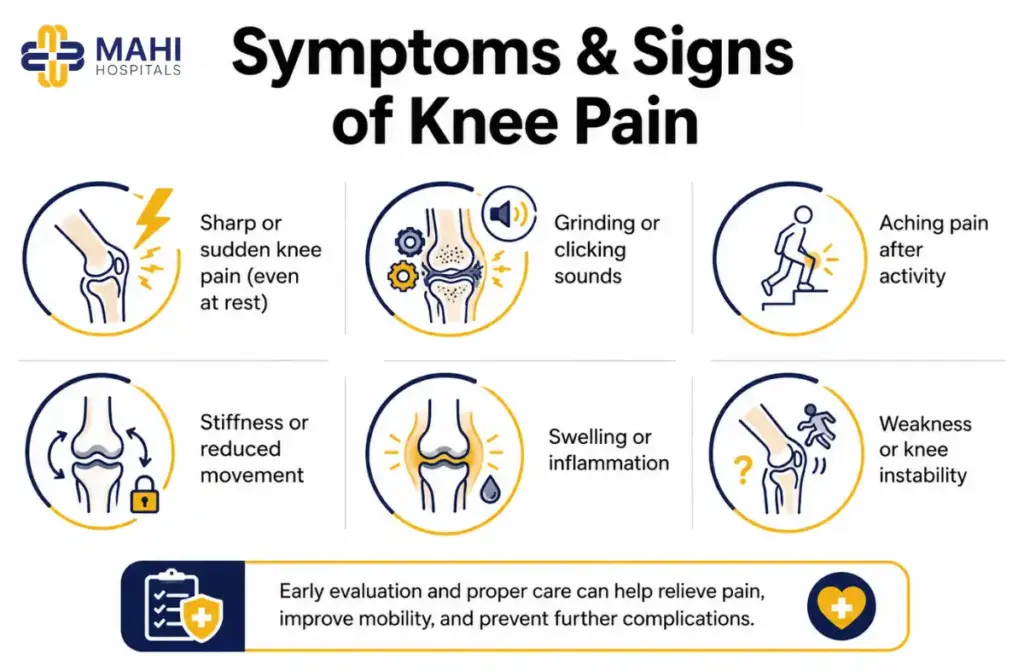
Most mild knee pain does not automatically require urgent medical care. However, certain symptoms should not be managed indefinitely at home.
| What you notice | Why assessment matters |
| Severe or rapidly worsening pain | The cause may need prompt evaluation rather than continued self-treatment. |
| Difficulty bearing weight | Significant injury or another problem may need to be ruled out. |
| Major swelling or a change in knee shape | This can occur with more substantial injury or joint problems. |
| Locking or repeated giving way | Mechanical or structural problems may require assessment. |
| Significant injury followed by pain | A ligament, bone, cartilage or other injury may need evaluation. |
| A hot, red, swollen knee with fever or feeling unwell | This combination can indicate a condition requiring urgent medical attention. |
Persistent pain also deserves attention when it continues despite appropriate changes in activity and basic self-care.
Conclusion
Reducing knee joint pain is not simply about resting until the discomfort disappears. The more useful goal is to calm what is aggravating the joint, maintain comfortable movement and address the reason the pain is continuing.
Small changes adjusting activity, managing swelling, rebuilding strength and avoiding movements that consistently worsen symptoms can make everyday movement more manageable. But when pain persists, worsens or is accompanied by significant swelling, instability, locking or difficulty bearing weight, professional assessment becomes important.
At MAHI Hospitals, the focus is on understanding what may be contributing to knee pain and helping patients choose an appropriate path towards better comfort, mobility and confidence in everyday movement.
Read More: Best Multispeciality Hospital in Chennai.