

Medically Reviewed by Dr. Vijay Kumar Sohanlal, MBBS, MS (Orthopaedics), Orthopaedic & Joint Replacement Surgeon, Founder & Owner of MAHI Multispeciality Hospitals, Kilpauk, Chennai
Last medically reviewed: September 2026
When a disease like Hantavirus appears in the news, it is natural for Chennai residents to wonder, “Is it spreading here too?” The concern becomes even more understandable when reports mention severe respiratory illness and deaths.
The good news is that the recent international Hantavirus outbreak should not be mistaken for a current Hantavirus outbreak in Chennai. The 2026 outbreak involved Andes virus and was linked to an international cruise ship. WHO reported on July 2, 2026, that the outbreak had been contained and that no further related transmission was expected.
At the same time, Hantavirus is a genuine rodent-borne infection, and India has documented evidence of hantavirus exposure. So, rather than worrying about every rodent sighting, it is more useful to understand how exposure happens, what symptoms matter, and when medical care is appropriate.
Hantavirus in Chennai: What is the Current Situation?
India is not unfamiliar with hantaviruses. National health guidance has documented previous evidence of hantavirus exposure in India, including findings from Tamil Nadu.
However, evidence that hantaviruses exist in a region is not the same as evidence of an ongoing outbreak.
The 2026 international outbreak involved Andes virus, a hantavirus associated mainly with South America. WHO reported 13 cases, including three deaths, connected to the cruise-ship event before confirming that transmission had been interrupted.
What this means for Chennai
| Concern | What residents should know |
| Is Hantavirus a real infection? | Yes, it is a recognised rodent-borne viral infection. |
| Has Hantavirus been documented in India? | Yes, previous evidence of exposure exists. |
| Does that mean Chennai has an outbreak? | No. Existing evidence does not establish a current widespread Chennai outbreak. |
| Was the 2026 international outbreak a Chennai outbreak? | No. It involved Andes virus and an international cruise journey. |
| Should residents panic? | No. The sensible focus is reducing rodent exposure and recognising illness. |
That distinction is important because a headline about Hantavirus does not automatically represent the local situation in Chennai.
How Does Hantavirus Spread?
Hantaviruses are naturally maintained in certain rodents. People can become infected after exposure to urine, droppings, saliva or nesting material from infected rodents, particularly when contaminated material is disturbed.
The risk therefore relates much more to the type of exposure than simply to living in Chennai.
Situations that can increase exposure
- Cleaning heavily rodent-infested rooms: Disturbing old droppings or nesting material can release contaminated particles into the air.
- Working in warehouses or storage areas: Repeated exposure to rodent activity can increase opportunities for contact with contaminated surfaces.
- Entering long-closed spaces: Enclosed rooms with accumulated rodent waste may require greater care before cleaning.
- Handling rodent nests or contaminated materials: Direct contact with contaminated material can create an exposure opportunity.
Seeing a rat does not mean you have Hantavirus. The concern is meaningful exposure to an infected rodent or contaminated environment.
Can Hantavirus spread from person to person?
For most hantaviruses, person-to-person transmission is not the usual route.
Limited human-to-human transmission has been documented with Andes virus, particularly following close and prolonged contact. This was relevant to the 2026 cruise-ship outbreak, but WHO reported that the event was contained and did not result in sustained transmission.
What Symptoms Should You Watch For?
One reason Hantavirus can be difficult to recognise early is that its initial symptoms can resemble many other infections.
| Early symptoms | What they mean |
| Fever and chills | Common early features but not specific to Hantavirus |
| Headache and muscle aches | Can resemble influenza and other infections |
| Fatigue or weakness | May occur with a range of febrile illnesses |
| Nausea or vomiting | Can accompany systemic infection |
| Abdominal discomfort | May occur in some forms of Hantavirus illness |
Symptoms vary depending on the specific hantavirus. In Europe and Asia, hantaviruses are mainly associated with haemorrhagic fever with renal syndrome, while some hantaviruses in the Americas can cause hantavirus pulmonary syndrome, which affects the lungs.
The symptoms that need more attention
A mild fever should not immediately make someone think of Hantavirus. The concern increases when illness becomes rapidly more severe.
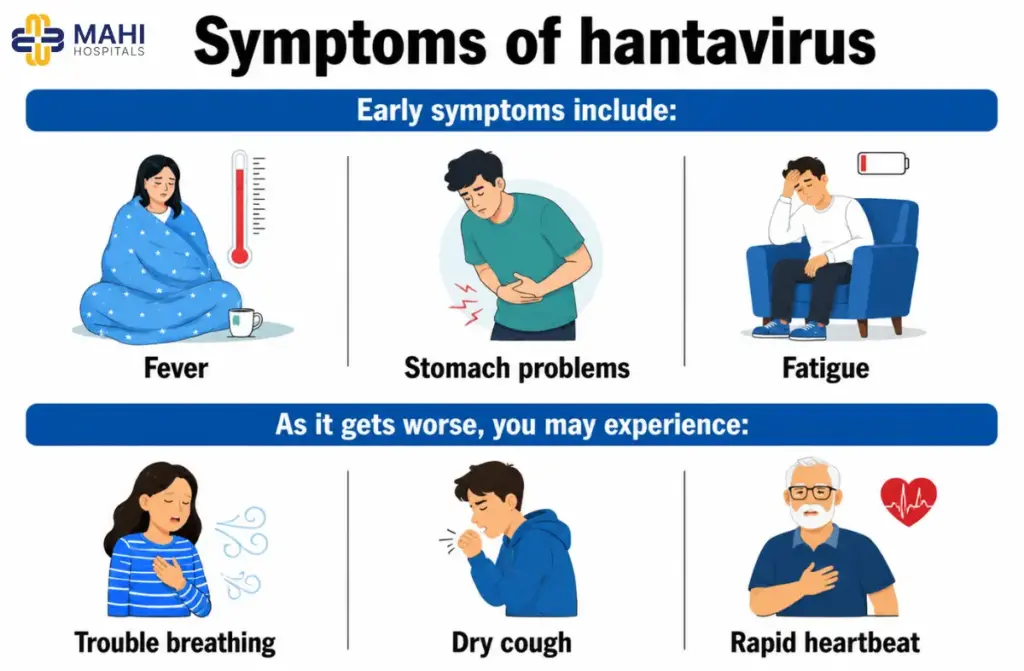
Seek prompt medical evaluation if fever or systemic symptoms are accompanied by:
- Increasing breathlessness or difficulty breathing
- Rapidly worsening cough
- Severe weakness or dizziness
- Fainting or symptoms suggesting low blood pressure
- Reduced urine output
- Severe abdominal or back pain
- Rapid deterioration over a short period
Clinical Pearl:
The combination of compatible symptoms + significant rodent exposure + worsening illness is more clinically meaningful than any single symptom.
Who May Have a Higher Exposure Risk?
Hantavirus risk is mainly related to environmental exposure, not simply where someone lives.
| Exposure situation | Why it matters |
| Rodent-infested storage areas | Greater opportunity for contact with contaminated material |
| Cleaning enclosed spaces | Disturbing dried droppings can create airborne particles |
| Warehouse or godown work | Repeated rodent exposure can increase cumulative risk |
| Handling nesting material | Direct contact may expose a person to contaminated material |
| Poorly sealed buildings | Easier rodent access can increase infestation |
This does not mean everyone in these settings will develop Hantavirus. It simply means that exposure history becomes important if compatible symptoms develop.
How is Hantavirus Diagnosed?
Hantavirus cannot be diagnosed from symptoms alone.
A doctor considers the clinical picture, exposure history and laboratory findings. Testing may be considered when the pattern makes Hantavirus a reasonable possibility.
What helps the doctor?
- Recent exposure to rodents or heavily contaminated areas
- The timing between exposure and symptoms
- Respiratory or kidney-related symptoms
- Relevant travel history
- Laboratory findings that suggest a particular infection
India has established a viral diagnostic infrastructure, and ICMR-NIV continues to support testing and research related to Hantavirus. ICMR’s current network also includes 163 Viral Research and Diagnostic Laboratories, supporting broader viral-disease surveillance and diagnosis.
Because early symptoms can overlap with illnesses such as dengue, leptospirosis, influenza and other infections, doctors need to consider the overall clinical picture rather than assume Hantavirus.
Is There a Treatment?
There is no universal specific treatment that eliminates every Hantavirus infection. Management is mainly supportive, with treatment depending on the type and severity of illness.
A patient with serious disease may require:
- Oxygen and respiratory support when the lungs are affected
- Careful monitoring of blood pressure and circulation
- Monitoring of kidney function
- Dialysis when severe kidney complications occur
- Intensive care when multiple organs are affected
This is why rapidly worsening symptoms should not be managed by simply waiting for them to pass.
How Can Chennai Residents Reduce Their Risk?
Prevention is mostly about controlling rodents and cleaning contaminated areas safely.
Simple precautions that matter
- Seal gaps and openings that allow rodents to enter homes or workplaces.
- Keep food, grains and waste securely stored.
- Reduce clutter that can provide nesting areas.
- Address an infestation rather than repeatedly cleaning droppings.
- Avoid dry sweeping or vacuuming rodent droppings and nesting material.
- Follow appropriate damp-cleaning and disinfection practices.
- Consider professional pest-control or cleaning assistance for heavily infested enclosed spaces.
WHO specifically recommends avoiding practices that can aerosolise contaminated rodent material.
The goal is not to make everyday life feel unsafe. It is simply to reduce avoidable exposure where rodent infestation is actually present.
When Should You See a Doctor?
You do not need a Hantavirus test simply because you saw a rat or found a few droppings. Medical evaluation becomes more relevant when significant rodent exposure is followed by unexplained fever or worsening illness.
Especially seek prompt care if you develop:
Fever + significant rodent exposure + breathing difficulty, severe weakness, dizziness, reduced urine output or rapidly worsening symptoms. When consulting a doctor, explain what exposure occurred and when it happened. Saying, “I cleaned a heavily rodent-infested storeroom a week ago,” gives the doctor more useful information than simply saying, “I think I have Hantavirus.”
What Should Chennai Residents Remember?
The recent Hantavirus reports deserve awareness, but they also need context. The major international outbreak reported in 2026 was caused by Andes virus and linked to an international cruise ship. WHO confirmed in July that the outbreak was contained, with no further related transmission expected.
For someone living in Chennai, the practical message is therefore straightforward:
| Remember | Why it matters |
| Hantavirus is real | It is a recognised rodent-borne infection. |
| An outbreak in another country does not mean an outbreak in Chennai | Local evidence matters. |
| Rodent exposure is the key concern | Especially in heavily contaminated or enclosed environments. |
| Symptoms alone cannot confirm Hantavirus | Several common infections can look similar initially. |
| Rapidly worsening illness needs medical attention | Serious Hantavirus disease can progress quickly. |
Conclusion
Hantavirus can understandably sound frightening when it appears in the news, but Chennai residents do not need to panic simply because cases have been reported elsewhere.
The current evidence does not establish a widespread Hantavirus outbreak in Chennai. What residents can do is much more practical: control rodent exposure, clean contaminated areas carefully, and pay attention to unexplained or rapidly worsening illness after significant exposure.
If symptoms such as fever, severe weakness or breathing difficulty develop after meaningful rodent exposure, timely medical assessment is the safest approach. Many other infections can cause similar symptoms, so the aim is not to assume Hantavirus but to find the actual cause and begin appropriate care without unnecessary delay.
At MAHI Hospitals, the approach is to assess the patient’s symptoms, exposure history and clinical findings together, with appropriate investigations when required. For anyone worried after a possible exposure, that balanced evaluation can provide something equally important: clarity, timely care and reassurance when Hantavirus is not the cause.