
Medically Reviewed by Dr. Vijay Kumar Sohanlal, MBBS, MS (Orthopaedics), Orthopaedic & Joint Replacement Surgeon, Founder & Owner of MAHI Multispeciality Hospitals, Kilpauk, Chennai
Last medically reviewed: September 2026
When your knee hurts, exercise may be the last thing you feel like doing. It is natural to worry that movement could make the pain worse.
But the right exercises for knee pain can often become part of better knee care rather than something to avoid. Gentle movement, muscle strengthening, and appropriate low impact activity can help maintain mobility, support the muscles around the knee, and make everyday movements easier. Exercise is also an important part of non surgical management for conditions such as knee osteoarthritis.
The key is choosing exercises for knee pain that match why your knee hurts, how much you can comfortably move, and what your knee needs to become stronger. There is no single exercise routine that works equally well for every type of knee pain.
Why Exercise Can Make a Difference to Knee Pain
The knee does not work in isolation. Your quadriceps, hamstrings, glutes and calf muscles all contribute to how your lower limb moves and handles everyday loads.
When these muscles become weak or movement becomes limited, activities such as walking, climbing stairs or getting up from a chair can become more demanding.
A well-planned exercise programme can help by:
- Building supporting muscle strength, which can improve the way your knee handles everyday movement.
- Maintaining flexibility and mobility, particularly when stiffness is limiting comfortable movement.
- Improving functional ability, making activities such as walking, standing and using stairs easier.
- Supporting long-term knee health, particularly when exercise is combined with appropriate activity and other aspects of knee care.
For knee osteoarthritis specifically, clinical guidelines recommend exercise—including strengthening, low-impact aerobic activity and neuromuscular training—as part of non-surgical management.
But more exercise is not automatically better. The goal is controlled, progressive movement—not pushing a painful knee until it hurts more.
The Right Exercise Depends on Why Your Knee Hurts
Knee pain can develop from osteoarthritis, muscle weakness, overuse, injury, stiffness and several other conditions. The same exercise may therefore be appropriate for one person and unsuitable for another.
| Knee problem | Exercise focus |
| Stiffness | Gentle mobility and range-of-motion exercises |
| Muscle weakness | Progressive strengthening of the muscles supporting the knee |
| Knee osteoarthritis | Strengthening combined with suitable low-impact activity |
| Recovery after an injury | Condition-specific rehabilitation and gradual return to activity |
| Reduced balance or stability | Strength, coordination and controlled functional movements |
This is why an exercise should not be selected simply because it is labelled a “knee exercise.” Your symptoms and underlying condition matter.
A Gentle Warm-Up Before Knee Exercises
Starting with a few minutes of gentle movement can prepare your muscles and knee for exercise.
You might begin with:
- Slow walking around the room or on a level surface
- Gentle bending and straightening of the knee
- Controlled ankle movements
- Easy seated movements before progressing to strengthening exercises
The purpose is not to exhaust the knee before the actual workout. A warm-up should prepare the joint and muscles for movement, not become another strenuous exercise session.
Low-Impact Exercises That Can Support a Painful Knee
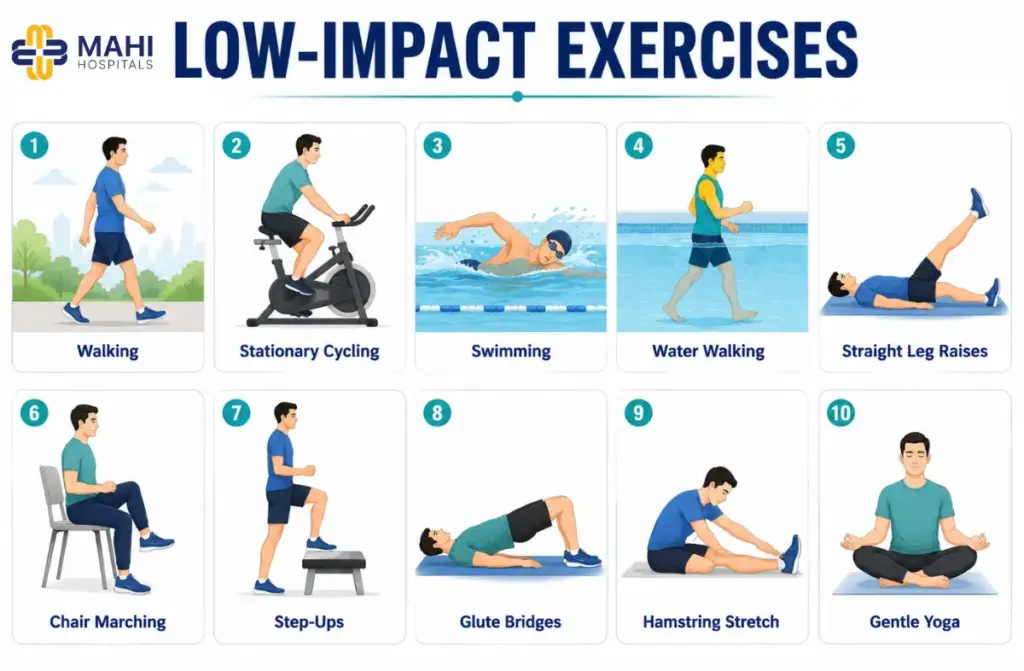
The following movements are commonly used to build mobility and strength around the knee. They are general examples rather than a personalised rehabilitation programme.
| Exercise | Main focus | How it may help |
| Heel Slides | Knee mobility | Encourages controlled bending and straightening of the knee |
| Quad Sets | Quadriceps activation | Helps maintain engagement of the muscles at the front of the thigh |
| Straight Leg Raises | Quadriceps strength | Builds strength while keeping knee movement relatively limited |
| Seated Knee Extensions | Strength and control | Works the quadriceps through controlled knee extension |
| Hamstring Stretch | Flexibility | Helps maintain flexibility around the back of the thigh |
| Calf Stretch | Lower-leg flexibility | Supports comfortable movement around the knee and ankle |
| Glute Bridges | Hip and glute strength | Strengthens muscles that contribute to lower-limb stability |
| Sit-to-Stand | Functional strength | Builds strength for everyday movements such as rising from a chair |
You do not need a long list of exercises to make progress. Consistency, appropriate progression and good technique are generally more useful than simply doing more exercises.
If you have a known knee injury, have recently had surgery or are experiencing significant pain, exercises should be selected according to your rehabilitation needs rather than copied from a general list.
How to Exercise Without Making Knee Pain Worse
A common mistake is to assume that you have to push through pain for an exercise to be effective. That is not the goal. During exercise, pay attention to how the knee responds both during the movement and afterwards.
| What you notice | What it means for your routine |
| Gentle stretching | Usually acceptable if comfortable |
| Mild muscle effort | Expected during strengthening |
| Mild temporary soreness | Can occur as activity increases; monitor how quickly it settles |
| Sharp or sudden knee pain | Stop the movement and reassess |
| Increasing pain or swelling | Reduce the exercise load and seek guidance if it persists |
| Locking or repeated giving way | Exercise alone may not be enough; seek professional assessment |
The exact amount of discomfort that is acceptable can vary by condition, so there is no universal pain threshold that applies to everyone. A useful principle is to progress gradually and avoid an exercise that clearly aggravates your symptoms.
Common Mistakes That Can Aggravate Knee Pain
Even a good exercise can become unhelpful when it is performed incorrectly or progressed too quickly.
Doing too much too soon is one of the most common problems. Increasing repetitions, resistance or exercise duration rapidly can place more demand on a knee that is not ready for it.
Ignoring sharp pain is another. Muscle effort and a challenging exercise are different from sudden or escalating joint pain. Pain that repeatedly worsens with a particular movement deserves attention rather than being pushed through.
Copying someone else’s routine can also be misleading. An exercise that works well for someone with mild stiffness may not be appropriate for someone recovering from a ligament injury or dealing with significant swelling.
And finally, focusing only on the knee can miss the bigger picture. Hip and thigh strength, balance, movement control and overall activity levels can all influence how comfortably you use your knee.
When Exercise May Not Be Enough
Exercise can be an important part of knee care, but it should not be used to explain away symptoms that need assessment.
Consider seeking professional advice if your knee pain:
- Persists or continues to worsen despite modifying activity.
- Is associated with significant swelling or difficulty bearing weight.
- Started after a significant twist, fall or other injury.
- Causes repeated giving way or locking.
- Is accompanied by marked redness, warmth or other concerning symptoms.
For example, NHS guidance recommends medical assessment when knee pain does not improve, is very severe, prevents weight-bearing or is associated with substantial swelling or a change in knee shape.
The purpose of an assessment is not simply to tell you to stop exercising. It is to understand what is causing the pain and which type of movement or treatment is appropriate for your knee.
Building a Knee-Friendly Routine
Once you know which exercises are appropriate, the next step is consistency rather than intensity.
A simple routine might combine:
| Component | Purpose |
| Mobility exercises | Maintain comfortable knee movement |
| Strengthening exercises | Build support around the knee |
| Low-impact aerobic activity | Improve general fitness without excessive joint impact |
| Functional movements | Help translate strength into everyday activities |
Walking, cycling and swimming are examples of lower-impact activities that may be incorporated depending on the individual and the cause of knee pain.
Your routine can then be progressed gradually by adjusting duration, repetitions, resistance or activity level as your knee becomes stronger and more comfortable.
The aim is not simply to exercise a painful knee. It is to gradually build a knee that can handle more of the activities you want to return to.
Conclusion
The right exercises can help you build strength, maintain mobility and become more confident in using a painful knee. But effective knee exercise is not about doing the hardest movement or completing the longest routine. It is about choosing movements that suit your condition, performing them with control and progressing at a pace your knee can tolerate.
If your knee pain is persistent, worsening or limiting everyday movement, understanding its underlying cause is just as important as choosing an exercise. At MAHI Hospitals, the focus is on helping you understand your knee pain and move towards a care plan that supports stronger, more comfortable and more confident movement.
Read More: Pain After Knee Replacement Surgery.