
Have you ever avoided a walk, hesitated before climbing stairs, or struggled to stand up because of knee pain? You’re not alone. Knee pain affects people of all ages, from young athletes to older adults. The good news is that the right exercises can help reduce pain, strengthen the muscles around your knee, improve flexibility, and restore confidence in movement. Many people think resting is the best solution for knee pain. While rest is important after an injury, too much inactivity can actually make the problem worse. Safe and targeted exercises help your knees stay strong, stable, and mobile.
Let’s explore the best exercises for knee pain and how to perform them safely.
Why Exercise Helps Knee Pain
Exercise is one of the most effective non-surgical ways to manage knee pain. Regular movement helps support the joint and improves overall knee function.
Benefits include:
- Strengthening the muscles that support the knee joint
- Improving flexibility and range of motion
- Reducing stiffness and discomfort
- Enhancing balance and stability
- Increasing blood circulation to damaged tissues
- Lowering stress on the knee through healthy weight management
- Improving confidence in daily movement
Even a few minutes of exercise each day can create noticeable improvements over time.
When to Avoid Certain Exercises
While exercise is beneficial, some situations require caution. Avoid or stop exercising if you experience:
- Sudden sharp pain during movement
- Significant swelling around the knee
- A feeling that the knee may give way
- Severe redness or warmth around the joint
- Pain that continues to worsen after exercise
- Recent fractures or untreated injuries
Exercises involving jumping, sprinting, deep squats, or sudden twisting movements should be avoided unless recommended by a healthcare professional.
Best Warm-Up Before Knee Exercises
Marching in Place
How to do it
Stand tall with your feet shoulder-width apart.
Slowly lift one knee, then the other as if marching.
Swing your arms naturally and continue for 1–2 minutes.
Why it helps
This gently increases blood flow and prepares the knee joint for movement.
Heel Raises
How to do it
Stand behind a chair and hold it for balance.
Slowly rise onto your toes and hold for 2 seconds.
Lower your heels back down and repeat 15 times.
Why it helps
Activates the calf muscles and improves balance.
Leg Swings
How to do it
Hold a wall or sturdy support with one hand.
Gently swing one leg forward and backward in a controlled motion.
Perform 10 swings, then switch legs.
Why it helps
Improves mobility and loosens tight muscles around the knee and hip.
Low-Impact Exercises for Knee Pain
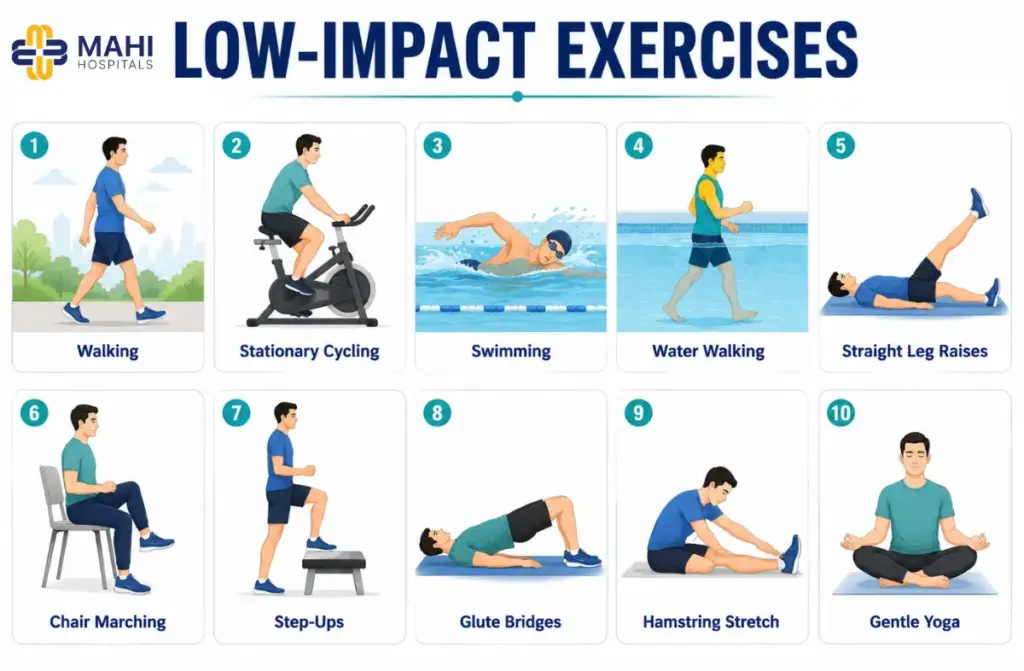
Stationary Cycling
How to do it:
Adjust the seat so your knees remain slightly bent while pedaling.
Begin with low resistance and pedal smoothly.
Continue for 10–20 minutes.
Why it helps:
Builds strength in the legs without excessive joint impact.
Swimming
How to do it:
Enter the pool and start swimming at a relaxed pace.
Choose a stroke that feels comfortable for your knees.
Focus on smooth, controlled movements.
Why it helps:
Water supports body weight, reducing pressure on painful knees.
Water Walking
How to do it:
Stand in waist-deep water.
Walk forward with slow, steady steps.
Continue for 10–15 minutes.
Why it helps:
Provides resistance training without stressing the joints.
Strengthening Exercises for Knee Support
Straight Leg Raises
How to do it:
Lie on your back with one knee bent and the other leg straight.
Lift the straight leg about 12 inches off the floor.
Hold for a few seconds, lower slowly, and repeat 10–15 times.
Why it helps:
Strengthens the quadriceps without placing pressure on the knee.
Wall Sits
How to do it:
Stand with your back against a wall.
Slowly slide down into a partial sitting position.
Hold for 10–20 seconds before returning to standing.
Why it helps:
Builds endurance in the thighs and improves knee stability.
Step-Ups
How to do it:
Stand in front of a low step or platform.
Step up with one foot, then bring the other foot up.
Step down carefully and repeat 10 times on each leg.
Why it helps:
Improves strength needed for everyday activities like climbing stairs.
Glute Bridges
How to do it:
Lie on your back with your knees bent and feet flat on the floor.
Lift your hips until your body forms a straight line from shoulders to knees.
Hold briefly, then lower slowly and repeat 15 times.
Why it helps:
Strengthens hips and glutes, reducing stress on the knees.
Stretching Exercises for Knee Flexibility
Hamstring Stretch
How to do it:
Sit on the floor with one leg extended.
Reach toward your toes without forcing the stretch.
Hold for 20–30 seconds and switch sides.
Why it helps:
Relieves tightness in the back of the thigh that can pull on the knee.
Quadriceps Stretch
How to do it:
Stand near a wall for support.
Bend one knee and gently hold your ankle behind you.
Pull the heel toward your buttocks and hold for 20–30 seconds.
Why it helps:
Improves flexibility in the front thigh muscles.
Calf Stretch
How to do it:
Place both hands against a wall.
Step one foot backward while keeping the heel on the floor.
Hold the stretch for 20–30 seconds before switching sides.
Why it helps:
Enhances lower-leg flexibility and knee movement.
Exercises for Specific Knee Conditions
For Knee Osteoarthritis
Seated Knee Extensions
How to do it:
Sit upright in a chair with your feet flat on the floor.
Slowly straighten one leg until it is parallel to the ground.
Hold briefly, lower slowly, and repeat 15 times.
Why it helps:
Strengthens the quadriceps and improves joint function.
For Runner’s Knee
Side Leg Raises
How to do it:
Lie comfortably on one side.
Keep the top leg straight and slowly raise it upward.
Lower gently and repeat 15 times before switching sides.
Why it helps:
Strengthens hip muscles that help control knee alignment
For ACL Recovery
Heel Slides
How to do it:
Lie on your back with your legs extended.
Slowly slide one heel toward your buttocks.
Return to the starting position and repeat 10–15 times.
Why it helps:
Improves knee mobility and flexibility after injury.
For Patellar Tendonitis
Mini Squats
How to do it:
Stand with your feet shoulder-width apart.
Bend your knees slightly and lower your body a few inches.
Return to standing and repeat comfortably.
Why it helps:
Strengthens supporting muscles while minimizing tendon stress.
Chair Exercises for Seniors with Knee Pain: Seated Knee Extensions
How to do it:
Sit comfortably in a sturdy chair.
Slowly straighten one leg until it is level with the floor.
Lower it gently and repeat 15 times before switching legs.
Why it helps:
Improves leg strength, circulation, and knee function.
Seated Marching
How to do it:
Sit upright with your back supported.
Lift one knee and then the other in a marching motion.
Continue for 1–2 minutes at a comfortable pace.
Why it helps:
Maintains mobility and encourages healthy blood flow.
Ankle Pumps
How to do it:
Sit comfortably with both feet resting on the floor.
Point your toes upward and then downward.
Repeat the movement 20 times slowly.
Why it helps:
Reduces stiffness and improves circulation in the lower legs.
Yoga and Mobility Exercises for Knee Pain
Child’s Pose
How to do it:
Kneel comfortably on a mat.
Sit back toward your heels and stretch your arms forward.
Hold the position for 20–30 seconds while breathing deeply.
Why it helps:
Provides a gentle stretch for the knees, hips, and lower back.
Cat-Cow Stretch
How to do it:
Start on your hands and knees.
Arch your back upward, then slowly lower your stomach while lifting your chest.
Repeat the movement 10 times.
Why it helps:
Improves mobility throughout the body and helps reduce stiffness.
Mountain Pose
How to do it:
Stand tall with your feet together or hip-width apart.
Keep your weight evenly distributed and engage your core.
Hold the position for 30 seconds while breathing normally.
Why it helps:
Enhances posture, balance, and joint alignment.
Different Exercises for Different Age Groups
| Age Group | Recommended Exercises | Duration | Intensity |
| 18–30 Years | Walking, Cycling, Swimming, Squats, Lunges | 30–45 Minutes | Moderate |
| 31–45 Years | Walking, Step-Ups, Bridges, Yoga | 25–40 Minutes | Moderate |
| 46–60 Years | Swimming, Cycling, Stretching, Strength Training | 20–35 Minutes | Low to Moderate |
| 60+ Years | Chair Exercises, Water Walking, Gentle Yoga, Mobility Drills | 15–30 Minutes | Low |
Common Mistakes While Exercising with Knee Pain
Many people unknowingly slow their recovery by making avoidable mistakes during exercise.
- Skipping warm-up exercises before starting a workout
- Increasing intensity or duration too quickly
- Ignoring pain signals and pushing through discomfort
- Using poor exercise form or technique
- Wearing unsupportive footwear
- Exercising on hard or uneven surfaces
- Performing high-impact movements before the knee is ready
Avoiding these mistakes can help prevent setbacks and improve long-term results.
Tips for Exercising Safely with Knee Pain
Following a few simple precautions can make exercise safer and more effective.
- Start slowly and progress gradually.
- Warm up before every workout session.
- Wear supportive and comfortable shoes.
- Choose softer surfaces whenever possible.
- Stay hydrated throughout the day.
- Listen to your body’s signals.
- Apply ice after exercise if mild swelling occurs.
- Use heat before exercise if stiffness is present.
- Schedule regular rest and recovery days.
- Focus on consistency rather than intensity.
Remember, small improvements performed regularly are often more effective than intense workouts done occasionally.
When to Consult a Physical Therapist
While many cases of knee pain improve with exercise, professional help may sometimes be necessary.
Consult a physical therapist if:
- Knee pain lasts longer than a few weeks
- Swelling repeatedly returns after activity
- Walking becomes difficult or painful
- The knee feels unstable or gives way
- Range of motion continues to decrease
- You have suffered a recent knee injury
A physical therapist can identify the root cause of your pain and create a personalized treatment plan designed specifically for your needs.
Conclusion
Knee pain may slow you down, but it doesn’t have to stop you. With the right combination of strengthening, stretching, mobility, and low-impact exercises, you can improve knee function, reduce discomfort, and regain confidence in everyday movement. The key is consistency. Small efforts performed regularly often produce greater results than occasional intense workouts. Every walk, stretch, and strengthening exercise contributes to healthier joints and better mobility.
Your knees support you through every step of life—from chasing goals and exploring new places to enjoying time with the people you love. Taking care of them today can help you stay active, independent, and pain-free for years to come.
“Every step you take toward stronger knees is a step toward a more active, confident, and fulfilling life. Start where you are, stay consistent, and let each pain-free step remind you how far you’ve come.”
Read More: Pain After Knee Replacement Surgery.